Hyde Park was platted in 1891 by the Missouri, Kansas and Texas Land and Town Company under Colonel Monroe Martin Shipe. A streetcar line was built the same year to connect the new subdivision to downtown Austin, which made it the city’s first streetcar suburb. Shipe’s promotional materials leaned hard on the idea of a park-like setting, and the developer planted trees, built out parkland, and added a small lake and a pavilion to draw buyers north of the University of Texas campus.
The earliest homes reflect that late 19th century ambition: elaborate Queen Anne houses built for locally prominent Austin families. The neighborhood’s second and larger wave of construction came between 1924 and 1935, when Craftsman bungalows went up on most of the remaining lots. That combination of eras is why Hyde Park today has one of the largest collections of historic homes in Austin, and why the Hyde Park Historic District was added to the National Register of Historic Places in 1990. The core historic district runs roughly from Avenue A to Duval Street and 40th to 45th Streets, while the broader neighborhood most people mean when they say “Hyde Park” extends from 38th Street up to 51st Street, bounded by Guadalupe Street on the west and Duval Street on the east.
If you want the longer version of Austin’s neighborhood history, I keep a running overview of the city’s different areas on my Austin, TX page.
TLDR (Too Long; Didn’t Read): Living in Hyde Park, Austin TX
- Hyde Park was platted in 1891 by Colonel Monroe Shipe as Austin’s first streetcar suburb, and a large section of it carries National Register historic district status dating to 1990.
- The housing stock mixes late 1800s Queen Anne homes with Craftsman bungalows, most of them built during a construction boom between 1924 and 1935.
- Shipe Park is the neighborhood’s main green space, and the Elisabet Ney Museum sits on the same block.
- Duval Street and the adjoining North Loop corridor carry most of the restaurants, coffee shops, and small retail within walking distance of the neighborhood’s homes.
- Hyde Park is zoned to Lee Elementary, Kealing Middle School, and McCallum High School within Austin ISD.
I show a lot of houses in Hyde Park, and I still slow down on Avenue G or 43rd Street just to look at the porches. This is one of the few Austin neighborhoods where the street grid, the tree canopy, and most of the houses have been in place since before World War II. That’s worth understanding before you go looking at a listing here, because Hyde Park’s value comes from specifics: the age of the house, the block it sits on, and whether it falls inside the historic district. Below is what I tell buyers and sellers when they ask me about the neighborhood.
The housing stock
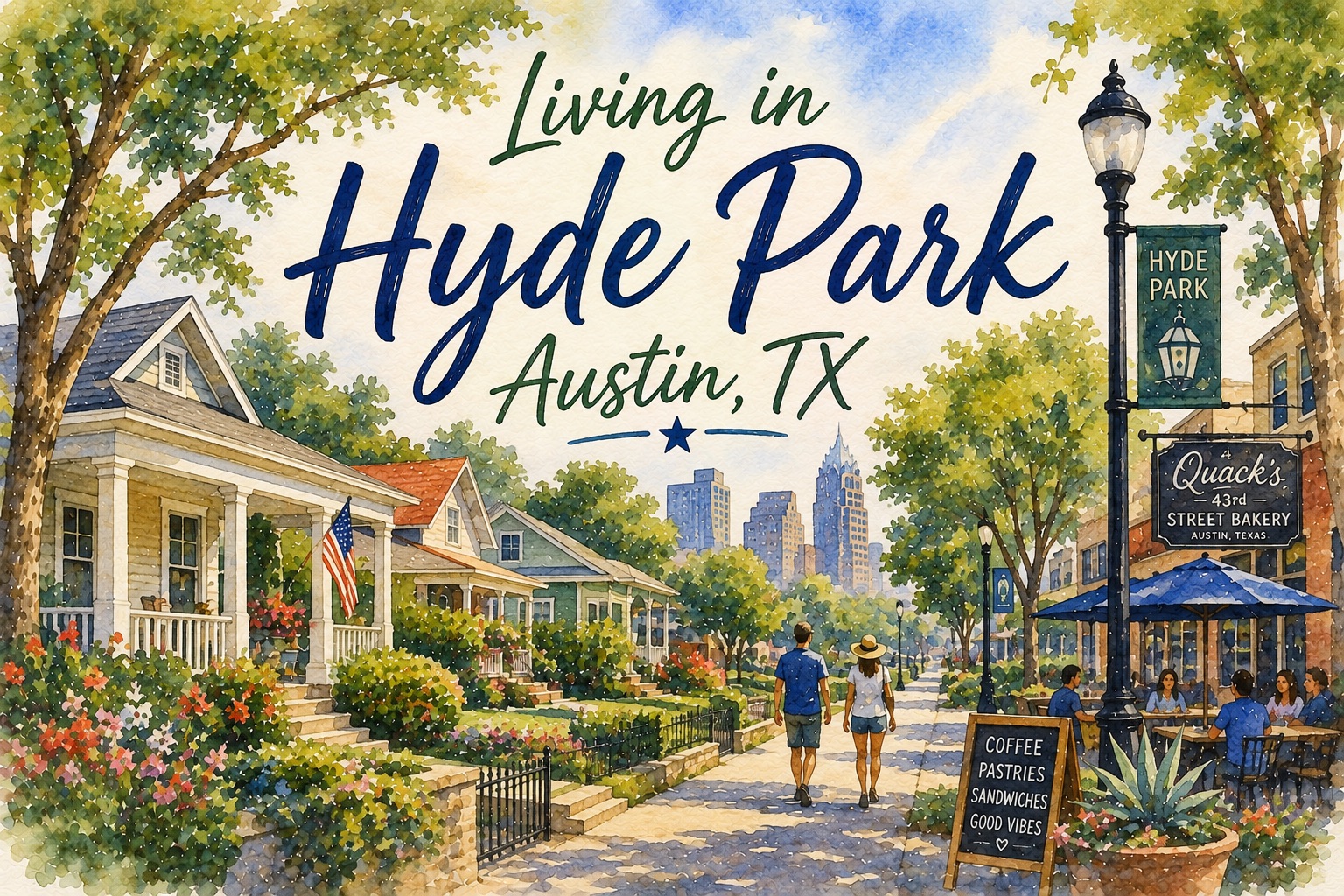
Walk a few blocks in Hyde Park and you’ll see the two eras side by side: a two-story Queen Anne with a wraparound porch next to a one-story Craftsman bungalow with a deep front porch and exposed rafter tails. Original details that still show up regularly include tongue and groove porch ceilings, brick or stone porch columns, double-hung wood windows, and narrow lot setbacks that keep the front yards close to the sidewalk.
Because so much of the neighborhood sits inside the historic district, exterior renovations on those properties go through the Historic Landmark Commission before a permit is issued. That review process protects the street-level character of the neighborhood, but it also means buyers planning an addition or a major exterior change should budget extra time for approvals. Outside the strict historic district boundary, particularly toward the northern and western edges of Hyde Park, you’ll find more homes that have been substantially updated or rebuilt without the same design review.
Lot sizes tend to be modest by Austin standards, and many original bungalows have been expanded toward the back of the lot to add square footage without disturbing the street-facing facade. Duplexes and small multi-family buildings also appear throughout the neighborhood, a holdover from decades of proximity to the university.
Shipe Park and the Elisabet Ney Museum
Shipe Park sits at 4400 Avenue G and takes its name from the same Monroe Shipe who developed the neighborhood. The three acre park was established in the early 20th century and today has a pool, tennis courts, and open lawn space that functions as the neighborhood’s primary shared green space.
Right next to Shipe Park is the Elisabet Ney Museum, housed in the former studio of the sculptor Elisabet Ney. The museum displays her sculptures and studio in the building where she worked, and it’s one of the more distinctive small museums in Austin given its residential setting inside a historic neighborhood.
Getting around
Hyde Park’s location just north of the University of Texas campus is one of its defining features. Guadalupe Street runs along the western edge of the neighborhood and connects directly into the West Campus and UT area, and several city bus routes run through the neighborhood along Duval Street and Guadalupe. The original street grid Shipe laid out in 1891 still holds up well for walking and biking, with consistent block lengths and sidewalks throughout most of the neighborhood. From most points in Hyde Park, downtown Austin and the UT campus are both a short drive or a manageable bike ride, which is part of why the neighborhood has stayed in demand since the streetcar era ended.
North Loop, the neighborhood immediately north of Hyde Park along North Loop Boulevard, shares a similar streetcar suburb history and functions as a natural extension of Hyde Park’s daily routines for a lot of residents. The two neighborhoods share enough of a border that people often move between them without thinking about where the line actually falls.
The Hyde Park Neighborhood Association and historic preservation
The Hyde Park Neighborhood Association has been active in the neighborhood for decades and played a central role in getting the historic district designation approved in 1990. The association continues to weigh in on zoning and development questions that affect the neighborhood’s built character, and it publishes historical background on individual houses and the district as a whole.
That level of organized attention to preservation is part of why Hyde Park’s original architecture has held up better than in a lot of Austin neighborhoods from the same era. If you’re buying a home inside the historic district, it’s worth reviewing what design review actually covers before you plan a project, since the association and the city’s Historic Landmark Commission both weigh in on exterior changes.
Duval Street and North Loop
Most of Hyde Park’s commercial activity runs along Duval Street. Hyde Park Bar and Grill, open since 1982, is one of the longer standing restaurants in the corridor, known locally for its fries and its mix of standard bar food with a few less expected menu items. Hyde Park Market, sometimes called “the flag store” for the flags that used to line its roof, carries a large selection of beer near the corner of Duval and 45th. Flightpath Coffeehouse is a regular stop for people working from a laptop or meeting for coffee.
Where Duval Street runs into North Loop Boulevard, the commercial strip picks up more retail, additional restaurants, and several longtime local shops. Between the two corridors, Hyde Park residents have a fair amount within a short walk or bike ride without needing to leave the immediate area.
Schools
Hyde Park is zoned to Lee Elementary School, Kealing Middle School, and McCallum High School, all part of Austin Independent School District. Kealing Middle School operates as one of AISD’s academic magnet campuses. McCallum High School runs a Fine Arts Academy with programs in band, dance, visual arts, and cinematic arts. If you want specifics on ratings, enrollment, or program details, check current information directly through Austin ISD, since boundaries and program offerings can change from year to year.
The real estate market in Hyde Park
Pricing in Hyde Park spans a wide range because the housing stock itself spans a wide range. Smaller updated bungalows and condo units tend to sit toward the lower end of the market, while fully restored historic homes on larger lots reach well into seven figures. Renovation quality and how faithfully a home has kept or restored its original details both play into value here more than in a lot of newer Austin neighborhoods, since buyers in Hyde Park are often looking specifically for that historic character rather than the newest finishes.
Location within the neighborhood matters too. Homes inside the core historic district boundary carry different renovation rules than homes on the outer edges of Hyde Park, and that distinction affects both pricing and what a buyer can do with the property after closing. A house a block outside the historic district line can sometimes be renovated or expanded with far less review than an identical house a block inside it, which changes how a buyer should think about resale and long-term plans for the property.
Inventory in Hyde Park also turns over differently than in newer subdivisions. Because so much of the neighborhood was built out before 1935, there’s little room for new construction beyond infill on the rare vacant lot or a full teardown and rebuild, and either of those runs into the same historic district review that applies to renovations. That keeps supply limited, and buyers end up paying closer attention to how well a given house has been maintained or updated. If you’re comparing a listing near Duval Street to one closer to Guadalupe, or trying to figure out whether a house falls inside the historic district, that’s exactly the kind of detail I walk through with buyers before they write an offer.
I’m Robbie English, a REALTOR and Broker working with Uncommon Realty here in Austin. If you’re weighing a purchase in Hyde Park, whether that’s a bungalow that needs work or a fully restored home closer to Duval Street, I’m glad to walk the neighborhood with you and talk through what a specific address means for your plans.
Robbie English, REALTOR, Broker at Uncommon Realty.