I’ve written contracts on houses in Buda where the sellers had lived there since before the H-E-B on Main Street existed, and I’ve helped young families close on new construction in subdivisions that were cattle pasture five years ago. Both of those are Buda right now, and honestly that’s the thing people ask me about most: is it still a small town, or has it turned into another Austin suburb. The answer is it’s both at once, and depending on which street you’re standing on, it feels like one or the other.
TLDR (Too Long; Didn’t Read): Living in Buda, TX
- Buda sits in Hays County right off I-35, roughly 15 to 17 miles from downtown Austin, with a drive time that runs 20 minutes off-peak to well over 30 during rush hour
- Kids here go to Hays Consolidated ISD, not Austin ISD, and the district covers Buda, Kyle, and part of Wimberley
- Downtown Buda is a genuine six-block historic district with buildings dating back to the 1880s, mixed in with newer restaurants and shops
- The city carries the Texas Legislature’s designation as the Outdoor Capital of Texas and hosts the annual Buda Country Fair and Wiener Dog Races
- Housing runs the full range from older in-town homes near Main Street to newer master-planned subdivisions on the outskirts, generally more affordable per square foot than comparable homes closer into Austin
- It’s a strong fit for commuters who want a shorter drive than Kyle or San Marcos, families who want a real school district and community identity, and buyers priced out of Austin proper who still want some small-town texture
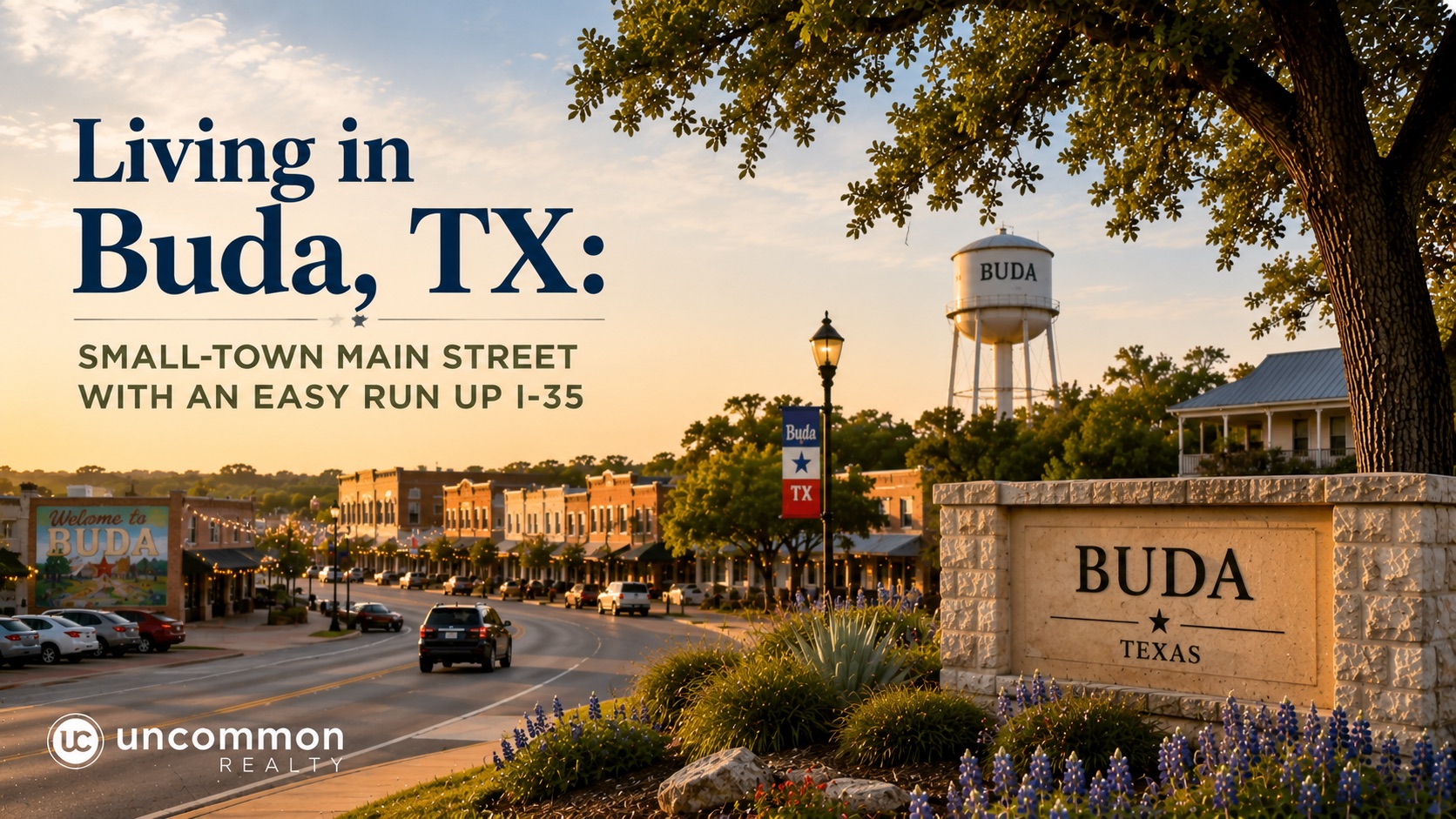
Where Buda Sits and What the Commute Actually Looks Like
Buda is in Hays County, just south of Austin along Buda‘s stretch of I-35, sandwiched between Austin and Kyle. It’s close enough that plenty of people who work downtown or in South Austin treat it as their bedroom community, and far enough that you notice the difference the moment you turn off the highway.
On the drive itself, I tell clients to plan for two very different commutes depending on the hour. Midday or evening, you can be downtown in 20 to 25 minutes. During the morning or evening rush, that same trip can stretch past 40 minutes once I-35 backs up through South Austin, which it does most weekdays. If your job is downtown or in the Domain, budget for the worse number, not the better one, because that’s the one you’ll actually live with five days a week. Buda also sits close to Austin-Bergstrom International, which matters more than people expect once they’re living here and flying regularly.
What I like about Buda’s location specifically, compared to Kyle or San Marcos further south, is that it’s the last stop before you’re solidly out of the metro. You get a shorter commute than either of those, plus quick access west into the Hill Country and Onion Creek country without much traffic to fight.
What the Town Actually Feels Like
Downtown Buda is the reason people fall for this place. It’s a real historic district, six blocks of brick and stone commercial buildings, some dating back to the 1880s when the town got its start as a railroad stop. Buda became an official Texas Main Street City in 2017, which means there’s been real money and real policy behind keeping that stretch intact instead of letting it get torn down for something generic. You’ll find local restaurants, a few bars, some genuinely old buildings sitting next to newer businesses that moved in because the foot traffic justified it.
Outside of downtown, Buda reads more like a lot of newer Central Texas suburbs: subdivisions built out over the last 10 to 15 years, a mix of production homes and larger custom lots as you get closer to the Hill Country edge. The city has grown fast, and you can feel that in the number of new rooftops going up on the fringes even as the historic core stays fairly static. If you want small-town character, live near downtown. If you want a newer house with a bigger yard and don’t mind driving a few minutes to get your coffee, the newer subdivisions deliver that instead.
The Housing Market, in Plain Terms
I won’t quote you specific sale prices here, Texas doesn’t require sellers to disclose those and I’m not going to pretend otherwise. What I can tell you from working this market directly is that Buda generally runs more affordable than comparable homes closer into Austin or in Lakeway and the western suburbs, while running a step up from some parts of Kyle depending on the specific neighborhood and how new the construction is.
Inventory splits into two clear categories. Older homes near downtown and along the original town grid tend to sit on bigger lots with mature trees, and they turn over less often because owners tend to stay put. New construction on the outskirts moves faster, comes with builder warranties and modern floor plans, and gives buyers more predictability on what they’re getting for the money. If you’re deciding between the two, it really comes down to whether you want character and a walkable downtown or a brand-new house with fewer surprises. I’ve sold both kinds to happy buyers, and the right answer depends entirely on what you’re trying to build a life around.
Schools
Buda is served by Hays Consolidated Independent School District, not Austin ISD, which surprises some buyers relocating from other parts of the metro. Hays CISD covers a wide swath of southern Hays County, including Kyle and part of Wimberley, and it’s grown right alongside the population boom in this corridor. If schools are a top priority in your search, I’d recommend looking up the specific campus zoned to whatever address you’re considering rather than assuming based on the neighborhood name, since attendance zones have shifted as the district has added new schools to keep pace with growth.
Parks, Trails, and What There Is to Do
Buda leans hard into its outdoor identity, and the Texas Legislature has formally recognized it as the Outdoor Capital of Texas, which isn’t just a marketing line the city made up. Green Meadows Park is one of the more popular neighborhood parks, with a splash pad, playground, basketball court, and trails that make it a real gathering spot on weekends, especially for families with young kids and dog owners. Historic Stagecoach Park is a different kind of stop, home to the McElroy-Severn Stagecoach House and the old Onion Creek Post Office, both genuine 19th-century landmarks that give you a sense of what this area looked like before the highway and the subdivisions.
The event that puts Buda on the map every year is the Buda Country Fair and Wiener Dog Races, run by the Buda Lions Club at Buda City Park each spring. It’s exactly what it sounds like: dachshunds racing, a fair with food and craft vendors, and the whole town showing up for it. It’s a good barometer for whether you’ll like living here. If a small-town festival built around racing wiener dogs sounds charming rather than corny, Buda’s sense of humor about itself is going to suit you fine.
Who Buda Is a Good Fit For
I put people in Buda for a few specific reasons, and it’s worth being honest about who this town does and doesn’t fit. It’s a strong choice for commuters who want to be close enough to Austin to make the drive workable but are done paying Austin prices, especially if your job is on the south side of town or you can flex your hours around traffic. It works well for families who want a defined school district and an actual downtown their kids can walk around in, not just a subdivision entrance sign. And it’s a good landing spot for buyers who got priced out of Austin proper or the western suburbs and want a place that still has its own identity instead of feeling like an extension of the highway.
Where it’s less of a fit is if you need to be in downtown Austin or North Austin daily and can’t tolerate I-35 traffic, or if you’re set on a walkable, dense urban lifestyle with nightlife at your doorstep. Buda gives you small-town living with quick highway access, not an urban core. If that trade makes sense for your life, I’d be glad to walk you through what’s actually available right now, because inventory here shifts fast and the neighborhoods vary more than they look from the outside.
Y'all Might Want To Check These Out Too...
 Living in Kyle, TX: Small-Town Roots and Big Growth South of Austin
 Living in Driftwood, TX: Ranch Land, Wineries, and Hill Country Space Southwest of Austin
 Living in Kingsland, TX: Life at the Confluence of Two Rivers on Lake LBJ
 Living in Highland Haven, TX: A Quiet Lake LBJ Community Near Marble Falls