I’ve sold homes on both sides of I-35 in Kyle for long enough now that I can tell you which streets pond up after a hard rain and which Plum Creek cul-de-sacs get shade in the afternoon before I ever pull an address. Kyle comes up in a lot of buyer conversations these days, usually from people who got priced out of Buda or South Austin and assumed they’d have to give something up to afford a house. Most of them are surprised by what they actually find here.
TLDR (Too Long; Didn’t Read): Living in Kyle, TX
- Kyle sits along I-35 in Hays County, roughly 20 miles south of downtown Austin, about 27-30 minutes with light traffic and 45 minutes or more during morning rush hour.
- The city has grown from a small farm town of a few thousand people in the 1990s to well over 60,000 residents today, consistently one of the fastest-growing cities in Texas.
- Kids in Kyle attend Hays CISD, a district that has had to build new campuses just to keep pace with growth.
- Housing ranges from older cottages in the historic downtown blocks to large new-build subdivisions and the Plum Creek golf course community.
- Parks are one of Kyle’s real strengths: Lake Kyle Park for kayaking and fishing, Gregg-Clarke Park for sports and trails, Steeplechase Park for disc golf.
- Housing here has generally run more affordable than Buda or South Austin, though that gap has closed some as the city has grown.
Where Kyle sits on the map
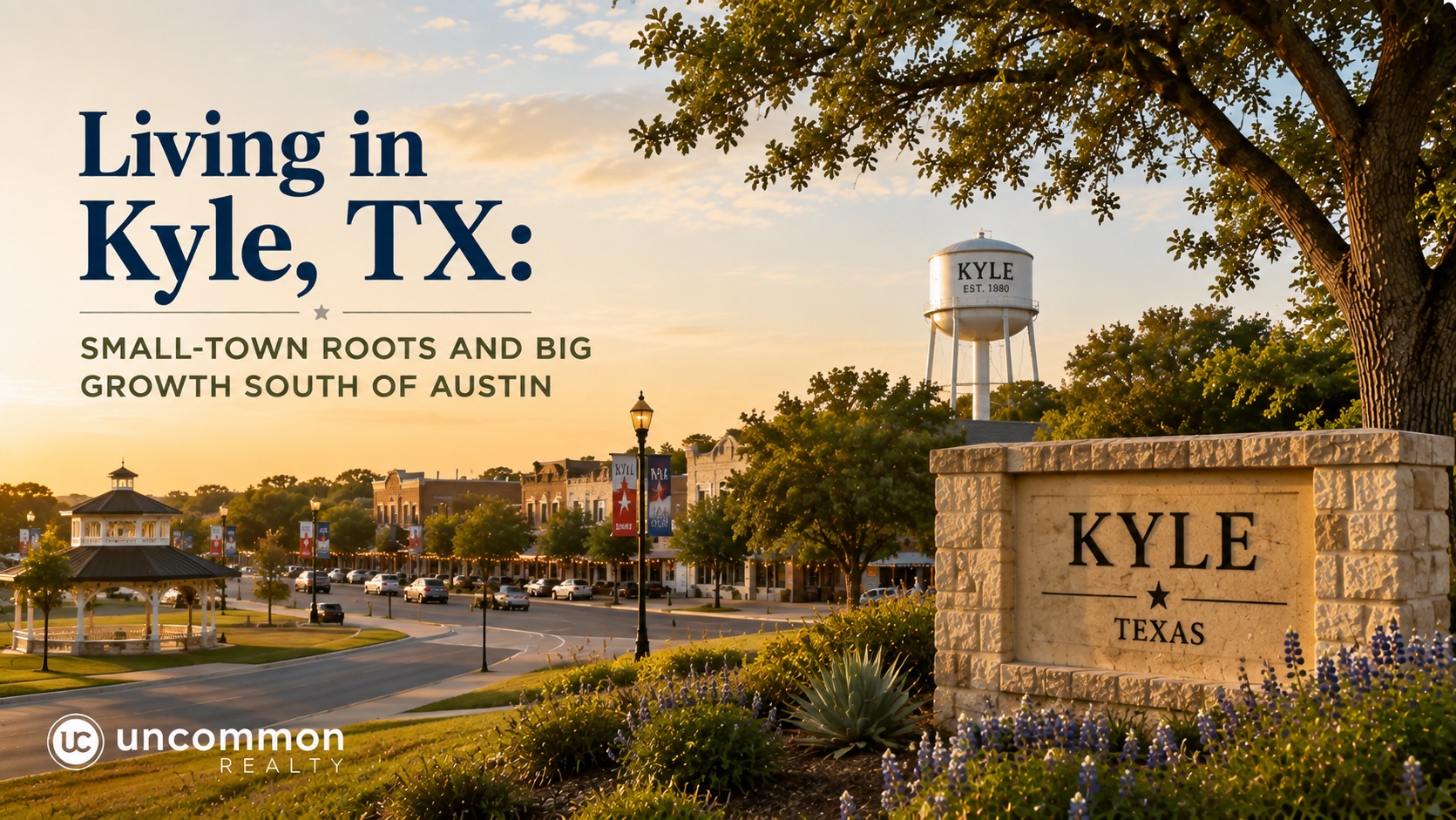
Kyle runs along I-35 in northern Hays County, wedged between Buda to the north and San Marcos, the county seat, a short drive south. Downtown Austin is about 20 to 22 miles up the highway. On a clear midday drive that’s a 27 to 30 minute trip. During the 7 to 8:30 a.m. push north, plan on 45 minutes to an hour, with the worst of it usually backing up somewhere around Slaughter Lane. I tell clients moving here from out of state the same thing every time: I-35 traffic is the real cost of living in this corridor, more than any number on a listing sheet, so drive it yourself at 7:45 on a weekday before you commit to a neighborhood.
FM 1626 and the Kyle Parkway give you a way to skip some of the interstate mess if you’re headed toward Buda or the south Austin job centers, and that’s often the difference between a tolerable commute and a miserable one depending on exactly where you end up working.
What kind of place Kyle actually is
Kyle was a farm town for most of its history, and you can still feel that in the old downtown blocks around City Square Park. That square went through a real revitalization in recent years, and now it anchors the historic Kyle Train Depot and Heritage Center along with a handful of local shops and restaurants. The city runs Market Days out of Mary Kyle Hartson Park through the spring and fall, with local vendors, food trucks, and live music, plus seasonal events like Movies in the Park and the holiday lighting on the square.
Outside of that downtown core, most of Kyle is newer. This is one of the fastest-growing cities in the country, not just Texas, and the population has gone from around 5,000 residents at the turn of the century to well over 60,000 today. That growth shows up everywhere: new subdivisions pushing out toward the edges of town, new retail along the 1626 and Kyle Parkway corridors, and a noticeable amount of construction traffic on weekdays. If you want a sleepy small town, Kyle isn’t fully that anymore, but it hasn’t lost the feel entirely either. The older neighborhoods near downtown still read as small-town Texas. The newer subdivisions read like most fast-growing Central Texas suburbs, which is its own kind of appeal if that’s what you’re after.
The housing market in Kyle
I can’t cite specific sale prices here since Texas is a non-disclosure state and that data isn’t public record, but I can tell you what I see working with buyers and sellers in this market. Kyle has generally priced more affordably than Buda or South Austin for comparable square footage, and that gap is a big part of why buyers end up here after starting their search closer to Austin. That gap has narrowed over the past several years as more people have discovered Kyle, so it’s not the steep discount it once was, but it’s still real.
Plum Creek is the community most people ask about by name. It’s built around the Plum Creek Golf Course, and it draws buyers who want a more established, planned feel with mature trees and a clubhouse amenity. Beyond Plum Creek, you’ll find a mix of large production-builder subdivisions on the edges of town, smaller established neighborhoods closer to downtown with older single-story homes on bigger lots, and pockets of new construction still going up as the city continues to expand its footprint. If you’re comparing Kyle to Buda, know that Buda tends to sit a little closer to Austin and often carries a premium for that, while Kyle gives you more house and more land for the money in a lot of cases, at the cost of a slightly longer drive.
Schools in Kyle
Kyle is served by Hays CISD, and growth here has been intense enough that the district has had to keep building new schools just to keep up with enrollment. Total enrollment has climbed well past 24,000 students, up from around 15,000 just fifteen years ago, and the district’s own projections have it growing substantially more over the next several years. If you’re moving here with kids, ask specifically which elementary, middle, and high school your address feeds into before you buy, because attendance zones shift as new campuses come online, and a home that fed one school last year can feed a different one now. Hays CISD’s website has a current zone locator, and I’d rather you check it directly than rely on anything secondhand, mine included.
Parks, recreation, and things to do
This is where Kyle quietly outperforms its reputation. Lake Kyle Park has canoe and kayak access, fishing, several nature trails, and a wildlife viewing area where you’ll actually spot birds, turtles, and the occasional beaver if you’re patient. Gregg-Clarke Park is more of the everyday neighborhood park, anchored by the Kyle Pool, with softball and football fields, tennis and basketball courts, covered playscapes, and walking trails that get steady use in the early morning and evening once the heat breaks. Steeplechase Park has a championship-level disc golf course designed by a hall of fame course designer, and it draws players from well outside Kyle on weekends.
Golfers have Plum Creek Golf Course, a public course carved through Texas oaks that plays well for a range of skill levels. Add in the downtown events at City Square Park and the regular Market Days, and there’s more going on here on a given weekend than the “bedroom community” label suggests.
Who Kyle is a good fit for
I’d point a buyer toward Kyle if they need more house for their money than Buda or South Austin will give them and they can live with a real I-35 commute a few days a week. Families with kids in Hays CISD tend to like the newer schools and the parks system, and buyers who want a golf course community without the price tag of somewhere like Barton Creek or Lakeway find Plum Creek does the job. Remote workers or people who only commute in occasionally have the easiest time here, since they get the space and the price without absorbing the drive every single day.
If your job requires you downtown five days a week with a hard start time, I’ll usually walk you through what that actually costs you in hours before we start touring houses in Kyle. For everyone else, it’s one of the more honest values left in this part of the Austin metro, and I’ve watched enough buyers move here and stay put to trust that it works for the right household. If you want to see what’s actually available right now, I keep current Kyle listings updated and I’m happy to walk the neighborhoods with you in person before you decide anything.