I get asked to compare these two communities more than almost any other pair in West Austin. Buyers usually arrive with a rough idea that both are gated, both involve golf, and both come with a serious price tag. Past that, the details get fuzzy fast. I have shown property in both neighborhoods for years, and I want to lay out what actually separates them: location, lot sizes, HOA structure, schools, and the kind of homes you will find in each. This is not a ranking. It is a side-by-side look at two very different properties that happen to sit about fifteen minutes apart.
TLDR (Too Long; Didn’t Read): Barton Creek vs. Spanish Oaks: Which Austin Community Fits You?
- Barton Creek sits in Austin’s 78735 zip code off Highway 71, built around the four-course Barton Creek Country Club, with lots generally running from just under an acre up to five acres across several gated enclaves.
- Spanish Oaks is a single 1,200-acre, 24-hour guard-gated community in Bee Cave off Highway 71 and Bee Cave Road, centered on the private Bobby Weed-designed Spanish Oaks Golf Club, with lots typically running a half acre to two acres or more.
- Barton Creek is served primarily by Austin ISD, zoned to Oak Hill Elementary, Small Middle School, and Bowie High School, though some western edges of 78735 fall in Eanes ISD near the Westlake boundary.
- Spanish Oaks is zoned to Lake Travis ISD, specifically Bee Cave Elementary, Bee Cave Middle School, and Lake Travis High School.
- Both communities offer custom architecture and Hill Country terrain, but they differ in HOA structure (multiple enclave associations in Barton Creek versus one governing association in Spanish Oaks) and in golf course pedigree (four resort-affiliated courses versus one dedicated private club).
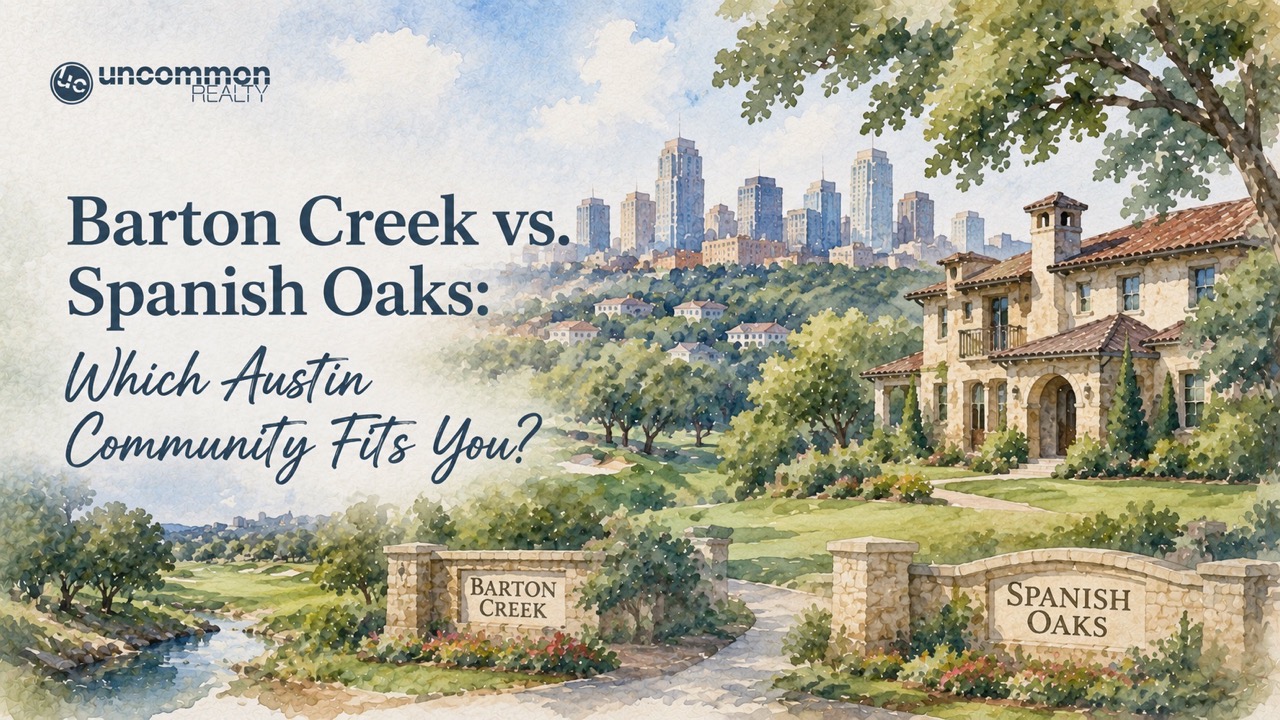
Where Each Community Sits on the Map
Barton Creek occupies Austin’s 78735 zip code, southwest of downtown along Highway 71 and Barton Creek Boulevard. Depending on which section of the community you are in, downtown Austin runs roughly 20 to 30 minutes away in normal traffic. The community grew up around the Omni Barton Creek Resort & Spa and its golf courses, and it is made up of several distinct gated enclaves rather than one single perimeter. Amarra Drive, Barton Creek West, and The Preserve at Barton Creek are three of the more recognizable sections, each with its own gate and its own homeowners association.
Spanish Oaks sits farther west, in Bee Cave, at the intersection of Highway 71 and Bee Cave Road. It is roughly 18 miles from downtown Austin, about a 20-minute drive under normal conditions. Unlike Barton Creek, Spanish Oaks is a single 1,200-acre community behind one 24-hour guarded gate, with one governing HOA over the entire footprint rather than a patchwork of separate enclave associations.
If you want a broader sense of how these two fit into the rest of the metro, I keep an overview of the market at austin-tx that covers commute patterns and pricing trends across West Austin.
Lot Sizes and Home Sizes
Barton Creek lots vary quite a bit by enclave. In sections like The Preserve, lots commonly run around 1.2 acres. In the newer, more custom sections such as Barton Creek West and Amarra Drive, lots can stretch from roughly one acre up to five acres, with homes set well back from the street. Home sizes across the community range from around 2,000 square feet in older or smaller sections up to 10,000 square feet or more in the newest custom builds.
Spanish Oaks lots generally run smaller on average but still substantial, typically a half acre to two acres, with some parcels reaching four acres and a handful of larger estate lots up to around seven acres. Homes range from about 2,500 square feet up to 10,000-plus square feet, and the architecture leans heavily into Spanish, Mediterranean, and contemporary Hill Country styles, often built around pools and outdoor kitchens that take advantage of the terrain.
Both communities sit in Hill Country terrain with rolling elevation changes, so lot shape and view lines vary block to block in each neighborhood. I always walk a lot in person before advising a buyer on build placement or renovation potential, since topography here can eliminate options that look fine on a plat map.
Golf and Amenities
This is one of the clearest differences between the two. Barton Creek Country Club operates four separate 18-hole golf courses across the property: Fazio Foothills and Fazio Canyons, both designed by Tom Fazio, the Coore Crenshaw course designed by Bill Coore and Ben Crenshaw in 1991, and the Palmer Lakeside course designed by Arnold Palmer in 1986. The Omni Barton Creek Resort & Spa is also part of the property, which means the community has a resort-scale amenity base: multiple clubhouses, a spa, tennis, and dining tied to the broader resort operation.
Spanish Oaks takes a narrower, more focused approach. The community is built around a single private course, Spanish Oaks Golf Club, an original Bobby Weed design that opened in 2001 and stretches 7,128 yards with significant elevation change and Hill Country views. It has ranked among the top private courses in Texas by both Golf Digest and Golfweek. Amenities in Spanish Oaks center on that one club rather than a resort campus, which gives it a quieter, more residential feel day to day compared to Barton Creek’s resort-adjacent atmosphere.
HOA and Gate Structure
Barton Creek’s HOA structure reflects its layout: each gated enclave has its own association, its own dues, and often its own architectural guidelines. That means two homes a half mile apart within “Barton Creek” as a whole can carry different HOA rules, different gate access, and different fee structures. Buyers need to check which specific enclave a listing sits in before assuming anything about dues or restrictions.
Spanish Oaks operates under one HOA covering the entire 1,200-acre community, with a single 24-hour guarded entry point. Architectural review and dues structure apply uniformly across the neighborhood rather than varying by section.
Schools
Barton Creek falls mostly within Austin ISD. Properties are generally zoned to Oak Hill Elementary, Small Middle School, and Bowie High School. Because the 78735 zip code straddles two districts, some western addresses near the Lost Creek area fall instead within Eanes ISD, zoned to Westlake High School. I confirm exact zoning against the specific address every time, since it can change block to block near that boundary.
Spanish Oaks is zoned entirely to Lake Travis ISD. Properties there are zoned to Bee Cave Elementary, Bee Cave Middle School, and Lake Travis High School. Lake Travis ISD serves the broader Bee Cave and Lakeway corridor, so families researching the district will find consistent zoning across the surrounding communities as well.
I do not weigh in on which district is the “better fit” for any given household. What I can tell you is which schools serve which streets, and I always verify current zoning boundaries directly with the district before a buyer writes an offer, since boundaries do shift.
Price Points
Pricing in both communities spans a wide range depending on lot size, age of construction, and which section you are in. In Barton Creek, more established or smaller-lot sections have listed in the $800,000 to $1.5 million range, while newer custom construction on larger lots in sections like Amarra Drive and Barton Creek West has reached $2 million to $8 million or more. Spanish Oaks pricing tracks similarly wide, with entry points in the low seven figures and custom estate construction on the larger lots reaching well into eight figures for the most substantial builds. Both markets move on a case-by-case basis, so I pull recent closed comps for the specific enclave or street before giving anyone a number to work with.
Barton Creek vs. Spanish Oaks: Side-by-Side Comparison
| Factor | Barton Creek | Spanish Oaks |
|---|---|---|
| Location | 78735, off Highway 71 and Barton Creek Blvd, southwest of downtown | Bee Cave, off Highway 71 and Bee Cave Road |
| Distance to downtown | Approximately 20 to 30 minutes | Approximately 20 minutes, about 18 miles |
| Gate structure | Multiple gated enclaves, each with a separate HOA | Single 24-hour guard-gated perimeter, one HOA |
| Typical lot size | Roughly 1 to 5 acres depending on enclave | Roughly 0.5 to 2+ acres, occasional larger parcels |
| Typical home size | Approximately 2,000 to 10,000+ sq ft | Approximately 2,500 to 10,000+ sq ft |
| Golf | Four courses at Barton Creek Country Club (Fazio Foothills, Fazio Canyons, Coore Crenshaw, Palmer Lakeside) | One private course, Spanish Oaks Golf Club, designed by Bobby Weed |
| Broader amenities | Resort-affiliated via Omni Barton Creek Resort & Spa | Community-focused around the single golf club |
| School district | Primarily Austin ISD (Oak Hill Elementary, Small Middle, Bowie High); some western edges in Eanes ISD | Lake Travis ISD (Bee Cave Elementary, Bee Cave Middle, Lake Travis High) |
| Architecture | Contemporary and traditional custom homes, varies by enclave | Spanish, Mediterranean, and contemporary Hill Country styles |
How I Help Buyers Decide
When a buyer asks me to walk them through Barton Creek versus Spanish Oaks, I start with the practical questions rather than the emotional ones. Which school district does the address fall in? What is the actual HOA structure and fee for that specific section, not the community as a whole? What lot size and setback rules apply to the parcel they are considering? Does the buyer want access to four golf courses and a resort campus, or a single dedicated club with one gate and one set of rules to track?
Barton Creek suits buyers who want variety within one general area, since each enclave has its own character, price point, and lot profile. It also suits anyone who wants resort-level amenities beyond golf, given the Omni property sits right in the middle of it. Spanish Oaks suits buyers who want a single, consistent governance structure and a tighter focus on one golf club and one architectural identity across the neighborhood.
Both communities require careful due diligence on HOA documents, deed restrictions, and current district zoning before a contract goes in. I pull that paperwork for every buyer I represent, because assumptions based on a neighborhood’s general reputation rarely match the specific parcel you are actually buying.
I work these two communities regularly out of my office at Uncommon Realty, and I am happy to walk through current inventory, recent closed sales, and the specific HOA structure for any section of either neighborhood. You can read more about my background at my about page, and see how Barton Creek and Spanish Oaks fit into the wider Austin market at austin-tx.
If you are trying to decide between the two, send me the specific streets or listings you are considering. I can tell you which enclave or section they fall in, what the HOA actually covers, and what the district zoning looks like today, so you are working from verified facts rather than general reputation.
Robbie English, REALTOR, Broker at Uncommon Realty.
You Might Also Find These Helpful
- explore homes for sale in Austin
- search current listings
- Why Texans Are Choosing Highland Lakes Over The Coast
- Living in Barton Hills, Austin TX
For more on this, I wrote up Is the Bouldin Creek Area Good for Buying a Home? As Asked On Reddit as well.