I get asked about downtown Austin condos more than almost any other segment of this market, and I’ve noticed most of what’s written about it online only covers one slice: whether a luxury tower is “worth it.” That’s a fair question, but it skips the bigger one people actually need answered first, which is what it’s like to live down there day to day, block by block. I put this guide together to cover the whole picture: where downtown actually starts and stops, what each sub-area feels like, what the housing stock looks like, and how the market is behaving right now.
TLDR (Too Long; Didn’t Read): Living in downtown Austin, TX
- Downtown Austin runs roughly from Lady Bird Lake on the south to MLK Jr. Boulevard and the Capitol grounds on the north, with I-35 as the eastern edge and Lamar Boulevard and Shoal Creek marking the west side
- The area breaks into distinct pockets including Rainey Street, the Second Street District, the Warehouse District, the Seaholm and Green Water redevelopment zone, and the Capitol government district, each with a different feel and price point
- Housing is almost entirely condos and apartments in mid-rise and high-rise buildings, ranging from units converted decades ago to towers still finishing construction, in sizes from studios to multi-bedroom layouts
- The Ann and Roy Butler Hike-and-Bike Trail wraps Lady Bird Lake for ten miles and connects directly into downtown, and daily errands like groceries and dining are walkable from most buildings
- Condo inventory downtown has grown compared to a couple of years ago, giving buyers more room to negotiate than during the tightest years of the market
Where downtown Austin actually is
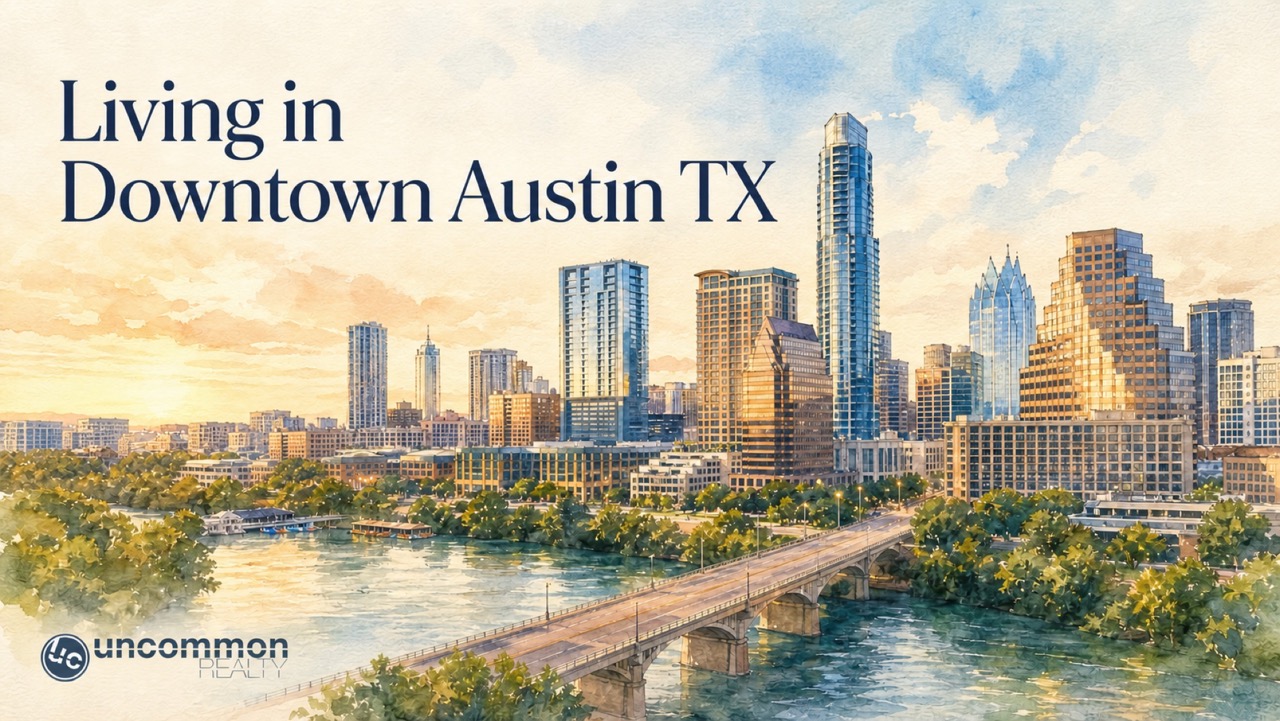
Downtown Austin’s boundaries get debated locally, but the generally accepted lines are Lady Bird Lake to the south, I-35 to the east, Martin Luther King Jr. Boulevard and the Capitol complex to the north, and Lamar Boulevard and Shoal Creek to the west. Inside that footprint you’ve got the central business district, the government core around the Capitol, and several distinct residential and entertainment pockets that each go by their own name. If you’re comparing downtown to other close-in areas, I’ve written a broader overview of Austin, TX neighborhoods that puts this in context alongside the rest of the city.
The sub-districts, and how they differ
Rainey Street
Rainey Street was a residential street of small bungalows until it got rezoned into the central business district in the early 2000s. Since then, most of those original houses have been converted into bars and restaurants, and the blocks around them have filled in with high-rise condo towers. It sits in the southeast corner of downtown, close to Lady Bird Lake and a short walk from the Rainey Street entrance to the hike and bike trail.
Second Street District
This is a compact several-block stretch known for retail and restaurants, running near City Hall and the Austin Convention Center. It’s one of the more walkable, street-level commercial corridors downtown, with residential towers built above and around the retail.
Warehouse District
North of Second Street, the Warehouse District sits in a cluster of older brick and masonry buildings, some of them converted commercial or industrial structures now holding bars, restaurants, and residential lofts. It reads differently than the newer glass towers elsewhere downtown because of the older building stock.
Seaholm and the Green Water district
The Seaholm district grew out of the old Seaholm Power Plant, a decommissioned mid-century plant along the river that’s now the anchor of a mixed-use development with condos, apartments, retail, and the downtown Trader Joe’s and Whole Foods. Just north and connected to it, the former Green Water Treatment Plant site was decommissioned and redeveloped into several office and residential towers, including some of downtown’s tallest apartment buildings. Together these two areas form the western edge of downtown along Shoal Creek and the lake.
The Capitol and government district
To the north, the area around the Texas State Capitol is its own distinct pocket. It’s largely government office buildings and the Capitol grounds themselves, with residential towers filling in around the edges. Walk Score consistently rates this area among the most walkable in the entire city, and Waterloo Park, adjacent to the Capitol complex, hosts outdoor events and green space that the denser blocks to the south don’t have as much of.
What the housing stock actually looks like
Downtown Austin housing is almost entirely vertical. You’re looking at condos and apartments in mid-rise and high-rise buildings rather than single-family homes or townhomes, and the building stock spans a wide range of ages. Some buildings downtown are older conversions and early-2000s construction, while others are recently completed towers or still finishing construction in the Seaholm and Green Water areas. Unit sizes run from studios up through multi-bedroom layouts, and floor plans, finishes, and HOA structures vary a lot by building age and developer, which is part of why I always walk buyers through the specific building’s reserve fund and HOA documents rather than assuming one downtown building is like another.
Getting around without a car
Downtown is one of the few parts of Austin where you can realistically handle daily errands on foot. Grocery stores, including Trader Joe’s and Whole Foods in the Seaholm area, along with restaurants, pharmacies, and other day-to-day needs sit within walking distance of most downtown buildings. The Ann and Roy Butler Hike-and-Bike Trail runs ten miles around Lady Bird Lake and connects directly into downtown at multiple points, including near Rainey Street, and it’s one of the most heavily used pieces of public infrastructure in the city, drawing millions of visits a year for walking, running, and cycling. Between the trail, the street grid, and the concentration of everyday amenities, downtown consistently scores among the most walkable areas in Austin.
What it’s like living around SXSW and downtown’s event calendar
One thing worth knowing before you buy downtown is that a lot of Austin’s biggest annual events happen right outside your door, SXSW chief among them. Street closures, crowds, and noise around Rainey Street, Sixth Street, and the Red River corridor are part of the deal for a stretch of March each year. I put together a separate SXSW Austin guide if you want the details on what that looks like from a downtown address specifically.
The market right now
Condo inventory across Austin has grown compared to a couple of years ago, and downtown high-rise units are part of that shift. A number of owners who bought during the 2021 and 2022 run-up are now listing at prices below their original purchase, and per-square-foot pricing on downtown high-rises has come down from where it stood at the peak. That’s given buyers more negotiating room and more time to make decisions than was typical a few years back, when units downtown were moving fast and often over asking. Every building downtown carries its own HOA fee structure, reserve fund, and rental or short-term rental rules, so I always dig into those specifics with a buyer before we get attached to a unit, since two condos at the same price point can carry very different ongoing costs.
A few things I’d tell anyone looking downtown
- Read the HOA financials and reserve study before you fall in love with a unit. Downtown buildings vary widely in how well-funded their reserves are, and that affects both your monthly costs and your ability to get financing.
- Ask about short-term rental restrictions if that matters to your plans. Some downtown buildings allow it, others don’t, and the rules have shifted over the past several years.
- Factor in parking. Not every downtown unit comes with a dedicated space, and that’s worth confirming early rather than assuming.
- Consider which sub-district matches how you actually want to live day to day. Rainey Street, the Warehouse District, and the Capitol area each have a different pace and noise level even though they’re all technically downtown.
I’ve spent years working buyers and sellers through downtown Austin condos specifically, and the building-by-building differences matter more here than in almost any other part of the city. If you want to talk through what’s available right now or how a specific building’s HOA and reserves stack up, you can read more about my background and how I work, or about Uncommon Realty, the brokerage I work under.
Robbie English, REALTOR, Broker at Uncommon Realty.
For more on this, I wrote up Living in Granite Shoals, TX: Life on the Quiet Side of Lake LBJ as well.