I get questions about manufactured homes more often than you might expect, and I have almost nothing written on my site to point people to. That is a gap I want to fix, because manufactured housing is a legitimate part of the Austin-area market and it comes with its own rules, financing paths, and terminology that differ from a typical site-built purchase. Here is what I think buyers should understand before they start shopping.
TLDR (Too Long; Didn’t Read): Buying a Manufactured Home in the Austin Area: What to Know
- Manufactured homes are built to a federal HUD code, while modular homes follow the same local and state building codes as a site-built house, and that difference affects financing, appraisal, and insurance.
- Whether you own the land, lease a homesite in a community, or buy land and home together as a package changes your financing options and how the home is titled in Texas.
- Chattel loans finance the home alone as personal property, usually with shorter terms and higher rates than a traditional mortgage, while a conventional mortgage generally requires the home to be permanently affixed to land you own and titled as real property.
- Manufactured homes typically cost meaningfully less per square foot to build than a site-built home, though land, foundation work, utility hookups, and site prep add to the total project cost.
- Manufactured housing tends to show up more often in the outer counties of the Austin metro, where lot sizes are larger and land costs less than closer to the city center.
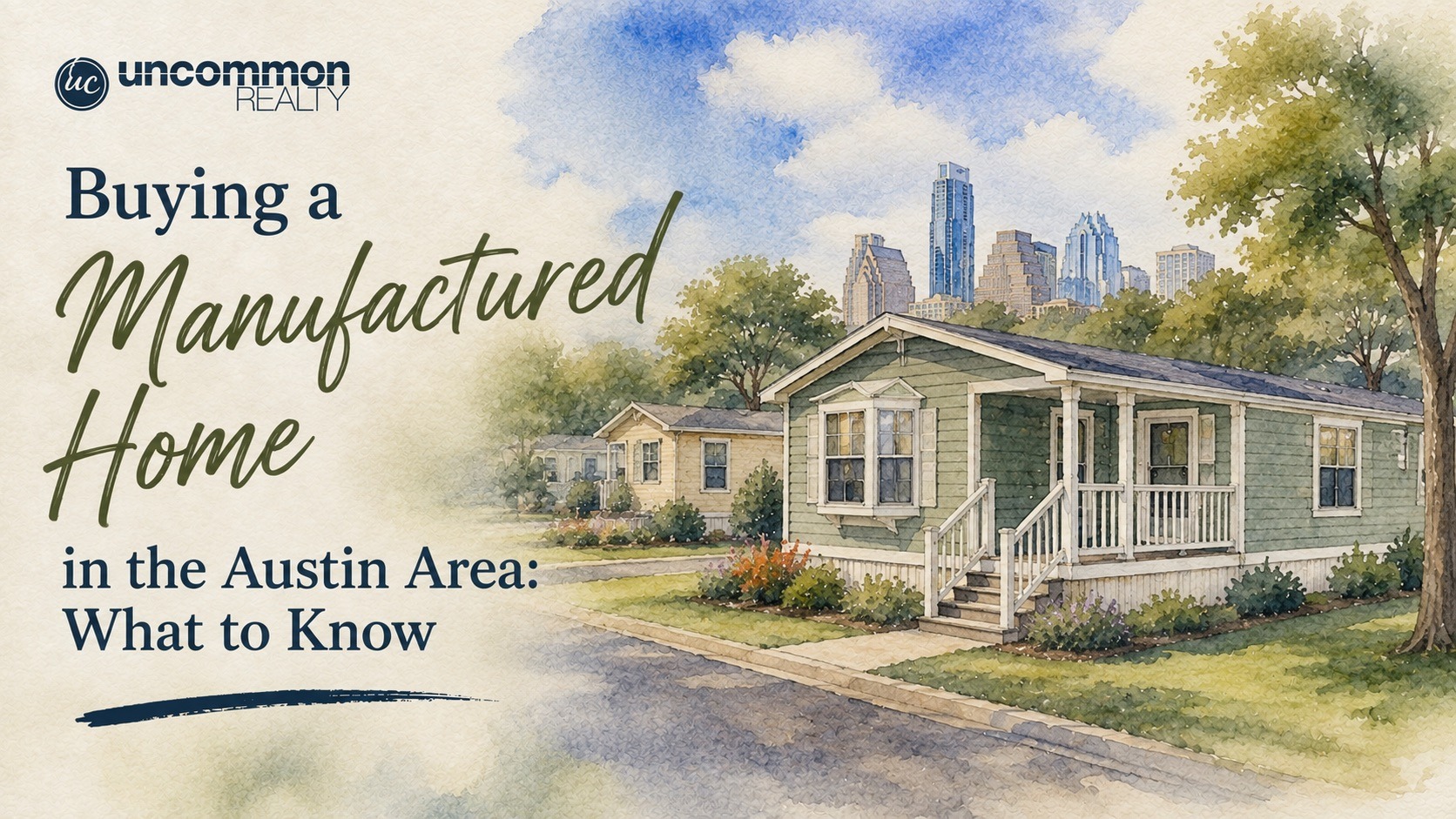
Manufactured, Modular, and Mobile: These Terms Are Not Interchangeable
People use “mobile home,” “manufactured home,” and “modular home” as if they mean the same thing, but they describe three different types of construction with three different regulatory frameworks.
A manufactured home is built entirely in a factory on a permanent steel chassis, then transported to its site in one or more sections. The federal government regulates manufactured homes under a single national building code, commonly called the HUD code, which the Department of Housing and Urban Development established in 1976. Because the HUD code preempts local building codes, a manufactured home built to that standard can generally be sold and installed anywhere in the country without meeting a separate local code for the structure itself.
“Mobile home” is technically the older term. Homes built before June 15, 1976, when the HUD code took effect, are properly called mobile homes. No new mobile homes have been built since that date, so a factory-built home from the 1990s or later that people casually call a “mobile home” is, by definition, a manufactured home.
A modular home is a different animal altogether. It is also built in factory-produced sections, but those sections must meet the same state and local building codes that apply to a site-built house in that jurisdiction, not the federal HUD code. Once the modules are set on a permanent foundation and finished on-site, a modular home is generally treated like any other site-built house for appraisal, financing, and resale purposes, and it cannot be relocated once assembled the way some manufactured homes can.
Why does this distinction matter to a buyer? Because it affects how a lender underwrites the loan, how an appraiser values the property, and how easily the home fits into the comparable sales an appraiser needs for a conventional loan. Knowing which category a home actually falls into before you fall in love with it saves a lot of frustration later in the process.
Land: Owned, Leased, or Purchased Together
How you obtain the land under a manufactured home shapes almost every other decision in the purchase, so it is worth separating the common arrangements.
- Owned land. You already own the lot, or you buy vacant land separately, and place the home on it. This path generally opens the door to conventional mortgage financing once the home is permanently installed.
- Land-in-lieu. Some lenders will let you use land you already own, free and clear, as your down payment equity instead of cash. The land’s value substitutes for part or all of the cash down payment on the loan.
- Leased-land communities. You own the home but pay a monthly lot rent to a community owner for the ground underneath it. Because you do not own the land, the home is classified as personal property, which limits you to chattel financing rather than a traditional mortgage.
Each arrangement carries a different level of long-term control. Owning the land under your home gives you more predictability, since you are not subject to a landlord raising lot rent or changing community rules. A leased-land setup can lower the upfront cost of getting into a home, but it also means your ongoing housing cost includes a rent payment that is not fixed the way a mortgage payment is.
Financing: Chattel Loans vs. Traditional Mortgages
This is where manufactured home financing diverges most sharply from a typical home purchase, and it trips up a lot of first-time buyers.
Chattel loans
A chattel loan finances the home as personal property, using the home itself as the only collateral, separate from any land. Buyers use this type of loan when the home sits on leased land, or in some cases even when the land is owned but the buyer has not converted the home’s title to real property. Chattel loans typically close faster than a mortgage, often within about 30 days, and they generally carry fewer upfront costs. In exchange, they usually come with shorter terms, often 10 to 20 years rather than the 20 to 30 years common with a mortgage, and interest rates that run higher than a comparable conventional mortgage rate. If a buyer defaults, a chattel loan does not carry the same foreclosure protections a real estate mortgage does. Instead, the lender can repossess the home through a process closer to what applies to a vehicle loan.
Traditional mortgages
A manufactured home can qualify for a conventional mortgage, an FHA loan, a VA loan, or other traditional real estate financing, but it has to clear a specific bar first. The home generally needs to be permanently affixed to a foundation on land the borrower owns, with the wheels, axles, and towing hitch removed, and it needs to be titled as real property rather than personal property. Programs exist, including Fannie Mae’s MH Advantage program, that extend conventional financing terms such as low down payments to manufactured homes that meet specific construction and design standards and are titled as real property. Once a manufactured home clears that bar, it can be financed and later resold much like a site-built house, with an appraisal based on comparable real estate sales rather than a personal-property valuation.
The practical takeaway is that the financing path depends almost entirely on land ownership and how the home is titled, not on the buyer. If you are shopping for a manufactured home, ask early in the process whether the specific home and lot combination will qualify for a mortgage or whether you are looking at chattel financing, because that answer changes your monthly payment, your loan term, and your total interest cost significantly.
Titling a Manufactured Home in Texas
Texas handles manufactured home ownership differently than it handles site-built real estate. The Texas Department of Housing and Community Affairs, through its Manufactured Housing Division, issues and maintains a Statement of Ownership for every manufactured home in the state. By default, every manufactured home in Texas is titled as personal property, similar to a vehicle title, unless the owner takes the additional step of electing real property status.
To convert a home to real property status in Texas, the home generally needs to be permanently attached to a foundation on land the owner holds title to, and the owner files the appropriate paperwork with TDHCA to retire the personal property title. This step matters because it is often a prerequisite for conventional mortgage financing and it affects how the home is treated for resale. If you are buying a manufactured home that a previous owner already converted to real property, confirm that the paperwork was completed correctly and that the title status matches what the seller represents. If you are buying one that is still titled as personal property and you plan to convert it, build the time and cost of that process into your purchase timeline.
What Manufactured Homes Typically Cost Compared to Site-Built Homes
Cost is usually the first reason buyers look at manufactured housing. Because these homes are built in a factory under controlled conditions, with less labor and material waste than a home built entirely on-site, the structure itself typically costs meaningfully less per square foot than a comparable site-built house, often somewhere in the range of 40 to 50 percent less for the structure alone.
That said, the sticker price of the home is only part of the total project cost. Land, foundation work, utility connections, site preparation, delivery, and installation all add to what you actually spend to end up living in the home. Depending on the lot, the size of the home, and the scope of site work required, total project costs can range widely, so I encourage buyers to build a full budget that includes every one of these line items rather than comparing only the base price of the home to a site-built home’s list price.
Appreciation and Resale Considerations
Whether a manufactured home holds or grows its value over time depends heavily on how it is classified and where it sits. Federal Housing Finance Agency data covering 2000 through 2024 shows manufactured homes appreciating at a rate close to site-built homes nationally, roughly 5 percent annually on average, when those manufactured homes are situated on owned land and titled as real property. Homes on leased land, or those that remain titled as personal property, generally do not follow that same appreciation pattern, since their value is tied more closely to the home itself as a depreciating asset rather than to real estate market trends.
If long-term value growth matters to you, land ownership and real property titling are the two factors most within your control. A well-maintained manufactured home on owned land, properly titled, behaves a lot more like traditional real estate for resale purposes than a home on a rented lot.
Where Manufactured Housing Shows Up in the Greater Austin Area
Inside Austin’s city limits, land costs and zoning make manufactured housing less common than in the surrounding counties. As you move out toward the edges of the metro, into more of the unincorporated and rural parts of counties like Bastrop, Caldwell, Lee, and Burnet, larger lots and different zoning rules make manufactured and modular housing a more realistic option. I work across the greater Austin, Texas market, and I regularly help buyers compare what a given budget gets them closer to the city versus farther out, including how manufactured and modular options factor into that comparison.
Questions Worth Asking Before You Buy
- Is this home manufactured, modular, or an older mobile home, and can the seller confirm which one?
- Is the land owned, leased, or available as a land-in-lieu arrangement, and how does that affect financing?
- Is the home currently titled as real property or personal property with TDHCA, and if personal property, what does converting it involve?
- Does this home and lot combination qualify for a conventional mortgage, or only chattel financing?
- What do total costs look like once land, foundation, utilities, and site work are added to the price of the home itself?
- What are the community rules and any lot rent terms, if the home sits in a leased-land community?
Manufactured housing is not simpler than a site-built purchase, it is just different, with its own vocabulary, its own titling process, and its own financing rules. Getting clear answers to these questions before you write an offer puts you in a much stronger position than working through them after the fact.
I am a broker at Uncommon Realty, and I spend my time helping buyers understand exactly this kind of nuance so they can make a confident decision. You can read more about my background on my about page. If you are considering a manufactured or modular home anywhere in the Austin area, I am glad to walk through the specifics of a particular property with you, including how it is titled, how it will finance, and what to expect for resale down the road.
Robbie English, REALTOR, Broker at Uncommon Realty.
You Might Also Find These Helpful
- search current homes for sale
- schedule a buyer consultation
- get pre-approved for a mortgage
- What to Expect from Your First Home Closing in 2025
Related Reading
Worth a look if you’re still researching this: Fourplex Options for Sale in Austin.