I get some version of the same question almost every week, usually early in a buyer conversation: what does my number actually buy right now? It’s a fair question and it doesn’t have one answer, because Austin isn’t really one market. It’s a collection of submarkets that happen to share a metro area, and a budget that feels tight in one part of town stretches a lot further twenty minutes away.
I wanted to lay out what I’m seeing at four common price points, based on current listing and sale data across the metro. I’m not describing a specific house. I’m describing patterns, the kind of square footage, lot size, location, and age you can reasonably expect at each budget as of right now. Those patterns shift as the market moves, so treat this as a general guide rather than a guarantee.
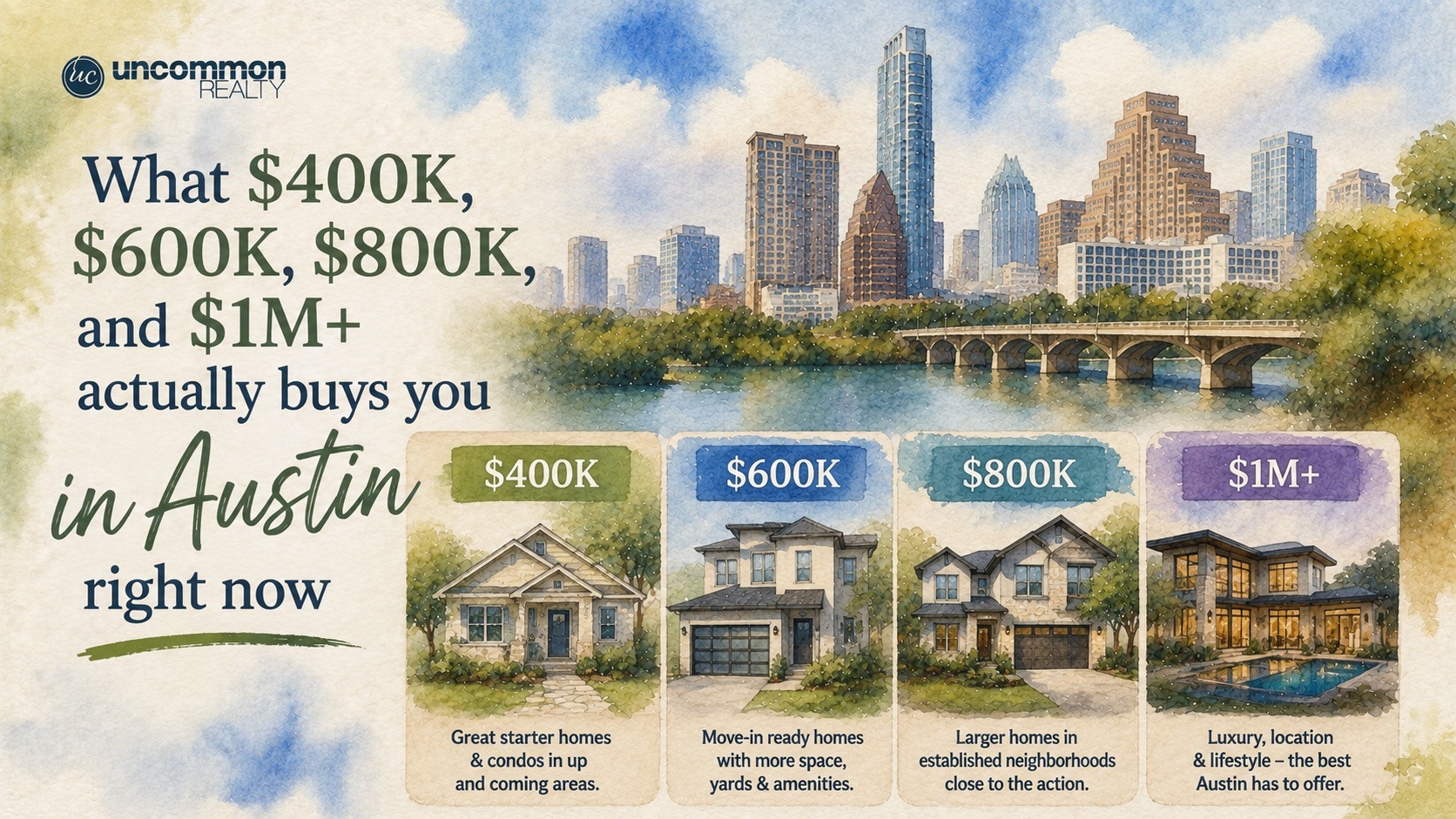
TLDR (Too Long; Didn’t Read): What $400K, $600K, $800K, and $1M+ actually buys you in Austin right now
- Austin-area home prices vary enormously by submarket, so the same budget can mean a condo near downtown or a house with a yard forty minutes out, depending on where you look
- Around $400K you’re mostly looking at condos and townhomes inside the city, or single-family homes in the outer suburbs and exurbs
- Around $600K to $800K opens up established single-family neighborhoods in the inner suburbs and some of the more affordable pockets of central Austin
- At $1M and above you’re generally in central, walkable neighborhoods with older, larger lots, or newer construction with more square footage in the western suburbs
- Price per square foot runs noticeably higher inside Austin city limits than in the surrounding metro, so the same number on a budget can translate to very different square footage depending on location
The short version on Austin pricing right now
As of mid-2026, the median sale price across the Austin metro area sits somewhere around $550K to $560K over a recent three-month window, while the median inside Austin’s city limits is closer to $426K. That gap alone tells you a lot. Price per square foot inside the city runs well above $300, while the broader Austin-area MLS median is closer to $210 to $215 per square foot. A $400K budget puts a buyer at roughly the 25th percentile of the metro overall, which means it’s below the entry point in some of the pricier northwest suburbs and above the median in some of the further-out towns.
None of this is static. Prices move, inventory shifts by season, and individual streets inside the same zip code can price very differently depending on lot size, school zoning, and how much work a house needs. What follows are ranges I’d consider typical right now, not fixed numbers.
What $400K buys you
At this price point in the city of Austin, you’re mostly in the condo and townhome market. Older, smaller single-family houses do come up here and there, usually needing some updating, but a detached house with a yard on this budget inside the city is the exception rather than the rule.
Where $400K goes further is in the outer suburbs and exurbs. Places like Hutto, Elgin, Manor, and Taylor put a $400K budget above the local median, which generally means a newer single-family house, often built in the last ten to fifteen years, in the 1,800 to 2,200 square foot range, on a standard subdivision lot. Pflugerville and parts of Round Rock also land in this range for older or smaller homes. I’ve written a full guide to living in Hutto if you want more detail on what that submarket looks like day to day.
The tradeoff at this price point is mostly about distance and age of construction. You get more house and more land the further out you go, but you’re also further from central Austin’s job centers and the drive gets longer.
What $600K buys you
This is where single-family homes in established neighborhoods start becoming realistic in more parts of the metro. In the inner suburbs, Round Rock and Cedar Park in particular, $600K typically lands you a house in the 2,000 to 2,600 square foot range on a standard lot, often built within the last fifteen to twenty years.
Inside Austin proper, $600K reaches into some of the more affordable central and near-east neighborhoods, where home values often sit in the $450K to $550K range and a $600K budget covers a mid-century house, sometimes updated, sometimes not. Windsor Park is a good example of this kind of neighborhood: mid-century construction, smaller lots than the suburbs, and a location close enough to downtown to matter. I cover that market in more detail in my Windsor Park guide.
At $600K you’re generally choosing between more square footage and newer construction further out, or an older house on a smaller lot closer to the center of the city. Condition varies a lot at this price point in the city, so I’d expect to budget for some updating if you want a fully renovated kitchen or bathrooms.
What $800K buys you
This is a transition tier. In the suburbs, $800K generally buys a larger, newer house, often 2,800 to 3,500 square feet, sometimes on a bigger lot in a newer-build community in Cedar Park, Leander, or Georgetown. You’re getting more space and often better finish quality at this level than at $600K in the same area.
Inside central Austin, $800K starts to reach some of the neighborhoods known for walkability and mature tree cover. Homes here tend to be smaller in square footage than what the same money buys in the suburbs, typically 1,600 to 2,400 square feet, but on lots with more established landscaping and closer proximity to downtown, South Congress, or the Barton Springs area. Age of construction ranges widely, from original mid-century houses that haven’t been touched in decades to fully remodeled versions of the same floor plan two doors down. Condition is genuinely the biggest variable at this price point in central Austin, more than location or square footage.
If walkability and a shorter commute matter more to you than square footage, this is usually the price range where that tradeoff becomes concrete rather than theoretical.
What $1M and above buys you
North of $1M, you’re generally looking at two different kinds of properties depending on where in the metro you’re looking. In central, established neighborhoods, this budget reaches homes in areas like Rosedale, Clarksville, Barton Hills, and Travis Heights, where $1M is often close to the entry point rather than the ceiling. Lots in these neighborhoods tend to be larger and more mature than what you’ll find in newer subdivisions, home ages vary from original construction to full renovations, and square footage often runs in the 2,000 to 3,000 range, sometimes less for an unrenovated original house on a valuable lot.
Further west, Tarrytown currently has a median sale price a little over $1M, and Westlake Hills runs considerably higher, with a year-to-date median north of $2.3M as of 2026. Those areas generally mean larger lots, more square footage, and newer or more extensively renovated construction than what the same budget gets in the closer-in central neighborhoods.
The overall Austin luxury market, generally defined as $1M and up, has a median price around $1.45M right now, and the bulk of that activity sits in the $1M to $1.5M range. Above that, you’re increasingly paying for lot size, school zoning, and proximity to the lake or downtown rather than raw square footage.
Why the same number buys such different things
The pattern across all four tiers comes down to a tradeoff between location, square footage, lot size, and age of construction. Central Austin has always priced for proximity and lot scarcity more than for size, so a smaller, older house close to downtown can cost the same as a much larger, newer house forty minutes out. Neither is objectively the better buy. It depends on what you’re optimizing for, whether that’s commute time, outdoor space, walkability, or getting the most square footage for the number on your pre-approval letter.
I’d also add that these are current patterns, not permanent ones. Austin’s price per square foot has come down from its 2022 peak in a lot of submarkets, and some neighborhoods have moved more than others. A number that felt aggressive a couple of years ago might land differently in today’s market, which is part of why I’d rather walk through current data with a buyer than rely on what a price point used to mean.
Getting a number that actually applies to your search
Averages and medians are a starting point, not a guarantee for any one house. The best way to see what your specific budget buys in a specific part of the metro is to look at current, active listings rather than trailing averages. I’d point you to the Austin market overview on my site as a starting place, and from there I’d rather just search live inventory with you at your actual number than have you guess from a blog post, mine included.
If you want to talk through what a specific budget looks like in a specific neighborhood, or you’re trying to decide between more space further out and less space closer in, that’s the kind of conversation I have with buyers constantly. You can read more about how I work on my about page, and about the brokerage I work with on the Uncommon Realty page.
Robbie English, REALTOR, Broker at Uncommon Realty.
Worth a look if you’re still researching this: Build-to-Rent Communities in Austin: What Renters and Buyers Should Know.