If you are buying a home in Texas, one of the first decisions you now have to make happens before you ever walk through the front door of a property. You have to decide who is going to represent you.
For a lot of buyers, that is where the hesitation starts. They may have spent months scrolling through listings online, saving houses, watching prices, and figuring out where they want to live. Then suddenly someone is asking them to sign an agreement with a real estate broker before they have even found the house they want to buy.
I understand why that feels like a big decision. It is a big decision.
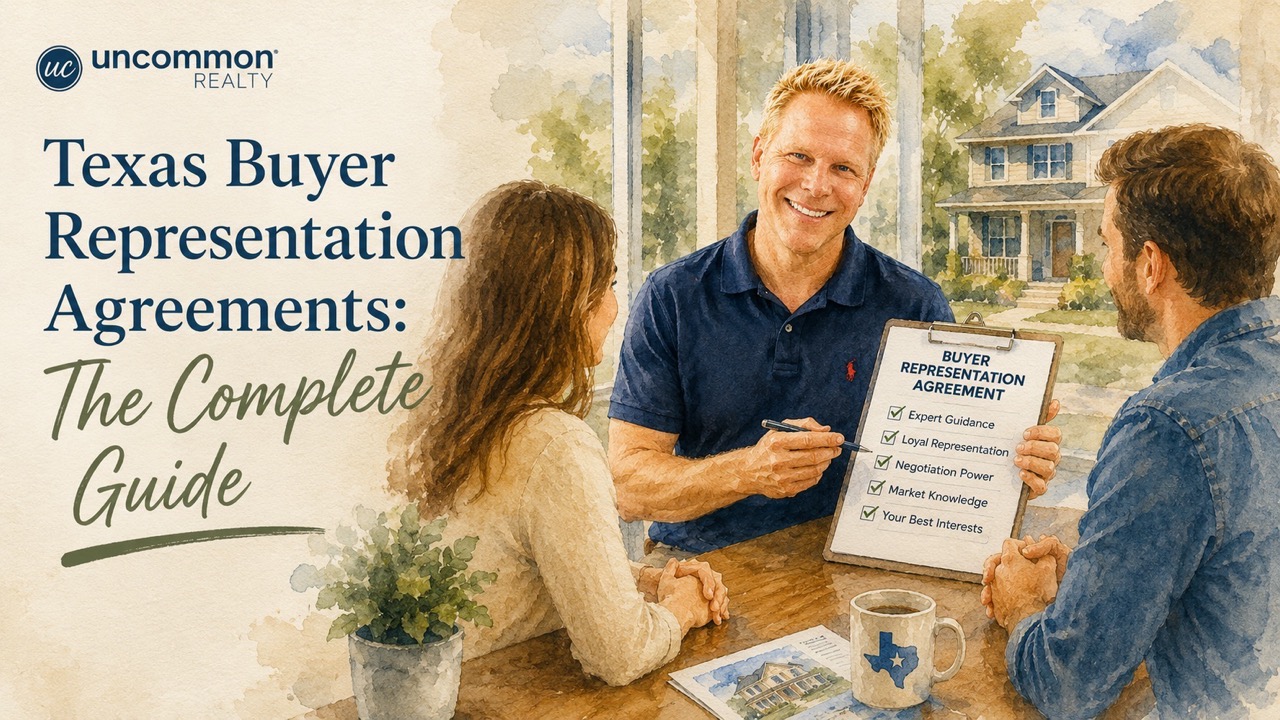
The Texas buyer representation agreement is not simply another form somebody puts in front of you so you can start looking at houses. It establishes the relationship between you and the broker who is going to represent you through what can be one of the largest financial transactions of your life.
As of January 1, 2026, Texas law requires a license holder working with a prospective residential buyer to enter into a written agreement before showing residential real property or, if there will be no showing, before presenting an offer on the buyer’s behalf. Texas also allows a limited written non-representation agreement that can be used solely for showing property under specific circumstances. You can read the Texas Real Estate Commission’s explanation of the 2026 buyer representation changes.
That makes choosing your agent or broker part of getting your ducks in a row before you begin shopping for a home. I think that is the right way to look at it. You are not starting with a contract. You are starting by deciding who you want on your side.
Why Texas Buyers Have to Make This Decision Earlier
For years, buyers could meet an agent, look at properties, spend some time together, and eventually formalize the relationship. That process has changed.
Under the current Texas requirements, a written agreement comes before a license holder shows a prospective residential buyer a property. The agreement has to address things such as the services being provided, when the agreement ends, whether it is exclusive or non-exclusive, whether the license holder represents the buyer, and how the broker will be compensated. Broker compensation is not set by law and is negotiable.
The change means buyers have to think about representation earlier, but I don’t think that should mean choosing somebody casually just because they are the first person available to open a door.
Before you start touring property, I think you should know who you are working with, what that person knows, how they work, what they expect from you, what you can expect from them, and whether you are comfortable putting that person in a position to advise you.
If your biggest concern is whether you have to sign something before seeing a home, I go into that specific issue in Do You Have to Sign a Buyer Agreement Before a Showing in Texas?
A Buyer Representation Agreement Is Really About Who Is on Your Team
When buyers are hesitant about signing an agreement, I usually don’t start by trying to talk them out of the hesitation. I start by asking questions.
What are you concerned about? Is it the length of the agreement? Are you worried about compensation? Are you uncomfortable choosing one agent? Have you had a bad experience with an agent before? Do you simply not know enough about the person sitting across from you yet?
Every buyer comes into the process with different priorities and different experiences. I think good representation begins by meeting people where they are and answering the questions they actually have instead of giving everyone the same rehearsed presentation.
The underlying question is usually pretty simple: Am I choosing the right person?
That is a question buyers should take seriously.
I have spent more than 40 years practicing real estate, and I am also a national real estate instructor. When I talk with buyers about hiring me, I come back to three things: education, experience, and trust.
Education matters because real estate is full of contracts, deadlines, negotiations, legal responsibilities, financing issues, property-condition questions, and situations that don’t fit neatly into a script. Experience matters because knowing something in theory and recognizing it when it is happening in front of you are two different things. Trust matters because none of the rest works very well if the buyer and the broker cannot be open with one another.
You Cannot Have Two People Both Thinking They Are Your Agent
One of the concepts buyers sometimes struggle with is exclusivity.
I tend to explain it pretty plainly: you can’t ride two horses with one ass. You have to choose who is representing you.
If you are entering into an exclusive buyer representation relationship, the point is to have someone on your team who is working with you, learning what matters to you, researching properties with you, helping you evaluate what you are seeing, preparing you to compete when necessary, and guiding the transaction once you find the right property.
That relationship works best when everybody knows where they stand.
I need my clients to be honest with me. I need them to communicate with me. I need to know when their financial circumstances change, when their priorities change, when something bothers them, or when they have a question they are afraid might sound silly. There are very few silly questions in real estate. There are plenty of expensive assumptions.

What Representation Gives a Texas Buyer
A buyer can certainly contact a listing agent directly. There is nothing magical preventing you from picking up the phone and calling the person whose name is on the listing.
What you need to understand is who that listing agent works for.
If the listing agent represents the seller, that agent has obligations to the seller. The seller hired that broker to market the property, negotiate on the seller’s behalf, and protect the seller’s interests within the duties imposed by Texas law.
If you walk into that situation without your own representation, you should understand that you are not suddenly getting the listing agent’s advocacy simply because you are interested in buying the property.
Texas requires license holders to provide consumers with information explaining brokerage relationships at the first substantive communication concerning specific real property. The Texas Real Estate Commission’s Information About Brokerage Services guidance explains the roles of brokers and agents, written agreements, and representation and non-representation status.
I believe a buyer deserves someone in the transaction whose job is to work with the buyer.
That person should be able to look at the contract through the buyer’s eyes, discuss the buyer’s options, identify deadlines and risks, help evaluate the property, negotiate strategically, coordinate with the other professionals involved, and keep the transaction moving toward closing.
If you’re considering going directly to a property or trying to see homes without full representation, there are limited ways that can happen under Texas law. I cover those choices separately in Can You View a Home Without a Buyer Agreement in Texas?
Choosing an Agent Before Choosing a House Is Not Backwards
I actually think finding the house before finding the agent is backwards.
It would be a little like having the surgery and then deciding which surgeon you should have hired. I suppose you could try to do the surgery yourself, but the repercussions of getting it wrong can be fairly serious.
Buying real estate works better when the team is put together first.
Before we seriously start looking at property, I want to know that a buyer has proof of funds if they are paying cash or an appropriate preapproval if they are financing the purchase. I am a strong believer in working with lenders who understand the market and the transaction we are putting together. Real estate has local nuances, and Austin and Central Texas certainly have their share.
We want to know what price point actually makes sense. We want to know what the buyer is comfortable spending. We want to understand the financing before we fall in love with a property that doesn’t fit the financial plan.
Then we can search intelligently.
If the right house comes on the market and several buyers want it, the buyer who already has representation, financing, documentation, and a strategy in place is in a much different position from someone who finds the house first and then starts scrambling to assemble everything.
Preparation doesn’t guarantee that you’ll win a competing-offer situation, but it can keep you from losing simply because you weren’t ready.
My Job Is Not to Sell You a House
This is probably the most important thing I tell buyers about how I work.
I am not going to push you into buying a property.
In fact, I tell my clients that I will talk you out of a home before I will talk you into one.
When I walk through a property with a buyer, I am not standing there admiring the countertops and trying to convince them how wonderful everything is. Buyers are usually perfectly capable of seeing the pretty parts.
I am looking for what they might be missing.
We are looking at cracks. We are looking at construction quality. We are looking at condition. We are looking at deferred maintenance. We are looking for things that don’t make sense. We are looking for the reasons this may not be the property they should buy.
Sometimes a house has plenty of lipstick on it, but underneath all that lipstick there may still be a pig.
That doesn’t mean every crack is a catastrophe or every older component means you should walk away. It means somebody needs to keep their head while the buyer is deciding whether this is the place they can see themselves living.
I want my buyers to love the property they buy, but I want them to love it with their eyes open.

What Happens After You Find the Right Property
Finding the property is only one part of the job.
Once a buyer decides, this is the one I want, the work changes.
Now we have to evaluate the property and the transaction, determine how we want to structure the offer, consider price and terms, understand the seller’s position where we can, prepare the contract, negotiate, and then manage all the moving pieces that begin once the contract is executed.
There are deadlines. There is financing. There may be inspections, repair discussions, title matters, homeowners association documents, appraisal issues, insurance questions, lender requirements, amendments, notices, and closing preparation.
I use technology heavily to make that process easier for my clients. My buyers have access to property documentation as we are evaluating homes, and once they are under contract we use a shared drive and an app where transaction documents are available to them. I also communicate throughout the transaction so they know what is happening and what comes next.
The technology isn’t the representation. It is simply how I make the representation easier to use.
How Long Does a Buyer Representation Agreement Last?
The term of a representation agreement is something the buyer and broker need to discuss and agree upon.
In my own practice, I have typically used a six-month term for buyer representation. That approach has been consistent for me over the years because I want the agreement to provide enough time to search seriously for a property, negotiate a purchase, complete due diligence, work through financing, and get all the way to the closing table.
A buyer may find the right property in the first month. Another buyer may need longer.
The point is not to predict exactly how many days it will take somebody to fall in love with a house. It is to establish a working relationship that can reasonably cover the process.
Whatever term you agree to, read it. Understand when it begins, when it ends, what property or geographic scope it covers, and what obligations may continue after termination regarding properties the broker introduced to you.
What If the Relationship Is Not Working?
A written agreement does not magically make two people compatible.
If we don’t get along and we don’t work well together, neither one of us is going to enjoy the transaction very much.
I have ended buyer relationships when I knew the trust required for me to represent the client was no longer there. I don’t say that lightly. I may genuinely like someone as a person and still recognize that I cannot effectively represent them if I don’t believe the information I am receiving or if they are unwilling to be open with me about things that affect the transaction.
Representation has to work in both directions.
A buyer should be able to ask questions, disagree with me, tell me what is bothering them, and expect an honest answer. I need the same honesty in return.
Termination also does not necessarily erase every contractual obligation. For example, if a buyer terminates a relationship and later purchases a property that was introduced during the representation period, compensation provisions or protection provisions in the agreement may still matter. That is one of the reasons I want buyers to understand what they are signing before the relationship begins.
Who Pays the Buyer’s Agent?
This is one of the most misunderstood parts of buyer representation today.
The buyer representation agreement establishes how the broker representing the buyer will be compensated. Under Texas law, brokerage compensation is not set by law and is negotiable.
In the market I work in, sellers still commonly agree to pay buyer-agent compensation as part of the transaction. That compensation is something that can be addressed and negotiated in the contract. If the seller does not agree to cover the compensation the buyer has agreed to pay, then the buyer may be responsible for the difference or the entire amount, depending on the agreement and the transaction.
That can become a very real financial conversation.
Buyers already have other expenses to consider, including their down payment, closing costs, inspections, appraisal, moving expenses, and the costs that come with taking ownership of a home. If a particular seller refuses to contribute toward the buyer’s agent compensation and the buyer would have to bring substantially more cash to closing, the buyer may decide that property simply does not make financial sense.
That doesn’t mean a seller is required to pay it. It means compensation becomes one of the economic terms the parties may have to negotiate.
I cover the seller’s side of this issue in Buyer Agent Compensation in Texas: What Sellers Need to Know, and the buyer’s choices when a seller declines to pay in Can a Seller Refuse to Pay the Buyer’s Agent? Here Are Your Options.
What If You Want to Buy Without an Agent?
You can decide that you do not want your own representation.
Some buyers believe they know the process well enough to handle the purchase themselves. If that is the decision you want to make, you need to understand what that decision means rather than assuming the listing agent will fill the gap.
The listing agent may be representing the seller. If so, that agent is not there to become your advocate simply because you showed up without one.
You also should not assume that being unrepresented automatically saves you money or makes your offer more attractive. A seller may consider a number of things when evaluating an offer, including price, financing, contingencies, timing, likelihood of closing, and the overall risk of the transaction.
If you are thinking about making an offer without your own agent, I address that situation from the seller’s perspective in Can a Seller Reject an Offer Because the Buyer Has No Agent?
Experience and Education Matter More Than a Sales Pitch
If you’re interviewing agents before signing a buyer representation agreement, ask questions that tell you how that person actually practices real estate.
Ask about experience. Ask about education. Ask how they handle contracts. Ask what happens when an inspection goes badly. Ask how they prepare for multiple offers. Ask how they communicate during a transaction. Ask how they evaluate property. Ask what they do when they don’t know the answer.
That last question matters more than people think.
One of the most useful definitions of competency I know is knowing the right questions to ask and when to ask them.
A newer agent may have tremendous enthusiasm and plenty of time to devote to a client. What they cannot manufacture overnight is experience. They may have a broker or team available to help them, but the agent still has to recognize when a question needs to be asked.
Education matters for the same reason. Doing something for years does not automatically mean someone has spent those years improving. Contracts change. Laws change. Forms change. Markets change. Financing changes. The way we practice real estate changes.
I believe the combination of education and experience is powerful because each makes the other more useful.
The Right Representation Should Help You Make Your Decision, Not Make It for You
There are plenty of moments in a real estate transaction when a buyer needs advice. There should never be a moment when an agent decides which house the buyer should love.
I can tell you what I see. I can point out concerns. I can help you understand the contract. I can talk through the numbers. I can explain risks. I can help you negotiate. I can bring in inspectors, lenders, title professionals, attorneys, contractors, and other professionals when their expertise is needed.
What I cannot do, and what I don’t want to do, is sell you on a house you don’t really want.
The home, condo, or property has to fit your life. You are the one who will wake up there every morning. You are the one making the payment. You are the one who has to live with the decision after everyone else leaves the closing table.
My job is to help you make that decision with better information and better representation.
A Good Transaction Starts With the Team
After more than 40 years in this business, one of the things I believe most strongly is that success in real estate comes from putting the right team together.
The right real estate broker or agent should lead that team, but they shouldn’t pretend to be every professional on it. There may be a lender, inspector, title company, attorney, insurance professional, contractor, surveyor, appraiser, or another specialist whose expertise becomes important along the way.
When the right people are in place and communicating with one another, you save time, reduce surprises, and have a much better chance of dealing with problems before they turn into expensive lessons.

Some people have to take the field trip and learn those lessons the hard way. Sometimes that lesson is losing the property. Sometimes it is losing earnest money. Sometimes it is discovering after closing that the transaction could have been handled very differently.
I’d rather help my clients avoid the field trip.
I also believe every buyer deserves the same level of service regardless of price point. Whether someone is buying their first home or another property in a long line of purchases, the responsibility I take on when I agree to represent them is the same.
Buying a home can still be stressful. It should also be exciting, and with the right preparation and the right people around you, it can actually be enjoyable.
Buyer Representation and Appraised Value
Compensation can also intersect with other parts of the transaction, including how seller-paid amounts and concessions are considered in the economics of a sale. That is a separate issue from whether a buyer should have representation, and it deserves its own discussion rather than trying to squeeze all of the appraisal math into this guide.
You can read that analysis in How Buyer-Agent Commissions Paid as Concessions Affect Appraised Value.
What I Want Texas Buyers to Understand Before They Sign
A buyer representation agreement is a contract, and you should treat it like one. Read it. Ask questions. Understand how long it lasts, what services are being promised, whether the relationship is exclusive, how compensation works, how termination works, and what obligations could survive the end of the agreement.
But don’t make the mistake of focusing so closely on the document that you overlook the bigger decision.
You are hiring the person who may be standing beside you when you’re deciding how much to offer, whether to walk away from an inspection, whether a contract term is acceptable, how to respond to a seller, whether a problem is routine or serious, and what needs to happen next when something doesn’t go according to plan.
Choose that person carefully.
Ask about education. Ask about experience. Decide whether you trust the answers you’re getting. Find someone who will tell you what you need to hear, not simply what makes the house easier to sell.
Then get the relationship, the financing, and the rest of your team in place before you start running from house to house.
When you eventually walk into the property that feels right, you should be able to concentrate on deciding whether it is truly the home you want. Everything you could have prepared ahead of time should already be handled.
That is what good buyer representation looks like to me.
















Thank you, Robbie, for breaking down buyer representation agreements in a way that actually makes sense. Your explanation cleared up a lot of the confusion that buyers in Texas tend to carry around about what this agreement really does and why it matters. I especially appreciated how you explained the protection aspect, not just for the agent, but for the buyer and how it locks in loyalty, advocacy, and real accountability. This kind of straight shooting education is exactly what people need before they start touring homes and signing paperwork. Appreciate you taking the time to spell it out so clearly and without sugarcoating anything.
Thank you, Robbie, for such a clear and well written breakdown of what a Buyer Representation Agreement really means for Texas buyers. So many agents gloss over this topic or make it sound more complicated than it needs to be, but your explanation actually helps people understand why this agreement protects them instead of boxing them in. I especially appreciated how you explained the shift in the law in plain English and tied it back to what buyers should realistically expect when they work with an agent. This kind of honest perspective is exactly what buyers in Texas need right now, and it is refreshing to see someone put education first instead of fear or pressure.
Great post, Robbie, and thank you for breaking down Texas Buyer Representation Agreements in a way that actually makes sense to real people, not just industry insiders. I appreciate how you explained not only what the agreement is, but why it matters to buyers who want real protection, real advice, and someone truly in their corner. Your perspective makes it clear that this is not just paperwork, it is about accountability, transparency, and making sure buyers are represented the right way from day one.