I’ve lived in Austin long enough to hear the Armadillo come up in conversation more times than I can count, usually from someone who either saw a show there or wishes they had. This is the first article in a series I’m starting on Austin’s history, the buildings and moments that shaped the city before it looked anything like it does now. I’m kicking it off with Armadillo World Headquarters because if you want to understand why Austin calls itself the live music capital of the world, this is where that story really starts.
TLDR (Too Long; Didn’t Read): The history of Armadillo World Headquarters, Austin’s lost music landmark
- Armadillo World Headquarters was a music venue that ran from 1970 to 1980 inside a converted National Guard armory on Barton Springs Road, just south of downtown Austin.
- It became the home base for the “progressive country” or “cosmic cowboy” scene, a mix of country and rock that pulled in two crowds who usually kept their distance from each other.
- Willie Nelson’s August 1972 show there is the night most historians point to when Austin’s hippies and its country fans realized they liked the same music.
- Touring acts who played the Armadillo ranged from Frank Zappa and Bruce Springsteen to Ray Charles, Van Morrison, and AC/DC’s first American show.
- Rising land values near downtown pushed the venue out in December 1980, and the building came down the next year for an office tower that still stands on the site.
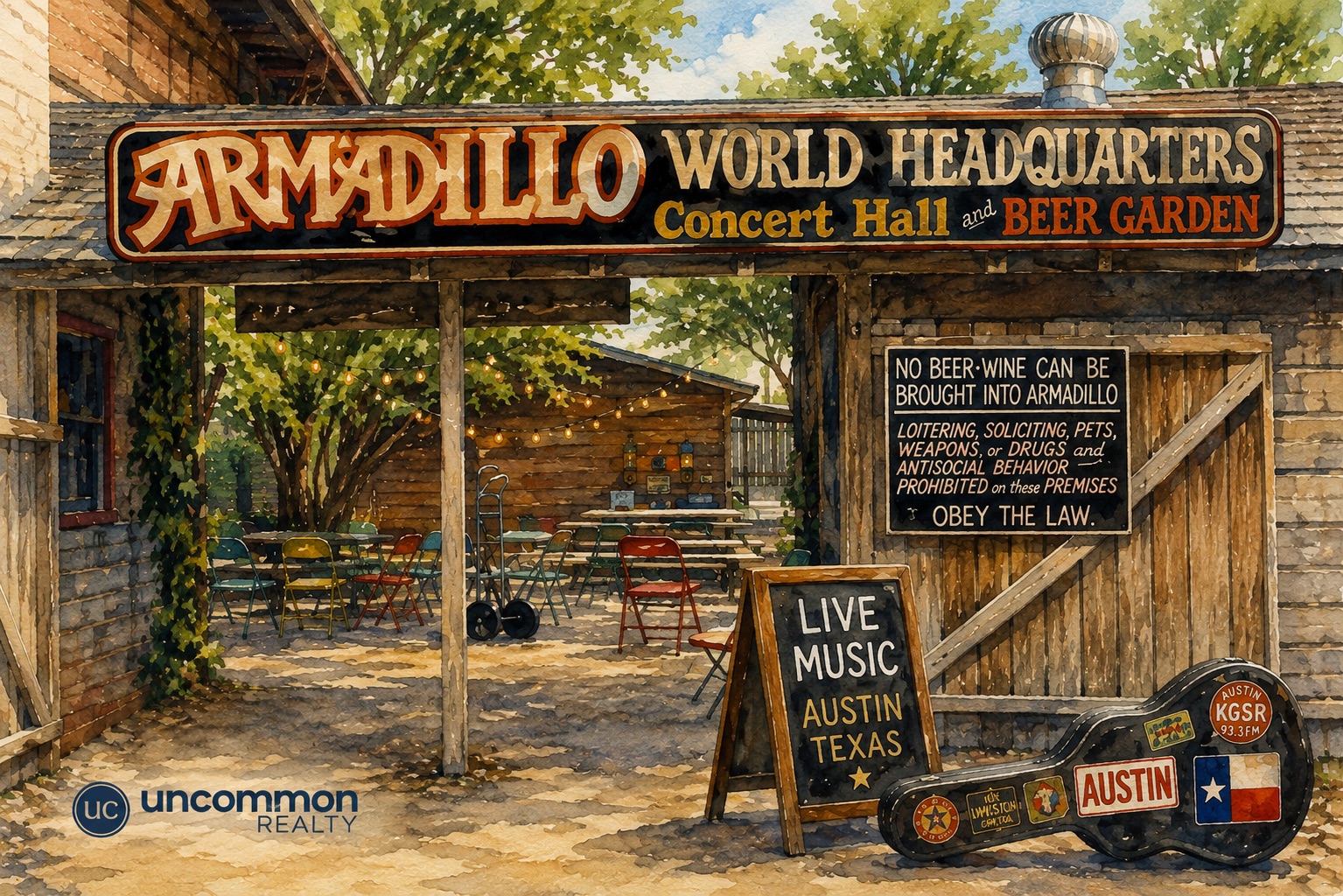
A National Guard armory becomes a music hall
Armadillo World Headquarters opened on August 7, 1970, in a 1,500-capacity building at 525½ Barton Springs Road, near South First Street, in the area now occupied by One Texas Center and close to today’s Palmer Events Center and Auditorium Shores. The building had been a National Guard armory, and before that a sporting goods warehouse. It sat mostly forgotten until Eddie Wilson, who was managing the local psychedelic band Shiva’s Headband, spotted it while stepping outside a nearby club.
Wilson pulled together roughly $4,000 from his own pocket, from Shiva’s Headband co-founder Spencer Perskin, and from a bit of Capitol Records money tied to the band’s contract. That covered rent of about $500 a month for 30,000 square feet of raw armory space. Poster artist Jim Franklin, entertainment attorney Mike Tolleson, and Bobby Hedderman, who’d come over from the Vulcan Gas Company (Austin’s earlier psychedelic music room), rounded out the founding group.
The name came from Franklin, who had already been drawing armadillos on handbills for a couple of years. He liked the idea of an armored creature as the mascot for a building that used to be an armory, and it stuck. Franklin’s armadillo art became so tied to the venue that people still call him the “Michelangelo of armadillo art” in write-ups of the era.
The night hippies and rednecks found common ground
The Armadillo is remembered for a lot of shows, but the one that shows up in nearly every account of Austin music history happened on August 12, 1972, when Willie Nelson played the room for the first time. Austin in the early 1970s had a real divide: longhairs weren’t exactly welcome in the honky-tonks, and country fans didn’t have much use for the peace-and-love crowd. Nelson, who’d grown frustrated with Nashville and moved back to Texas, found an audience at the Armadillo that mixed both groups in the same room.
Nelson wrote later that “rednecks and hippies who had thought they were natural enemies began mixing without too much bloodshed. They discovered they both liked good music.” That blend of country songwriting with rock and blues instincts became known as progressive country, or the cosmic cowboy sound, and Nelson is generally credited as the artist who did the most to bring it together. Other regulars associated with the sound included Jerry Jeff Walker and Michael Martin Murphey, along with local acts like Greezy Wheels, who often opened shows at the venue. That first Nelson show reportedly drew around 400 people, split about evenly between longtime country fans and the hippie crowd who came for Greezy Wheels, and it’s still the single most cited night in the venue’s ten-year run.
Who else played there
Once the Armadillo built a reputation, it started drawing touring acts that a room of its size in a city Austin’s size wouldn’t normally land. Frank Zappa played there. So did Ray Charles, Bruce Springsteen (five shows in 1974, years before he was filling arenas), Van Morrison, ZZ Top, Waylon Jennings, Freddy Fender, and Commander Cody and His Lost Planet Airmen, who closed out the venue’s final New Year’s Eve show on December 31, 1980. AC/DC played their first American show there in July 1977, and The Clash played the room in October 1979.
The Armadillo also gave a stage to musicians who were still building their careers, including Stevie Ray Vaughan, Joe Ely, and Marcia Ball. Time magazine took notice too, comparing the Armadillo’s cultural role in Austin to what the Fillmore had meant for rock music in San Francisco.
The beer garden, the art, and the atmosphere
The Armadillo added a beer garden in 1972, partly to bring in more revenue for a venue that was chronically short on cash. It worked well enough that at one point the room reportedly sold more Lone Star draft beer than any venue in Texas outside the Astrodome. The beer garden became as much a part of the Armadillo experience as the shows themselves, a place where the crowd spilled outside between sets.
Inside, the walls carried the work of what became known as the Armadillo Art Squad, poster artists including Jim Franklin, Micael Priest, Guy Juke, and Kerry Awn. Their concert posters weren’t just advertising, they became collectible artifacts of the era, and Austin galleries and the Austin History Center still display them today.
Why it closed
The Armadillo never made money easily. It paid touring acts real money while keeping ticket prices low, and it filed for Chapter 11 bankruptcy in 1977 after laying off staff the year before. What finally ended it wasn’t the music business, though, it was real estate. The Armadillo owned the business inside the building but not the land underneath it, and the site sat on more than five acres close to downtown. As Austin grew through the late 1970s, that land became worth far more as an office site than as a concert hall. The property changed hands, the lease ran out, and the Armadillo played its last show on December 31, 1980, with Asleep at the Wheel and Commander Cody sending it off. The building came down in 1981, and a 13-story office building, One Texas Center, went up in its place and still stands on the site today.
Eddie Wilson’s next chapter
Eddie Wilson didn’t step away from Austin’s music scene after the Armadillo closed. He went on to take over Threadgill’s, the old filling station turned honky-tonk on North Lamar where Janis Joplin got some of her earliest stage time in the 1960s. Wilson reopened it as a restaurant and music venue in 1981, and later opened a second Threadgill’s location, keeping another piece of Austin’s music history alive rather than letting it disappear the way the Armadillo did. He later wrote a memoir about the Armadillo years with Jesse Sublett.
What’s left of it now
A historical marker went up near the original site in 2006, unveiled at a ceremony Wilson attended along with Armadillo promoter Woody Roberts, and the venue still shows up regularly in books, documentaries, and oral histories of Austin music. A documentary on poster artist Jim Franklin came out in 2025. The Austin History Center holds a large collection of Armadillo photographs, posters, and other memorabilia from the era, and in recent years the “Armadillo Forever” brand has popped up on South Congress with merchandise and events that keep the name in front of a new generation. Austin FC even added an armadillo patch to its uniform in 2024 as a nod to the venue’s place in the city’s identity.
Austin didn’t officially adopt “Live Music Capital of the World” as a slogan until 1991, more than a decade after the Armadillo closed, and there’s some debate over who first coined it. But the case for Austin earning that reputation runs straight through the Armadillo years, when a converted armory on Barton Springs Road proved that a city this size could draw serious touring acts and build a local scene worth paying attention to.
Why this kind of history matters to me
I never got to see a show at the Armadillo. It closed years before I moved to this city. But I think about it every time I drive down Barton Springs Road, because the building that’s there now gives no hint of what used to happen on that ground. Austin has lost a lot of places like this to redevelopment, and I don’t think that’s automatically a bad thing, cities change and that’s normal. What I do think matters is remembering what came before, because the character of a neighborhood, a street, or a whole city doesn’t come from nothing. It comes from places like the Armadillo.
That’s part of why I like doing this work in Austin. Buyers ask me about schools and commute times, sure, but they also ask what a neighborhood feels like, what’s around, what its history is. Knowing that this city once hosted Frank Zappa, Willie Nelson, and a young Stevie Ray Vaughan on the same stage, in a converted armory, tells you something real about the place you’re moving to. If you want to know more about how I work or who I am, you can read more about me or about the brokerage I work with, Uncommon Realty.
I’ll keep adding to this series as I dig into more of Austin’s history. If there’s a building, a scene, or a moment in this city’s past you’d like me to cover next, let me know.
Robbie English, REALTOR, Broker at Uncommon Realty.
Worth a look if you’re still researching this: Down Payment Assistance Programs for Austin-Area First-Time Buyers.
Before you get too far into the search, it’s worth getting pre-approved so you’re shopping with a real number in hand.