The Austin housing market is showing two truths at once. Prices have settled from the boom, yet high inventory still gives buyers room to negotiate. I’ll explain what the numbers mean for buyers, sellers, renters, and investors, then show you how I’d use local data before making a move.
What the Austin Real Estate Market Looks Like Right Now
The Austin real estate market looks more stable than the headlines suggest, but stable doesn’t mean easy. Recent MLS data for the wider Austin area showed an average sales price near $585,190 and a median sales price near $434,240. Average days on market stood at 64, while the median was 33.
Those figures cover Austin and nearby suburbs. They don’t describe every zip code. A condo near downtown can behave very differently from a new home in Hays County. A well-priced house with good upkeep may draw strong interest while a similar home sits because it started too high.
Inventory remains the main story. One recent Central Texas market review counted about 4,600 homes for sale in Travis County, about 2,600 in Williamson County, and about 1,300 in Hays County. Those figures came from a period with unusually high supply. They point to a buyer who has time to compare homes and ask better questions.
Price reductions also matter. In one recent seven-day MLS snapshot, 2,185 homes had a price drop. That doesn’t mean every seller is in trouble. It does mean an initial list price can miss the market when the seller relies on old boom-era expectations.
I tell clients to look at three layers of data. First, study the wider metro trend. Then check the city, county, and zip code. Once you find a likely home, compare it with similar listings and recent closed sales within the same area.
My Austin real estate guide explains why housing types, taxes, commute patterns, and property condition can change the answer from one part of the region to another. That local detail matters more than a single metro-wide average.

My view is measured. Buyers have more use than they had during the frenzy. Sellers can still get a strong result, but preparation and price now matter much more. I don’t see a reason for panic on either side.
How Interest Rates and Affordability Are Changing Buyer and Seller Decisions
Interest rates shape the Austin real estate market through the monthly payment, not the headline rate alone. A small rate change can affect what a buyer qualifies for, how much cash remains after closing, and whether a seller feels ready to give up an existing loan.
Recent local commentary placed common conventional mortgage rates in the mid-to-high six percent range. Rates move often, so I would not build a purchase plan around one quote from one day. Ask a lender to show several payment cases instead.
- The payment at the rate you can lock today.
- The payment if the rate rises by half a point.
- The payment after taxes, insurance, and any HOA fee.
- The cash needed for closing, repairs, and reserves.
This is where affordability gets clearer. A home may look less expensive than it did during the boom, yet the full monthly cost can still strain a budget. Texas property taxes deserve special attention because the tax bill can vary by county, school district, exemptions, and special taxing areas.
Buyers should also ask what happens if they need to sell sooner than planned. A purchase can make sense over a longer hold while still being a poor fit for a two-year timeline. Closing costs, moving costs, and market value changes can erase a thin margin.
Look beyond the principal and interest payment when reviewing the cost of a home. I use that same approach with clients. The payment has to fit the full household budget, not just the lender’s approval limit.
Sellers face a different rate problem. Some owners may have a much lower rate on their current loan. Selling means giving that up and taking on a new payment. That can keep supply from rising as fast as it might otherwise rise.
For a seller who must move, the answer is not to wait for perfect rates. It is to price the home against current competition and plan the next purchase at the same time. A strong sale price can help, but it won’t fix an unaffordable replacement home.
Rate cuts could bring more buyers back. They could also bring more sellers back, which would add supply. I would treat any rate forecast as a planning input, not a promise.
Why Austin Prices Vary by Area, Zip Code, and Property Type
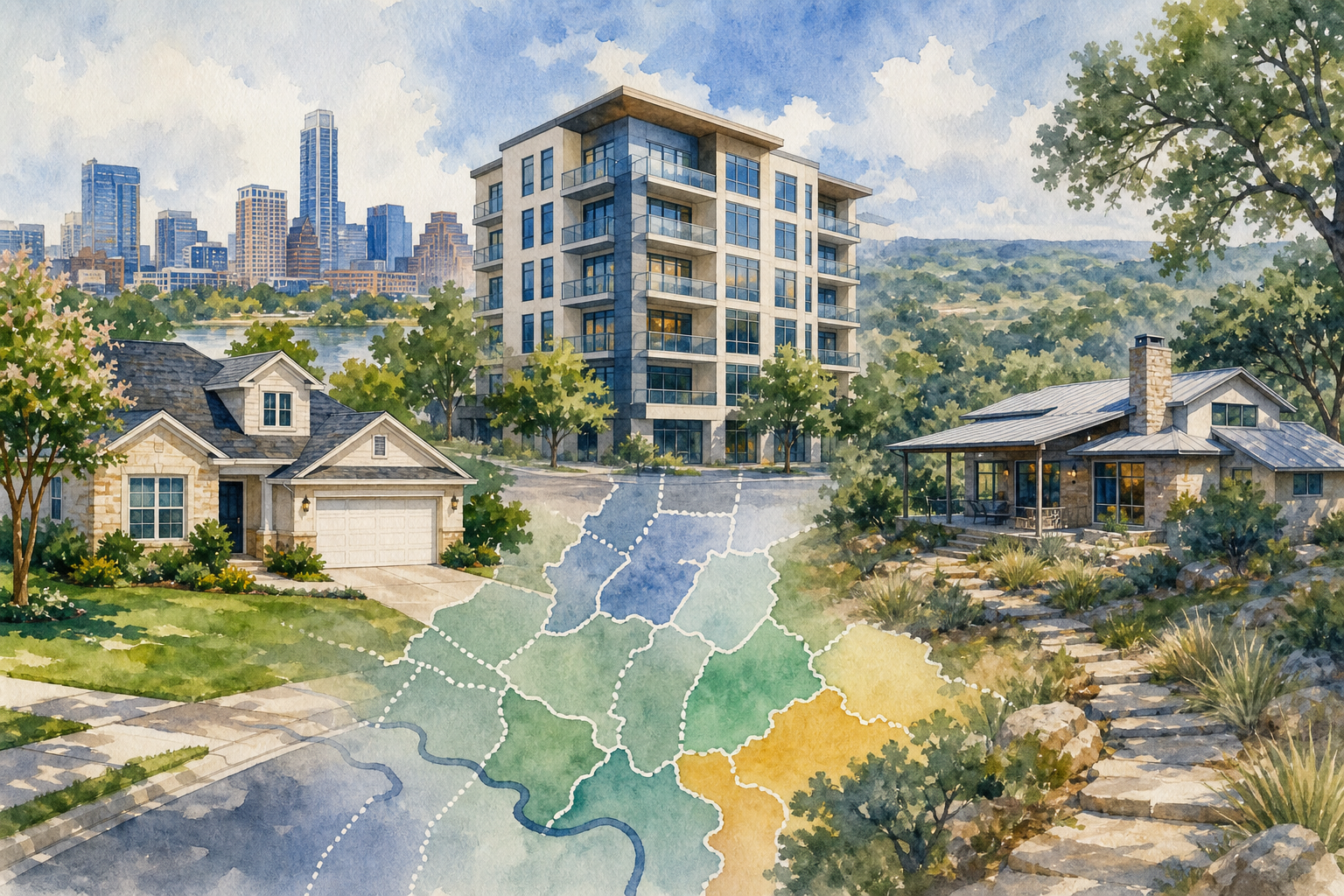
The Austin real estate market is made up of many smaller markets. Price changes can vary by zip code because buyers respond to different housing stock, lot sizes, commute routes, taxes, HOA rules, and access to services.
Central Austin may have older homes, condos, and smaller lots. North and Northwest Austin include established housing and major employment routes. Southwest Austin includes newer subdivisions, custom homes, and larger properties. The west side includes higher-priced homes and properties near lakes and hill country terrain. These labels help organize a search, but they don’t replace a property-level review.
Property type also changes the math. A resale home may have mature trees and a finished yard, but it can need work behind the walls. A condo may have less exterior upkeep, yet the HOA budget and rules matter. A new home may include a warranty, while the buyer still needs to review the builder contract, upgrades, drainage, and future construction nearby.
I also want to separate price from value. A low list price doesn’t automatically mean a home is underpriced. A higher price doesn’t prove overvaluation. A useful comparison includes recent sales with active competition, pending activity, lot utility, renovation quality, and the likely cost of deferred work.
Some analysts use valuation models to estimate whether a zip code looks overvalued or undervalued. I find those models useful as a screening tool. I don’t use them alone to set an offer because they may miss a view, a major remodel, a poor floor plan, or an unusual lot.
If you’re comparing several areas, spend time in each one at different hours. Check the route you would drive. Look at the housing stock, traffic flow, planned construction, and property taxes. You’re evaluating a home and its costs, not shopping from a city-wide average.
New Construction, Builder Incentives, and the Choice Between New and Resale
New construction has become an important part of the Austin real estate market because builders added a large amount of supply during the earlier demand surge. Some completed homes now compete directly with resale homes in the same price range.
Builders may use incentives to reduce the buyer’s upfront cost or monthly payment. The exact offer can change by community, inventory level, lender, and contract date. I never treat an advertised incentive as free money. The buyer still needs to compare the final price, loan terms, upgrades, closing costs, and restrictions.
Ask these questions before signing:
- Is the incentive tied to the builder’s preferred lender?
- Does the offer reduce the rate for a set period or for the full loan?
- What happens if the appraisal comes in below the contract price?
- Which upgrades are included, and which are extra?
- What are the expected taxes and HOA costs?
- Are nearby lots still available for future construction?
A new home can reduce some near-term repair risk, but it doesn’t remove the need for an inspection. I recommend an independent inspection at the stages allowed by the contract. Buyers should review drainage, grading, windows, roof work, HVAC installation, plumbing, and finishes.
Resale homes deserve the same careful review. A home with fresh paint may still have older systems. A large remodel may look good but lack permits or proper documentation. The inspection period gives the buyer a chance to learn what the house needs before the deal becomes harder to change.
There is no universal winner between new and resale. New construction may fit a buyer who values current finishes and a warranty. Resale may fit someone who wants an established lot or a location closer to work. A client’s decision should account for the full cost and likely holding period.
What Supports Austin’s Long-Term Growth, and What Could Slow It
Long-term demand gives Austin a stronger base than a short market cycle can show. Texas has no state personal income tax, and the state continues to attract companies, workers, and entrepreneurs. Austin also has a broad mix of employment centers, universities, outdoor space, and cultural activity.
Migration has slowed from the extraordinary pace seen during the pandemic period. Population estimates remain useful because they separate domestic migration from other population changes. I look at population estimates when thinking about long-term population patterns, but I still pair that data with local permits and sales.
Population growth does not translate into equal demand for every home. People arrive with different budgets, jobs, and timing. Some leave. Births and deaths also affect population change, though those shifts move slowly compared with housing construction.
Supply is the other side of the equation. Builders can add homes, but land, utility capacity, financing, zoning rules, permitting, and buyer demand all shape the pace. When builders complete homes after demand has cooled, buyers may gain choices and incentives.
Affordability policy may also shape the next phase. Local debates often focus on whether more housing should be allowed, how density should work, and how to support lower-cost homes. Rent control is a separate policy question from building more housing. Each proposal can affect supply, costs, and development choices in different ways.
Higher insurance costs, property taxes, severe weather, and commuting costs can also slow demand. A buyer may qualify for the mortgage and still decide the complete cost is too high. Investors face the same issue when expenses rise faster than rent.
My long-term view is cautious but not bleak. Austin has reasons to attract demand over many years. That does not mean every home will rise in value on a fixed schedule. A buyer still needs the right price, a sound property, and enough time to handle market swings.
Renting, Buying, and Investing: Comparing Cash Flow in Austin
Renting can be the more flexible choice when your job, income, or location may change. Buying can make sense when you expect to stay long enough for the upfront costs to spread across the holding period. Investing requires a separate test because the property must work as a business, not only as a place to live.
Rents have softened in parts of the Austin area as apartment supply increased and demand slowed. One local market discussion reported lower median rents and fewer closed leases during a recent period. That creates a better negotiating position for some renters, but it can pressure landlords who bought at a high price.
For a renter, compare the full monthly cost of each choice:
- Rent, parking, utilities, and renter’s insurance.
- Mortgage, taxes, insurance, HOA fees, and maintenance.
- Moving costs and the value of flexibility.
- The cash that would remain after a down payment.
For an investor, price-to-rent ratio is a starting point, not a final answer. I would build a full worksheet with expected rent, vacancy, repairs, taxes, insurance, management, financing, and capital expenses. Then I would test the deal with lower rent and a longer vacancy period.
My page on Austin real estate investing covers cap rates, financing, short-term rental rules, and the difference between an attractive listing and workable cash flow. The key question is simple: what remains after every expense, not what the rent looks like beside the purchase price?
Investors should also check whether the property’s use is allowed. A city rule, HOA restriction, or insurance condition may limit short-term rentals or other plans. Don’t assume a prior owner’s use proves your use will be allowed.
House hacking can change the numbers for some buyers, but it also changes privacy, management, and financing needs. A duplex may support rental income while bringing more maintenance and tenant responsibility. The strategy can work, but only when the buyer understands the work involved.
How to Use Market Data Before You Buy, Sell, or Wait
Market data helps you choose a plan. It cannot tell you the perfect day to act. I start with the client’s timeline, budget, cash position, and reason for moving. Then I use the market numbers to test that plan.
Before you buy
Begin with a lender-approved budget, then set a lower comfort budget if the payment feels tight. Ask for a full monthly estimate that includes taxes, insurance, HOA fees, and likely maintenance. Keep cash available after closing.
Next, compare at least three kinds of evidence:
- Recent closed sales, which show what buyers actually paid.
- Active listings, which show your current competition.
- Pending listings, when available, which hint at what is moving now.
Review the home’s days on market and price history. A long listing period may reflect price, condition, location, or a prior contract that failed. It is a clue, not a verdict.
Before you sell
Walk through the home as if you were competing against every similar listing nearby. Fix issues that buyers notice quickly. Clean the home well. Address deferred maintenance that could become a negotiation point.
Then set a price from current comparable sales. Don’t add the cost of every improvement to the value. A new roof may protect the sale, while a custom feature may appeal to only a small group of buyers.
Presentation matters more when buyers have choices. I would rather launch a prepared home at a defensible price than list early and rely on later reductions. The first days shape how buyers and agents read the property.
Before you wait
Waiting only works when you know what you’re waiting for. Write down the trigger. It might be a payment target, a larger cash reserve, a job change, or a specific type of home becoming available.
Also write down the cost of waiting. Rent may rise. A current home may need repairs. A future rate cut could bring more competition. A future price drop may never reach the area or property type you want.
These decisions can be reviewed with a simple monthly check:
- Inventory in the target zip code.
- Median days on market for similar homes.
- Recent sale-to-list price ratios.
- New construction and builder incentives nearby.
- Changes in taxes, insurance, and financing.
That process keeps a buyer or seller from reacting to one dramatic headline. It also gives us a record of what changed and what did not.
Austin Real Estate Market FAQ
Is the Austin real estate market going down?
The Austin real estate market has seen price declines from its earlier peak, but the current picture varies by area and property type. High inventory and longer market times still pressure some sellers. Other homes hold value better because of location, condition, or limited competition. I would review recent comparable sales instead of applying one metro-wide forecast.
Is Austin a buyer’s market right now?
Austin gives many buyers more negotiating room than they had during the boom, though conditions differ by zip code. Buyers may find more listings, longer market times, and builder incentives. A well-priced home can still attract attention. Your use depends on the home’s condition, price, competition, and the seller’s reason for moving.
Will Austin home prices rise or fall next?
No one can know the next price move with certainty. High inventory can keep pressure on prices, while lower rates or stronger demand could support them. I would focus on your time horizon and the property’s local numbers. A home bought for a long hold faces a different risk than one you may sell soon.
Is it better to buy a new home or a resale home in Austin?
Neither choice is always better. New construction may include current finishes and a builder warranty, while resale homes may provide an established location or larger mature lot. Compare the final contract price, upgrades, taxes, HOA costs, inspection results, and future construction. Builder incentives can help, but the terms deserve close review.
Are Austin rents going down?
Rents have softened in parts of the Austin area as apartment supply has grown and leasing demand has slowed. The result depends on the property type, location, lease term, and included fees. Renters should compare the full monthly cost. Landlords should test vacancy, repairs, taxes, insurance, and management before assuming rent growth will cover costs.
Should I wait to buy a house in Austin?
Waiting makes sense when your finances or timeline are not ready. It is less useful when you are waiting for a perfect rate or a guaranteed price drop. Set a clear target for savings, payment, or location. My perspective on when buying may fit your situation starts with those personal facts, then adds local market data.
Conclusion
I would approach Austin with patience, not fear. Buyers should use the added supply to compare homes and negotiate carefully, while sellers should price from current competition and prepare before listing. I’m Robbie English, REALTOR, Broker, and I’ve worked in real estate for over 40 years. If you’re weighing a move, start by gathering your budget, timeline, and target areas so I can help you build a plan around your actual situation.
Worth a look if you’re still researching this: Your Guide to Summer Tubing and Lake Days Near Austin.
Before you get too far into the search, it’s worth getting pre-approved so you’re shopping with a real number in hand.