I get asked about short-term rentals more than almost any other investment property question I field as a broker in Austin. The city has one of the most litigated STR ordinances in Texas, and the rules have shifted enough times over the past few years that even owners who did their homework two years ago are now working off outdated information. I put this guide together to walk through how Austin’s licensing system actually works today, based on the city’s current published requirements, so you can go into a purchase or an existing rental with a realistic picture of what compliance looks like. If you want more background on how I work with buyers and investors, you can read about me on my about page.
TLDR (Too Long; Didn’t Read): Austin’s Short-Term Rental Regulations: What Owners Need to Know
- Every short-term rental in the City of Austin needs an active operator’s license before it can legally book a single night, and the city has been actively identifying unlicensed listings and issuing citations.
- Austin moved its STR rules out of the zoning code and into a business licensing framework in late 2025, which changed how owner-occupied and non-owner-occupied properties are treated compared to the old rules many owners still remember.
- Current published fees run about $836 for a new license and about $385 for a renewal, with licenses now valid for two years instead of one, though owners should confirm current pricing before applying.
- Occupancy and spacing limits depend on how many units are on the property, and Austin enforces specific noise limits and quiet hours rather than a blanket ban on gatherings.
- Operating without a valid license can bring fines around $500 per day plus license revocation, and starting mid-2026 platforms are expected to remove unlicensed listings and display license numbers publicly.
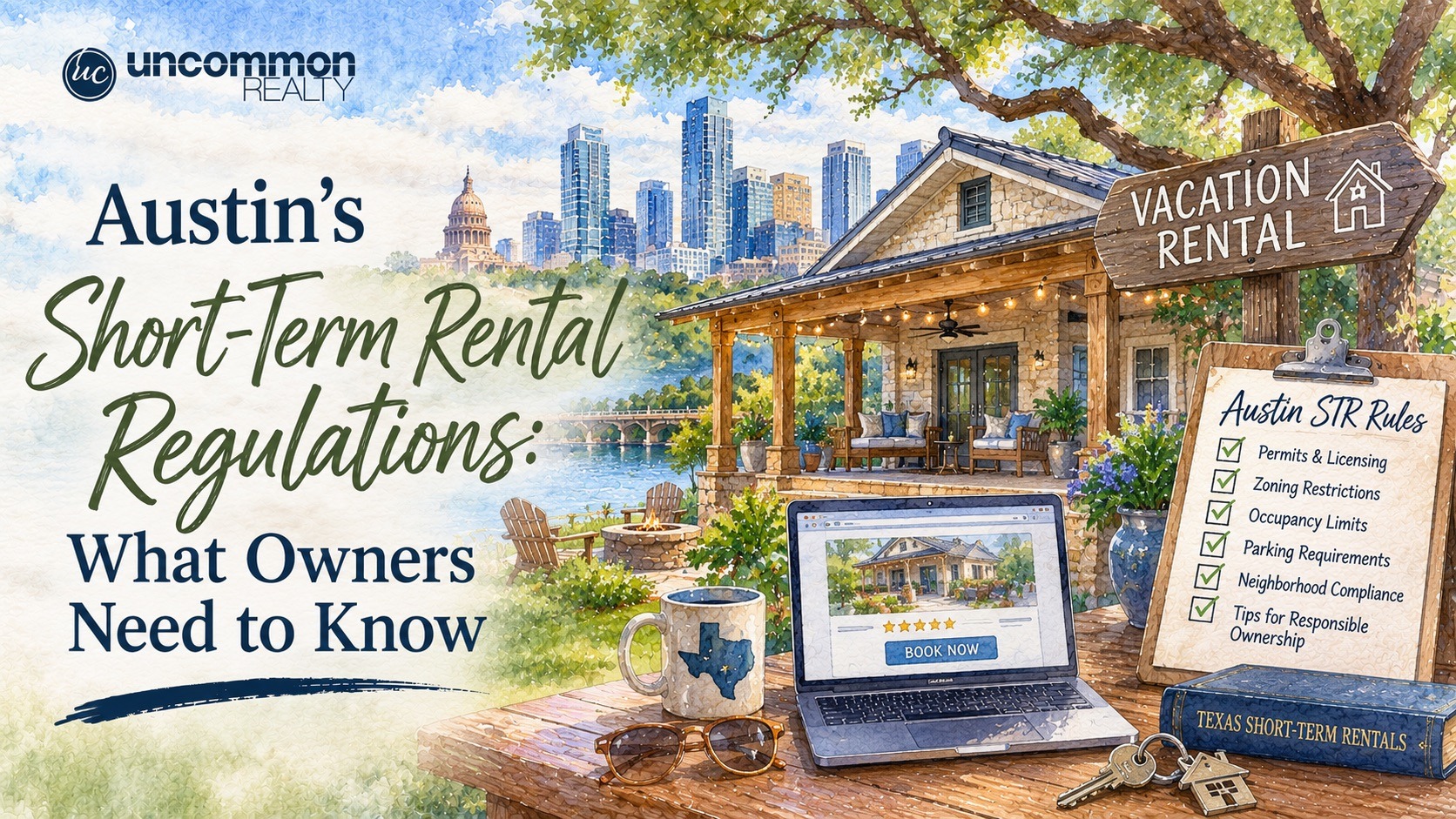
The Short Version: How Austin Regulates Short-Term Rentals
Austin defines a short-term rental as a residential property rented out for less than 30 consecutive days. Anyone operating one, whether it’s a spare room or a whole house on Airbnb or Vrbo, needs an active license issued by Austin Development Services. This applies regardless of whether you live at the property or not.
For years, the city ran its STR program through the zoning code, which is where the old “Type 1” and “Type 2” labels came from. Type 1 meant an owner-occupied property, and Type 2 meant a non-owner-occupied property, which came with tighter restrictions and, at times, an outright cap on new licenses in certain zones. As of October 1, 2025, the city restructured STR regulation as a business licensing program under Title 4 of the city code rather than a land-use classification. The practical effect is that the licensing process now centers on the operator and the property’s unit count rather than strictly on whether the owner lives there. Some application materials and city staff may still reference the older Type 1, Type 2, and Type 3 terminology during the transition, so if you see those terms on a form, don’t assume they work exactly the way they did a few years ago. Confirm directly with the city which category applies to your property before you submit anything.
Why the Rules Keep Changing: A Quick Legal History
Austin’s STR ordinance has been in court more than once, and that history explains why the current rules look different from what many owners remember. In 2019, the Third Court of Appeals ruled in Zaatari v. City of Austin that the city’s ban on new non-owner-occupied rentals, along with its restrictions on gatherings at STR properties, was unconstitutional. That ruling struck down the outright prohibition on new Type 2 licenses and the sweeping assembly bans that had been part of the 2016 ordinance.
Then in 2023, a federal case known as the Anding case went further, with a U.S. District Court in Austin striking down the city’s requirement that STR operators claim a homestead exemption on the property in order to qualify for certain license types. Together, these rulings made it much harder for the city to treat owner-occupancy as the deciding factor for whether a rental could legally operate. That’s a big part of why Austin shifted toward a business-licensing model built around unit counts, spacing, and operator accountability instead of owner-occupancy status. I mention this because it matters for owners: rules that felt permanent in 2018 or 2019 may no longer apply, and the pace of change here has been unusually fast for a Texas city.
How to Apply for an Austin STR License
Applications go through Austin’s online licensing portal rather than a paper process. Here’s the general flow based on the city’s current published requirements:
- Submit your application and supporting documents through the city’s online licensing system for the applicable STR category.
- Email a copy of the property owner’s government-issued ID to the city’s STR documentation address. If the mailing address on the ID doesn’t match the rental property address, you’ll need to note that in your email.
- If you’re not the owner, such as a property manager or a leasing agent applying on the owner’s behalf, you’ll need a notarized Agent Authorization Form signed by the owner that names everyone authorized to act on their behalf.
- Pay the application fee by credit card or e-check.
- Wait for review. Processing has generally run somewhere in the range of four to ten weeks depending on whether the property is a single-family home or part of a multi-family building, so this isn’t something to start the week before you plan to list.
Once approved, the city emails your operating license and any required postings to the address on file. As of the 2025 licensing overhaul, licenses are valid for two years rather than the previous one-year term, and current published fees are roughly $836 for a new application and about $385 for a renewal. I’d treat those numbers as a planning estimate rather than gospel, because fee schedules are exactly the kind of detail that gets adjusted with little notice. Always check the live fee schedule on the city’s licensing portal before budgeting.
Newer requirements also include naming a local contact person who lives within the greater Austin metro area and who can respond to emergencies at the property within a couple of hours, any time of day. This isn’t optional paperwork. It’s meant to give the city and neighbors a real point of contact if something goes wrong at a rental that isn’t owner-occupied.
Occupancy, Density, and Spacing Rules
Rather than capping licenses by zoning district the way the old ordinance tried to, current rules tie the number of STRs an operator can run to how many units exist on the property:
- On a single-family home or duplex site, an operator can generally hold up to two STR licenses.
- On a multi-family property with four or more units and no commercial component, an operator can run the greater of one unit or roughly 10 percent of the units they own or lease.
- If the multi-family property also has a commercial use on site, that share can rise to roughly 25 percent of units.
- If a single operator holds STR licenses at more than one property, those properties generally need to be at least 1,000 feet apart. This spacing rule applies to one operator’s portfolio, not to different owners operating near each other.
These caps are worth understanding before you buy, especially if your plan involves multiple units or a small portfolio rather than a single property, since the math changes quickly once you’re above the single-family threshold.
Noise, Parking, and Neighbor Rules
Austin doesn’t ban gatherings at STRs outright anymore, since that was one of the pieces struck down in the Zaatari ruling, but it does enforce specific sound limits. Roughly speaking, current rules restrict sound to about 75 decibels at the property line between 10 a.m. and 10 p.m., prohibit any audible sound crossing the property line between 10 p.m. and 10 a.m., and separately restrict musical instruments that are audible to neighbors between 10:30 p.m. and 7 a.m. If you’re marketing a property for events or larger groups, build your house rules around these hours rather than assuming anything goes as long as it’s indoors.
Neighbor notification is also part of the process. The city notifies nearby property owners when a new license is issued, and under the current rules that notification now happens again at each renewal, not just at the initial application. If you’ve had complaints in the past, expect your neighbors to know when you’re coming up for renewal.
Parking rules tend to be handled at the property or HOA level more than through the STR ordinance itself, so I always tell buyers to check deed restrictions and HOA rules separately from the city’s licensing requirements. A property can be fully compliant with the city and still run into a parking dispute with a neighborhood association.

Penalties for Operating Without a License
Running an STR without an active license is not a paperwork technicality the city ignores. Published penalties include fines around $500 per day, with each day of continued operation treated as a separate violation, plus the possibility of license revocation and a waiting period, reportedly around 12 months, before a property tied to repeated nuisance complaints can reapply.
Enforcement has picked up meaningfully. The city has been cross-referencing STR platform listings against its license database and has flagged thousands of addresses operating without a valid license. Starting mid-2026, platforms like Airbnb and Vrbo are expected to display license numbers directly in Austin listings and to begin removing unlicensed properties from their sites at the city’s request. If you’re buying a property with an existing STR history, confirm its license status directly with the city rather than trusting a listing description, since a property can look established online while quietly operating out of compliance.
Taxes: Hotel Occupancy Tax Basics
Short-term rentals in Austin owe Hotel Occupancy Tax, commonly called HOT, on top of any licensing requirements. The combined rate for direct bookings, meaning reservations that don’t go through a platform, runs around 17 percent, made up of the city’s 11 percent and the state’s 6 percent. For bookings made through major platforms, the platform now collects and remits the city’s portion automatically at checkout, which has simplified things for a lot of owners, but you’re still generally responsible for filing your own returns and keeping records even when a platform handles collection. I’d treat tax questions like this as a conversation for your CPA rather than something to piece together from a blog post, since penalties for underreporting hotel tax can add up fast.
What This Means If You’re Buying an STR Property in Austin
If you’re shopping for an investment property with short-term rental income in mind, the licensing and spacing rules should factor into your due diligence just as much as the numbers on a pro forma. Before you write an offer, I’d want to know whether the property already has an active license, what category it falls under, whether it sits within 1,000 feet of another property the seller or a prior owner licensed, and whether the neighborhood has an HOA with its own STR restrictions that are separate from the city’s rules entirely. Some HOAs in the Austin area prohibit short-term rentals outright regardless of what the city allows, so city compliance alone doesn’t guarantee you can operate.
I work with buyers across a range of neighborhoods and price points, and STR strategy shows up in a good number of those conversations. If you want a sense of the areas I cover and how local market conditions vary block to block, my Austin, TX area page is a good starting point. And if you’d like to know more about how my team operates day to day, you can read about Uncommon Realty.
Verify Before You Rely on This
I’ve done my best here to reflect Austin’s current STR rules accurately, sourced from the city’s own licensing information and recent coverage of the 2025 ordinance changes. That said, municipal ordinances change, sometimes quickly, and this is an area of city code that has already been rewritten multiple times in the past few years following court rulings. Before you apply for a license, close on an STR property, or make a business decision based on any figure in this article, confirm the current requirements directly with the City of Austin’s short-term rental licensing office through austintexas.gov, or have your real estate attorney review the current ordinance language. Treat this as a starting point for your research, not a substitute for it.
If you’re weighing an STR purchase in Austin and want to talk through what a property’s compliance picture looks like before you make an offer, I’m happy to walk through it with you.
Robbie English, REALTOR, Broker at Uncommon Realty.
You Might Also Find These Helpful
- get in touch with Robbie English
- Can the Listing Agent Just Represent the Buyer Too?
- Texas Is A Non-Disclosure State
- Understanding the Real Estate Contract in Texas
Worth a look if you’re still researching this: How Apartment Locator Services Work in Austin, TX.