I get asked about Halloween more than you’d think for a real estate broker. Buyers touring homes in September and October will stop mid-showing and ask whether a street does anything for the holiday, or whether a neighborhood has a reputation for it. It’s a fair question. How a street handles one night in October tells you something about how people there use their yards, their sidewalks, and each other. I’ve sold houses on streets that shut down for Halloween and houses on streets where nobody notices the date at all, and both are legitimate ways to live. This guide is what I actually tell people when they ask, based on what I’ve seen walking these streets myself and what’s been documented by local coverage over the years.
TLDR (Too Long; Didn’t Read): Your guide to Halloween in Austin
- Several Austin neighborhoods have built real Halloween reputations over the years, from Hyde Park’s older streets to Travis Heights’ house-by-house decorating and Cherrywood’s block parties
- Sixth Street’s Halloween night is its own tradition entirely, an adults-only street closure that has nothing to do with trick-or-treating and everything to do with Austin’s costume culture
- Mueller runs an organized trick-or-treat trail through its retail district, which is a different format than walking a residential street
- Pumpkin patches and fall festivals in Georgetown, Leander, Manchaca, and Uhland give the whole region options outside the city limits
- The Texas Book Festival lands on the Capitol grounds in the weeks around Halloween most years, so late October and early November get busy on the calendar if you live downtown or nearby
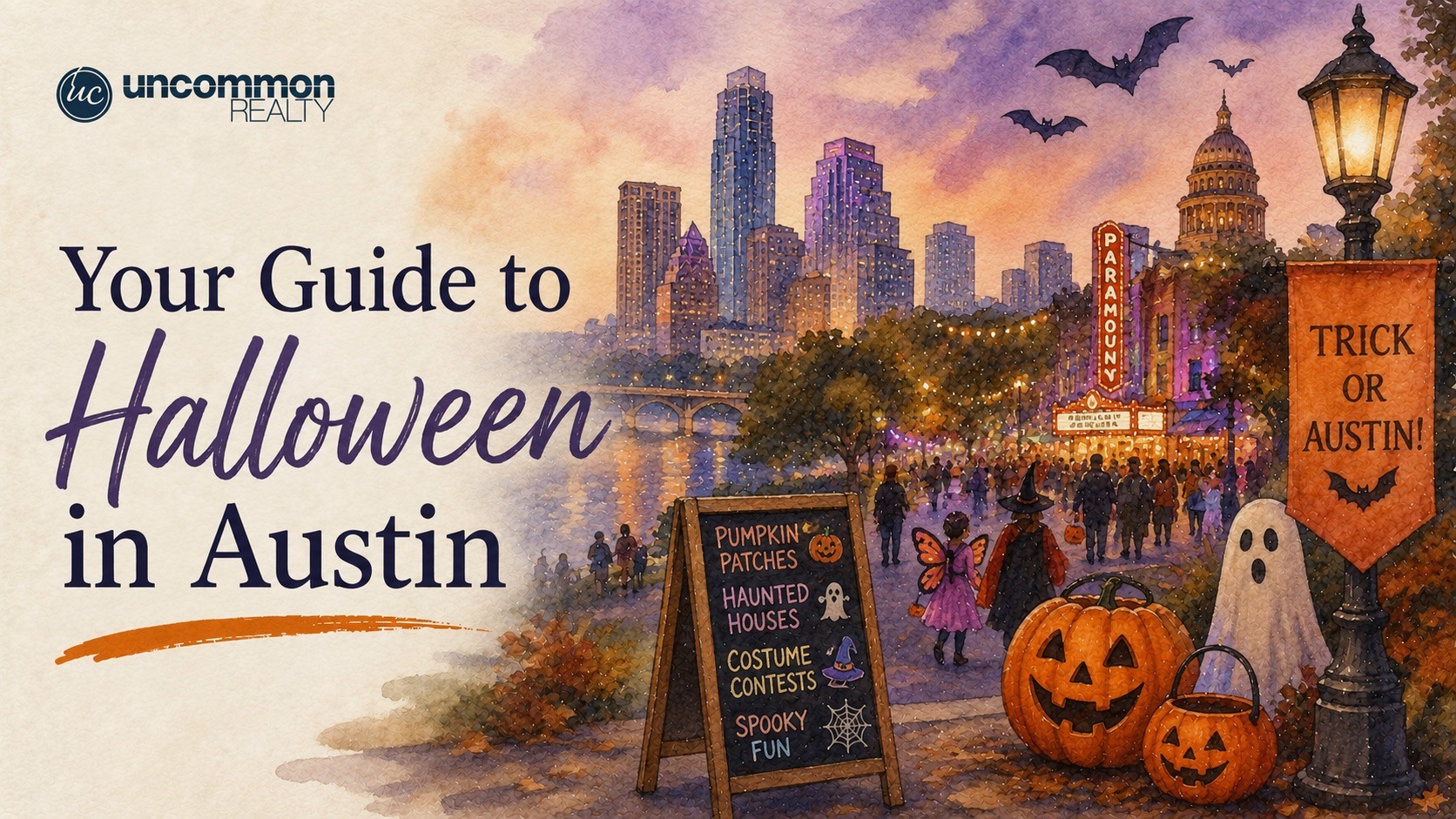
Neighborhoods where Halloween is a whole event
Austin doesn’t have one official Halloween neighborhood. It has a handful of pockets where the tradition built up over decades because the physical layout and the decorating habits reinforced each other. Here’s what I know about the ones that come up most often.
Hyde Park
Hyde Park is one of Austin’s oldest planned neighborhoods, and its grid of shaded streets and older bungalow-style homes has made it a long-running center of Halloween decorating and trick-or-treating. The lots are close together and the sidewalks are continuous, which matters more than people think. A kid can cover a lot of doors on foot in a short stretch without crossing a lot of side streets.
Travis Heights
South of the river, Travis Heights has a reputation for houses that go well past a few pumpkins on the porch. The homes here vary in age and architectural style more than in most planned subdivisions, and that variety shows up in how people decorate. Some streets end up with a real concentration of elaborate yard displays, which pulls foot traffic in from outside the immediate blocks.
Cherrywood
Cherrywood is known for shutting down streets on Halloween night and turning them into block parties, with neighbors setting up outside rather than just handing out candy at the door. That’s a different kind of event than a typical trick-or-treat route. It’s organized around the street itself as a gathering space.
Zilker
In Zilker, Ford Street has a track record of closing to car traffic for Halloween and bringing in food trucks for the evening. Zilker’s a smaller neighborhood tucked between Barton Springs and the greenbelt, so a single street closure has an outsized effect on how the whole area feels that night.
Mueller
Mueller runs things differently. Instead of a residential trick-or-treat route, the retail district hosts an organized trail where kids collect candy from participating storefronts. If you’re picturing a neighborhood built around a walkable town center rather than a subdivision, that’s Mueller, and its Halloween event reflects that layout.
Circle C and Allandale
Circle C, out in southwest Austin, has hundreds of homes across a large footprint, and enough of them participate in decorating that it’s become known as a destination within its own part of the city. Allandale, closer to central Austin, has tree-lined streets and a long-standing reputation for high participation in handing out candy. Both are worth knowing about if trick-or-treating turnout is something you care about when picking a street, not just a neighborhood name.
If you’re comparing areas like these against each other, it helps to look at the broader picture first. I keep a rundown of Austin neighborhoods that goes beyond any single holiday and covers the things that actually affect day-to-day life on a street.
Sixth Street’s Halloween night is its own tradition entirely
Everything above is about residential streets and kids with candy buckets. Sixth Street on Halloween night is a separate thing altogether, and it’s worth understanding as its own tradition rather than confusing the two.
Sixth Street closes to vehicle traffic from Brazos to Red River every October 31st, and the block fills with adults in costume. This has been building since the 1980s, growing from a smaller gathering into one of the larger costume street parties in the region. There’s even a documentary from 2010 about the phenomenon. It’s downtown bar culture wearing a costume, not a neighborhood event, and it draws people from across the metro and beyond for one night.
If you’re evaluating downtown living, this is a real factor to weigh. A condo a few blocks from Sixth Street means one loud, crowded night a year on top of the usual weekend bar noise. For some buyers that’s part of the appeal. For others it’s a reason to look a little further out. Either way, it’s worth knowing before you sign, not after.
Pumpkin patches and fall festivals outside the city
A lot of the fall activity people associate with Austin actually happens outside the city limits, on working farms and open land where a pumpkin patch has room to spread out.
- Sweet Eats Fruit Farm in Georgetown runs a corn maze, a petting zoo, and pumpkin picking from late September through early November
- Indian Springs Ranch in Manchaca, just south of Austin, has more than 30 pumpkin varieties along with a low ropes course and barnyard animals
- Texas Pumpkin Fest in Leander covers ten acres with live music and food vendors from early October through the start of November
- Uhland Fall Fest, about 25 miles south near Kyle, sets up on a historical farmstead with a dozen themed zones and runs weekends through the same stretch
These are worth knowing about regardless of where in the metro you end up. If you’re weighing a home in Georgetown against one closer to central Austin, proximity to something like this probably isn’t the deciding factor, but it’s a nice detail to have when you’re picturing what a fall weekend actually looks like from a given address.
The Texas Book Festival lands in the same stretch of the calendar
One thing that catches people off guard: the Texas Book Festival usually takes place on the Capitol grounds in the weeks around Halloween, often in early to mid-November. It’s free, draws a large number of authors, and takes over the streets around the Capitol for a weekend. If you live or work downtown, that means late October through early November can bring two separate waves of street closures and foot traffic, Halloween on Sixth Street and the festival a couple weeks later. Neither one should scare anyone off downtown living, but if you’re the type who likes to plan around road closures, it’s worth marking on the calendar.
Why I bring this up when people ask about neighborhoods
None of this is really about Halloween. It’s about what a street tells you when you watch how people use it. A neighborhood where residents shut down a block and set up food trucks together is telling you something about how connected that street is. A neighborhood where the sidewalks are continuous enough for a long trick-or-treat loop is telling you something about how it was built. Even a downtown block that goes wild one night a year is telling you what to expect the rest of the time, just at a smaller volume.
I’ve been walking these streets and selling homes on them long enough to have opinions about which ones fit which kind of life, and Halloween is just one lens I use to talk about it. If you want to go deeper on any of the neighborhoods mentioned here, or you’re trying to figure out which part of Austin actually matches how you want to live, I’d rather talk it through than have you guess from a listing photo. You can read more about how I work on my about page, and about the brokerage I work under at Uncommon Realty.
Robbie English, Broker, REALTOR at Uncommon Realty.