I get asked about Great Hills often enough that I wanted to put together a real guide to it, not a rehash of listing descriptions. I’m Robbie English, REALTOR and broker at Uncommon Realty, and I’ve shown and sold homes across this part of Austin for years. Great Hills is one of those neighborhoods people drive through and immediately start asking questions about. This guide covers what the area actually looks like day to day, from the terrain and home styles to schools and getting around.
TLDR (Too Long; Didn’t Read): Living in Great Hills, Austin TX
- Great Hills sits in Northwest Austin along the Highway 183 and Loop 360 corridor, with rolling terrain and mature tree cover throughout.
- Most homes date to the 1970s through the 1990s, ranging from ranch-style and hi-ranch construction to larger Mediterranean and Spanish-influenced houses built more recently.
- Great Hills Park covers more than 80 acres in the Bull Creek watershed, and the private Great Hills Country Club anchors the neighborhood with an 18-hole golf course built in 1973.
- The neighborhood splits between Austin ISD and Round Rock ISD depending on the specific street, so I always confirm zoning before a client makes an offer.
- The Arboretum and The Domain are both a short drive away for shopping, dining, and everyday errands, with quick access to 183, Loop 360, and MoPac.
Where Great Hills Sits in Austin
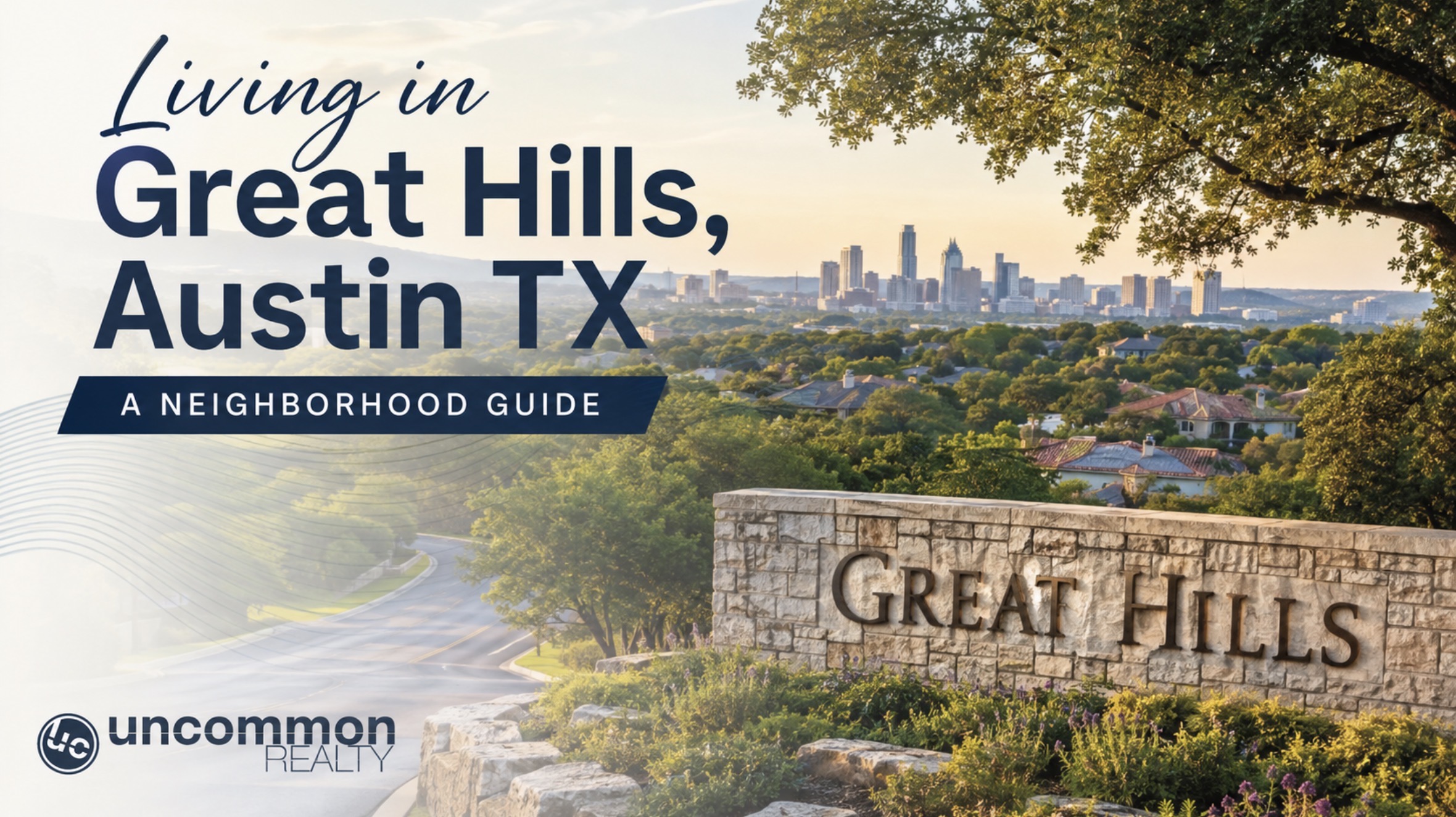
Great Hills is a Northwest Austin neighborhood built along the intersection of Highway 183 and Loop 360, also called the Capital of Texas Highway. The neighborhood spans both sides of 360 between Spicewood Springs Road and 183, though most people picture Great Hills as the section north of 360 and west of 183. The name fits. This part of Austin sits on genuinely hilly ground, and the streets curve and climb through the terrain rather than running in a flat grid.
The neighborhood developed starting in the early 1970s and kept building out through the 1990s, with pockets of newer construction added in the 2000s. That development timeline means Great Hills has mature landscaping and established tree canopy that newer Austin neighborhoods simply don’t have yet. Lots tend to be generous, and the rolling grade means a lot of homes have some elevation to work with, whether that’s a walkout basement, a sloped backyard, or a view of the hills beyond.
The Homes in Great Hills
Home styles in Great Hills reflect the decades it was built out. The earliest homes lean Southwestern ranch, single story with low rooflines and wide lots. Through the 1980s and into the 90s, builders added hi-ranch and split-level designs, along with two-story traditional homes. More recent construction, some from the 1990s forward, brings in larger footprints with Spanish, colonial, and Mediterranean influences, stucco exteriors, and tile roofs.
Square footage across the neighborhood generally runs in the 2,500 to 3,000 square foot range, though you’ll find smaller original homes and larger custom builds on the larger lots. Because the neighborhood has been around for decades, plenty of homes have been through at least one round of updates, so buyers see everything from untouched original interiors to full renovations. Lot shapes and sizes vary quite a bit too, since builders worked around the natural grade instead of flattening it, so you’ll see everything from fairly level cul-de-sac lots to steeper parcels with a walk-out lower level or a stepped backyard.
Kitchens and bathrooms are usually the first things buyers ask about when they’re comparing an original 1970s home to something updated in the last decade. In an original kitchen, expect closed floor plans, smaller windows, and finishes that match the build era. In an updated home, you’ll often see opened-up living areas, larger windows that take advantage of the hillside views, and finishes brought current. Neither approach is right or wrong, it just changes what a buyer should budget for after closing. If you’re comparing Great Hills to other established Northwest Austin neighborhoods, I’ve also written about Northwest Hills, which shares some of the same rolling terrain and older tree cover a bit further south.
Great Hills Park and the Country Club
Great Hills Park is the neighborhood’s main public green space, covering more than 80 acres within the Bull Creek watershed. It’s a wooded, hilly tract with trails that follow the natural drainage through the area, and it gives residents a genuine patch of undeveloped land within a few minutes of home.
The other anchor is Great Hills Country Club, a private club built in 1973 with an 18-hole golf course designed by PGA player Don January and architect Billy Martindale. The front nine runs along open ridgelines with wide views of the surrounding hills, and the back nine follows creeks and streams through more wooded terrain. The club also has tennis facilities and hosts member social events. It’s a private, member-owned club, so access for non-members is by invitation only, but its presence shapes a good part of the neighborhood’s layout and views even if you’re not a member yourself.
Shopping, Dining, and the Arboretum
The Arboretum shopping center sits just southeast of Great Hills and has been a fixture of Northwest Austin retail for decades. It’s an outdoor center with a mix of restaurants, retail shops, a movie theater, and bookstores, and it functions as the everyday commercial hub for people living in the neighborhood.
The Domain is also close by, a short drive north along the 183 corridor. It’s a larger, more recently developed mixed-use district with additional shopping, dining, and office space. Between the two, Great Hills residents have a wide range of retail and dining options without needing to head into central Austin for routine errands.
Getting Around: Highways and Commute
Great Hills benefits from direct access to three major roads: Highway 183, Loop 360, and MoPac Expressway (Loop 1). That combination makes it straightforward to reach other parts of Northwest Austin, the Domain corridor, and the broader employment centers that have built up along the 183 and MoPac stretch over the years. A drive downtown typically runs somewhere in the 20 to 25 minute range depending on time of day, which is a reasonable commute by Austin standards.
Because the neighborhood sits right at a major highway junction, residents get quick highway access without living directly on top of it in most sections. The interior streets wind through the hills away from the main roads, which keeps the residential pockets quieter than the immediate highway frontage might suggest.
Schools Serving Great Hills
This is a detail I flag for every buyer looking at Great Hills, because the neighborhood is split between two school districts. Depending on the specific street, a home in Great Hills is zoned to either Austin Independent School District or Round Rock Independent School District, so I always confirm the exact zoning for a given address rather than assuming based on the neighborhood name alone.
In the Austin ISD sections, closer to Great Hills Park, students are zoned to Hill Elementary School, Murchison Middle School, and Anderson High School. In the Round Rock ISD sections, students attend Caraway Elementary School, Canyon Vista Middle School, and Westwood High School. All of these campuses carry strong academic ratings, and Westwood High School in particular has drawn statewide recognition for its academic programs. If school zoning matters to your search, I’d rather walk through the boundary maps with you directly than have you guess from a listing description.
The Current Great Hills Market
Great Hills is an established neighborhood, which shapes how the market behaves. Inventory tends to be a mix of original condition homes priced for updates and renovated properties that have already had the work done. Because lots and homes vary so much in age and size across the neighborhood, pricing a home here takes more than pulling a flat per-square-foot number. A 1970s ranch on a wooded lot and a newer Mediterranean-style build a few streets over can sell in very different ranges even though they’re both technically “in Great Hills.”
Demand tends to stay steady given the location. The combination of highway access, established tree cover, proximity to the Arboretum and the Domain, and the split school zoning options all factor into how a given property is positioned. Because the neighborhood was built out over roughly three decades, comparable sales research takes some care. I typically pull comps by build era and lot type rather than just drawing a boundary around the neighborhood name, since a renovated hi-ranch and an original ranch-style home a block apart can move at meaningfully different price points.
Sellers in Great Hills also benefit from being specific about what makes their property stand out, whether that’s a recent renovation, a larger lot, a quieter interior street away from 183, or proximity to Great Hills Park. Buyers, on the other hand, do well to walk a handful of homes across different price points before deciding what tradeoffs matter most to them, since the neighborhood offers a wide enough range that comparing only two or three listings rarely tells the full story. If you’re weighing a purchase or a sale in Great Hills, I’d rather look at the specific street and school zone with you than speak in neighborhood-wide averages that won’t reflect your actual property.
Is Great Hills Right for You?
Great Hills works well for anyone who wants established tree cover, hilly terrain, and quick highway access without giving up proximity to Austin’s core retail and dining corridors. It’s not a neighborhood built around one particular home style or one particular decade, so there’s real variety block to block. The school district split is the one detail that trips people up most often, and it’s worth sorting out early in a search rather than after you’ve fallen for a specific house.
If you want to walk through specific streets, school zones, or current listings in Great Hills, reach out and I’ll go through it with you directly. You can read more about my background on my about page, and more about how Uncommon Realty approaches representation for buyers and sellers across Austin.
Robbie English, REALTOR, Broker at Uncommon Realty.