I get a version of the same question every time someone drives out to Horseshoe Bay for the first time: is this actually a real town, or is it just a resort with a zip code? It’s a fair question, because the golf and the yacht club are what get people out here in the first place. But once I start walking buyers through the different sections, some quiet and wooded, some tucked behind a marina, some built around a 55+ clubhouse, they start to see it’s a real community with real neighborhoods, not one homogenous resort. It just happens to be a community that was built on top of a resort, which is a different thing than most Hill Country towns.
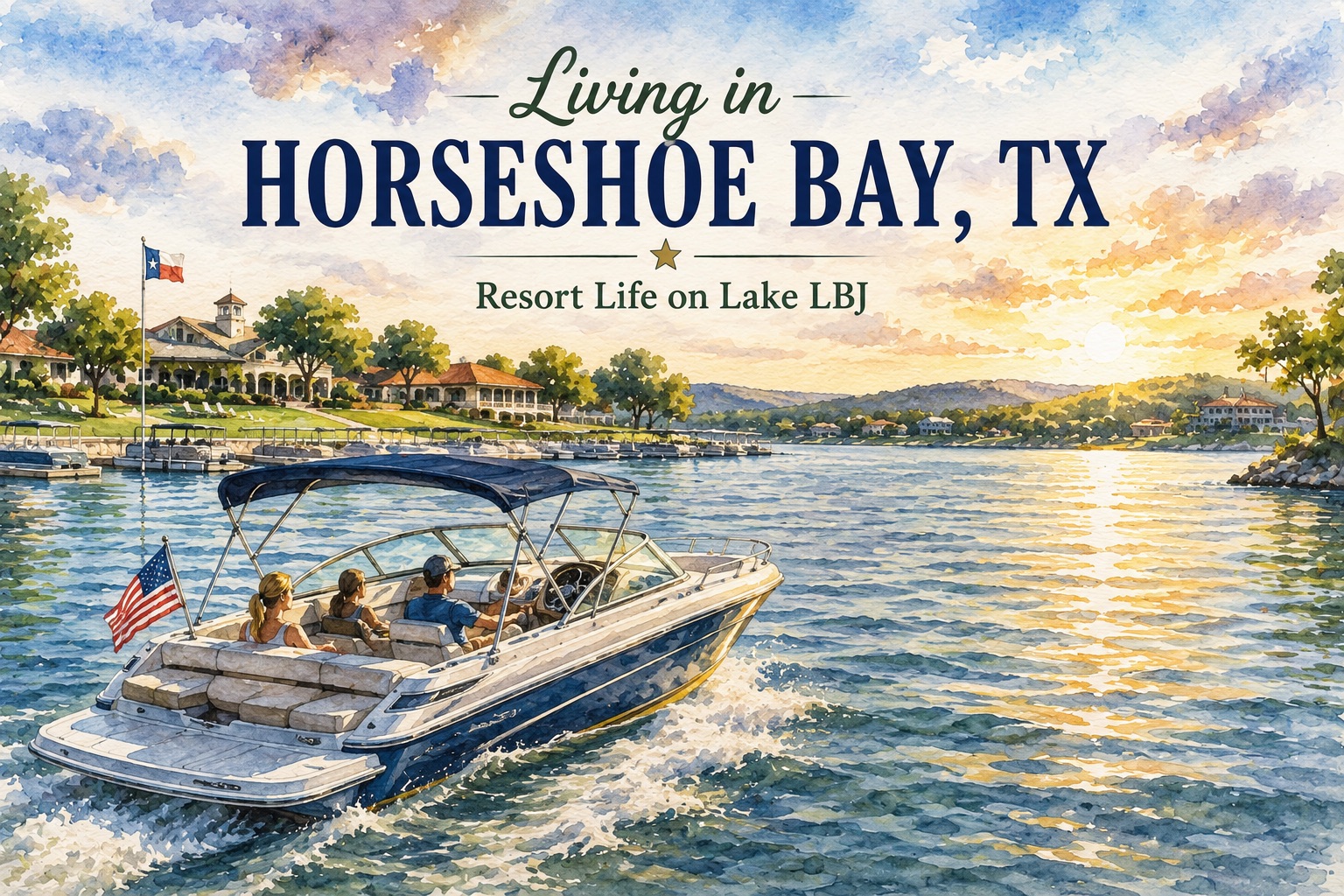
TLDR (Too Long; Didn’t Read): Living in Horseshoe Bay, TX
- Horseshoe Bay sits on Lake LBJ, straddling Llano and Burnet counties, about 52 miles west of Austin
- It started as a resort development in 1971, built around a yacht club, marina, and golf courses before there was much of a town around it, and it didn’t incorporate as a city until 2005
- Depending on the exact address, kids attend either Marble Falls ISD or Llano ISD, so confirming the district is one of the first things to check on any specific property
- There’s no single citywide HOA. Horseshoe Bay is broken into roughly twenty separate POA sections, each with its own rules, including on short-term rentals
- Golf is central to daily life here, with several resort courses known locally as the “Texas Triangle” and Summit Rock, a Jack Nicklaus Signature course, carrying a members-only feel
- Horseshoe Bay tends to suit retirees and second-home buyers who want a resort lifestyle with real infrastructure behind it, and it’s a tougher fit for anyone who wants a walkable small-town feel or needs to avoid POA rules and dues altogether
Where Horseshoe Bay Sits and What the Commute Looks Like
Horseshoe Bay sits on the southern shore of Lake LBJ, and the city limits actually straddle two counties. Most of the community is in Llano County, with a slice extending into Burnet County. That county line runs right through parts of the city, which is a detail worth knowing if you end up comparing tax rates or permitting rules between two properties that otherwise look similar.
For anyone commuting into Austin, it’s about 52 miles out, and depending on where you’re headed downtown or in the northwest suburbs, that’s roughly an hour to an hour and fifteen minutes on Highway 71. Most of my Horseshoe Bay buyers aren’t making that drive daily. They’re retirees, second-home owners, or remote workers who value the lake and golf lifestyle over a short commute. Marble Falls is the closer, more practical option for groceries, a hospital, and day-to-day errands, and it’s a short drive up 1431 or across the lake from most parts of the community.
How Horseshoe Bay Got Its Start
Horseshoe Bay is young by Hill Country standards, and it didn’t grow up the way most Texas towns did. In March of 1970, Norman and Wayne Hurd bought what was then known as the Coke Ranch, and by May of 1971 development was underway. The name itself came out of a bit of luck: while the Lower Colorado River Authority had Lake LBJ drawn down roughly 31 feet for power plant construction, Wayne Hurd found a rusty horseshoe sitting on the exposed lake bottom. Between that and the naturally horseshoe-shaped bay carved by Horseshoe Creek, the name stuck.
The resort came first, and the town came later. Construction in the early 1970s started with condominiums, a yacht club, a marina, stables, an airstrip, a lighthouse, and an entry gate before there was much of anything else out here. Slick Rock Golf Course opened in 1972 and 1973, and it’s still known for its “Million Dollar Hole,” where the cart path runs underneath a waterfall. For the next two decades, Horseshoe Bay grew almost entirely around retirees and resort visitors rather than a working local economy, and residents didn’t formally incorporate as a city with its own mayor and council until 2005. That order of operations, resort infrastructure first and municipal government decades later, still shows up in how the community is organized today.
Lake LBJ, the Marinas, and Life on the Water
Lake LBJ is the reason most people end up here, and it’s worth understanding why locals talk about it differently than they talk about Lake Travis. LBJ is a constant-level lake managed by the LCRA, which means the water stays at a steady line year-round instead of getting drawn down in dry summers. If you’re buying anything with a boat dock, that’s a real practical advantage over a lake that can leave a dock sitting on dry ground during a drought year.
Horseshoe Bay has two working marinas that anchor daily life on the water: the Horseshoe Bay Resort Marina on the south shore, which serves the resort and yacht club directly, and Blue Lake Marina, which serves the Blue Lake Estates side of the community. Between the two, boat storage, fuel, and slip access are a normal part of owning here rather than something residents have to drive elsewhere for. Bay View Restaurant, right on the water, is where a lot of residents end up for a lakefront dinner, and it’s usually the first place I mention when someone asks where to eat that actually has a view.
Schools
Because Horseshoe Bay straddles two counties, it’s also split between two school districts, and which one applies depends entirely on the specific address. Part of the community falls under Marble Falls ISD, and part falls under Llano ISD. I always confirm the exact district before a buyer gets attached to a property, since two homes a few streets apart can zone to different schools. Neither district is unusually large; both serve small to mid-size Hill Country communities rather than sprawling suburban enrollments, so this is a conversation worth having early if school assignment is a priority.
Golf, the Texas Triangle, and Summit Rock
If Lake LBJ is the reason people first look at Horseshoe Bay, golf is usually the reason they stay. The resort’s courses are collectively known around here as the “Texas Triangle,” and they’re built into the identity of the place in a way that goes beyond a typical amenity list. Summit Rock, a Jack Nicklaus Signature course, carries a members-only feel that’s noticeably different from the resort’s more publicly accessible courses. It’s the one locals bring up when they want to signal a certain level of exclusivity. Slick Rock, the original course from the early 1970s, still has its “Million Dollar Hole” with the cart path running under a waterfall, and it’s as much a piece of local history as it is a golf hole. For buyers who golf regularly, which section you land in changes how directly you can access which course, and that’s worth mapping out before you fall in love with a specific house.
The Sections of Horseshoe Bay
One of the first things I explain to buyers is that Horseshoe Bay isn’t one blanket HOA. It’s broken into close to twenty separate POA sections, each with its own rules, dues structure, and short-term rental policy. Some sections allow rentals outright, others restrict them, and a few ban them entirely, so if rental income is part of the plan, that’s one of the first documents I pull.
The community also breaks down into genuinely distinct neighborhoods, not just POA boundaries on paper. Horseshoe Bay West and Horseshoe Bay Proper are the two original halves of the resort. Escondido Golf & Lake Club is a newer, gated section built around its own golf course and private lake frontage, more self-contained than the older parts of the resort. The Trails sits away from the water in a quieter, more wooded setting, which appeals to buyers who want the Horseshoe Bay address without being on top of the lake traffic. Tuscan Village is a 55+ active-adult section, which matters immediately if you’re shopping for that stage of life. Bay Country and Golden Bear Reserve add more inventory closer to the golf courses, and on the water side, Applehead Island is a private, gated peninsula with some of the most exclusive real estate in the community, while Blue Lake Estates, on the Blue Lake Marina side, has its own nine-hole golf course and a more established, small-community feel dating back to the late 1960s. The Peninsula, a small gated enclave with fewer than a dozen waterfront estates, is about as exclusive as it gets. Listings there are scarce enough that they sometimes sell before ever hitting the open market. It’s a lot of names to keep straight, which is exactly why I walk every buyer through which section actually fits their budget and lifestyle before we start touring.
Who Horseshoe Bay Is a Good Fit For
I steer buyers toward Horseshoe Bay when golf and lake access are non-negotiable and they want real resort infrastructure, meaning marinas, a yacht club, and multiple golf courses, not just a house near water. It’s a strong fit for retirees and second-home buyers who like having dining and amenities close by, and increasingly for remote workers who want that lifestyle full-time rather than on weekends.
It’s a tougher fit for buyers who want a walkable small-town center, since Horseshoe Bay’s identity is built around the resort and the water rather than a courthouse-square downtown. It’s also not the right call for anyone who bristles at HOA-style rules and dues, since virtually every section here has a POA with real authority over what you can and can’t do, including on rentals. And if budget is the main driver, it’s worth knowing the community generally runs at a different price point than nearby lake towns. Kingsland, further up Lake LBJ, is the more affordable option for buyers who want real lake access without the resort infrastructure and POA overhead that come with Horseshoe Bay.
If Horseshoe Bay sounds like the right fit, you can see current inventory on the Horseshoe Bay homes for sale page, or search all current listings here.