A good chunk of the calls I get about Burnet start from the same wrong assumption: people hear “Highland Lakes” and picture a town with docks and a shoreline, the same way Kingsland or Horseshoe Bay work. Burnet isn’t that. It sits back from the water, and once buyers understand why, it usually becomes the more interesting option rather than the disappointing one. Burnet is the Burnet County seat, a working town with a courthouse, a hospital, real schools, and enough everyday infrastructure that it doesn’t slow down in the off-season the way a resort town does. If someone wants Highland Lakes proximity but actually needs acreage, a workable Austin commute, or a town that functions the same in January as it does in July, Burnet tends to be the answer.
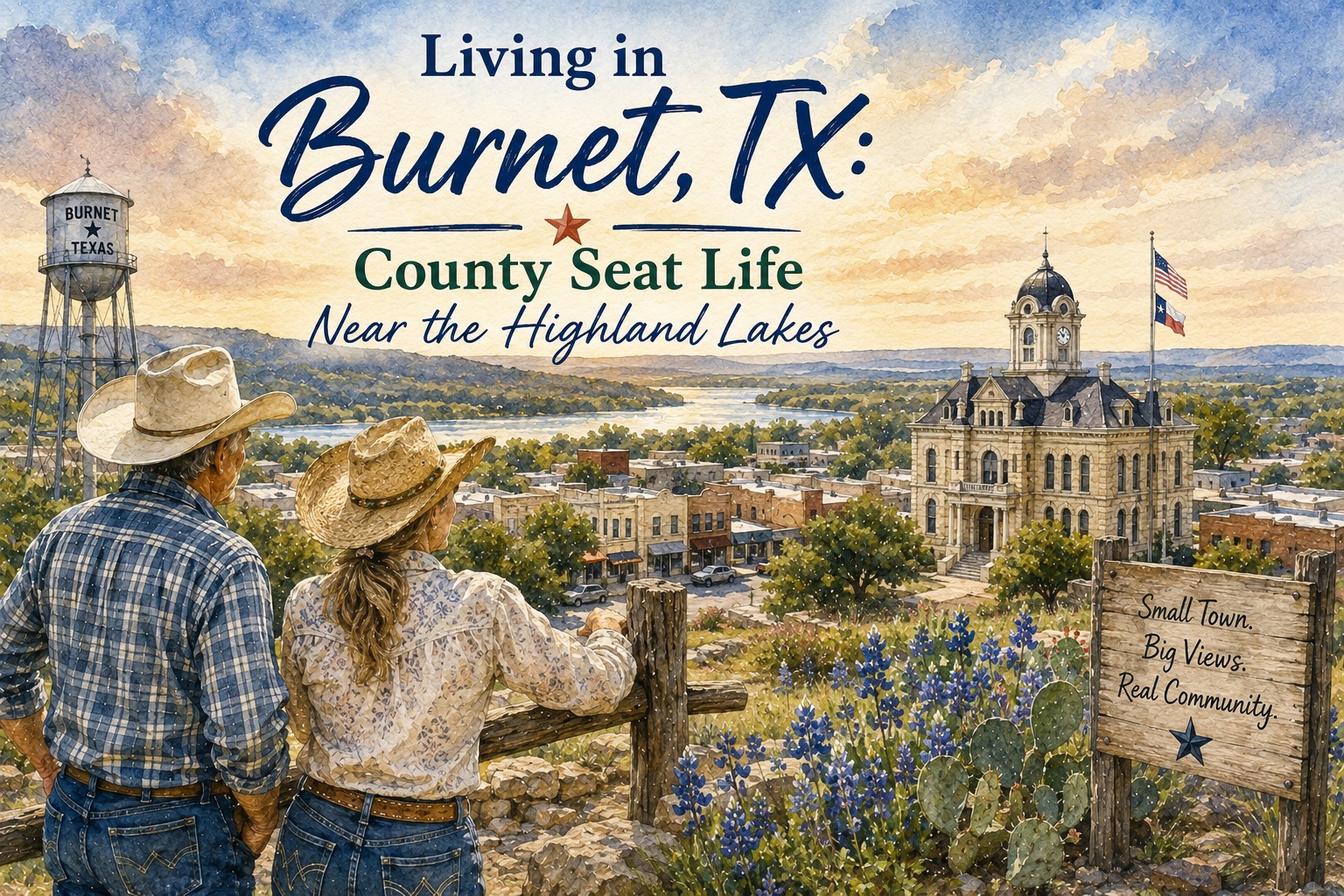
TLDR (Too Long; Didn’t Read): Living in Burnet, TX
- Burnet is the Burnet County seat, about 50 miles northwest of Austin, which makes for a workable but real commute rather than a short hop
- It’s called the gateway to the Highland Lakes, but Burnet itself isn’t waterfront; Lake Buchanan and Inks Lake are both a short drive away, not in town
- The town was founded as Hamilton in 1852 and renamed Burnet in 1858 for David G. Burnet, the first president of the Republic of Texas
- Population is around 6,900 as of 2025, small in size but functioning as the full-service hub for the surrounding county
- Kids attend Burnet Consolidated ISD, which runs Burnet High School, Burnet Middle School, and elementary campuses including Shady Grove and RJ Richey
- Burnet holds the official “Bluebonnet Capital of Texas” designation, granted by the Texas legislature in 1981 for the wildflowers that cover the area every spring
- Longhorn Cavern State Park and Inks Lake State Park are both close by, giving residents real state parks without an Austin-traffic drive to get to one
- Because its economy runs on government, schools, healthcare, and local commerce rather than tourism, Burnet doesn’t swing with the seasons the way a resort town like Horseshoe Bay does
Where Burnet Sits and What the Commute Actually Looks Like
Burnet sits about 50 miles northwest of Austin, mostly a drive up 183 or 71 depending on where you’re starting from. Figure on an hour or so each way under normal conditions, longer if you’re hitting Austin traffic at the wrong time. That’s not a commute I’d sell someone on if they need to be in a downtown Austin office five days a week. It’s a very different story for retirees, remote workers, or anyone who only needs to make that drive a couple of times a week, which describes a lot of the buyers I work with out here.
The town is genuinely positioned as the gateway into the Highland Lakes chain, but that phrase trips people up. Lake Buchanan sits north of town and Inks Lake is a short drive west, both close enough for a regular boating trip, but Burnet proper isn’t built along a shoreline the way Kingsland or Marble Falls is. What you get instead is a town with more room to spread out. Acreage and rural property that’s hard to find once you get closer to the lakeshore towns is still realistic here, which is a big part of why buyers end up choosing Burnet over its more water-adjacent neighbors.
A County Seat First, a Lake Town Second
Burnet started out as Hamilton, founded in 1852 when Burnet County itself was established. There was already another Texas town named Hamilton, so in 1857 a group of local residents petitioned the state legislature to change the name, and by 1858 the town became Burnet, named for David G. Burnet, who served as the first president of the Republic of Texas in 1836 and later as vice president under Mirabeau B. Lamar. That county-seat status is the throughline for almost everything else about how the town functions today. The Burnet County Courthouse still anchors the historic downtown square, and being the seat means Burnet carries the county’s day-to-day civic weight: courts, county offices, the main hospital serving this part of the Highland Lakes, and a broader base of local commerce that doesn’t depend on lake traffic to stay open.
That’s the real differentiator between Burnet and towns like Horseshoe Bay or Kingsland. Those places are built around vacation and second-home demand, and their local economies notice it when the season turns. Burnet’s economy is built on government, schools, healthcare, and everyday local business, so it holds a steadier, more year-round character all through the calendar.
Schools in Burnet
Kids in Burnet attend Burnet Consolidated ISD, a district that serves the city and the surrounding county. The high school lineup includes Burnet High School and the smaller Quest High School, feeding from Burnet Middle School and elementary campuses including Shady Grove Elementary and RJ Richey Elementary, along with a campus out in Bertram. It’s a rural, county-style district rather than a large suburban system, similar in scale to what you’d find in the other smaller Highland Lakes towns, but with the advantage of being centered in the county’s largest town rather than split across multiple small communities.
The Bluebonnet Capital, Fort Croghan, and the State Parks Nearby
Burnet holds an official state designation that a lot of Hill Country towns claim informally but don’t actually have on paper: the Texas legislature named it the “Bluebonnet Capital of Texas” in 1981, recognizing the wildflowers that blanket the fields around town every spring. It’s a real, legislated title, and it’s become the identity Burnet leans into every April with its bluebonnet festival downtown.
History runs deeper here than in a lot of the smaller lake towns nearby, mostly because Burnet predates most of them as an organized settlement. Fort Croghan, established in 1849 to protect frontier settlers, sits on the edge of town and is preserved today as a small history museum with original and relocated pioneer-era buildings. For state parks, residents don’t have to drive into Austin’s crowded park system to find one. Longhorn Cavern State Park, built around a natural limestone cavern the CCC developed in the 1930s, and Inks Lake State Park, known for its swimming and paddling access, are both close enough for a regular weekend trip rather than an occasional one.
What Living Here Actually Means Day to Day
The practical draw of Burnet is space. Because the town isn’t squeezed onto a lakeshore, there’s more acreage and rural property available here than in towns closer to the water, and that shows up in the kind of buyer I see moving here: people who want a few acres, room for animals or a workshop, or just distance between houses, without giving up a real town center with a hospital, schools, and a courthouse square. It’s a different lifestyle than buying a lake lot. You’re trading direct water access for land, for a lower cost of entry into acreage, and for a town whose economy runs on its own everyday business rather than a summer boating crowd.
Who Burnet Is a Good Fit For
I point buyers toward Burnet when they want genuine acreage or rural property, an Austin commute they’re willing to make a few times a week instead of daily, and a town with real infrastructure they can count on year-round. It fits retirees who want small-town pace with a hospital and services nearby, remote workers who don’t need a daily office commute, and anyone drawn to the Highland Lakes area who’s more interested in land than in a boat dock. It’s a weaker fit if direct lake or river access is the whole point of the move. For that, Kingsland or Horseshoe Bay will serve you better. It’s also not the place for someone who needs a short daily commute into downtown Austin, or who wants a dense walkable downtown with a wide restaurant scene; Burnet’s historic square is real but small. What Burnet does offer, better than most of its Highland Lakes neighbors, is the stability of a county seat and enough land to actually spread out on.
If you’re weighing Burnet against a true lake community, Living in Kingsland, TX covers the other side of that comparison.
If you want to see what’s actually available right now, you can search current listings here.