I get calls from buyers who found Jonestown on a map and want to know why it’s not on their radar sooner. Usually it’s the same story: they’ve been looking in Lakeway or Cedar Park, prices there make them wince, and then somebody mentions there’s a whole other lake town on the north shore of Lake Travis they never considered. I’ve written contracts on both sides of Jonestown’s city limits, and it’s one of those places where the reputation, quiet and a little sleepy, undersells what’s actually going on there. Here’s what I tell people who ask me about it.
TLDR (Too Long; Didn’t Read): Living in Jonestown, TX
- Small city of roughly 2,500 people on the north shore of Lake Travis in Travis County, about 25 to 28 miles from downtown Austin
- Commute to Austin runs 35 to 45 minutes depending on time of day, mostly via RM 1431 and US-183
- Split school zoning: parts of the city fall in Lago Vista ISD and parts fall in Leander ISD, so you have to confirm the exact address before you fall in love with a house
- Jones Brothers Park is the anchor of the town, with public boat ramps, ball fields, a playscape, and a trail connecting to Fireman’s Park
- Housing generally runs more affordable than Lakeway or the Cedar Park lake-adjacent pockets, with a mix of older lake cottages, newer builds, and larger lots
- Best fit for buyers who want lake access and small-town pace without paying Lakeway prices, and who don’t mind a longer drive for restaurants and shopping
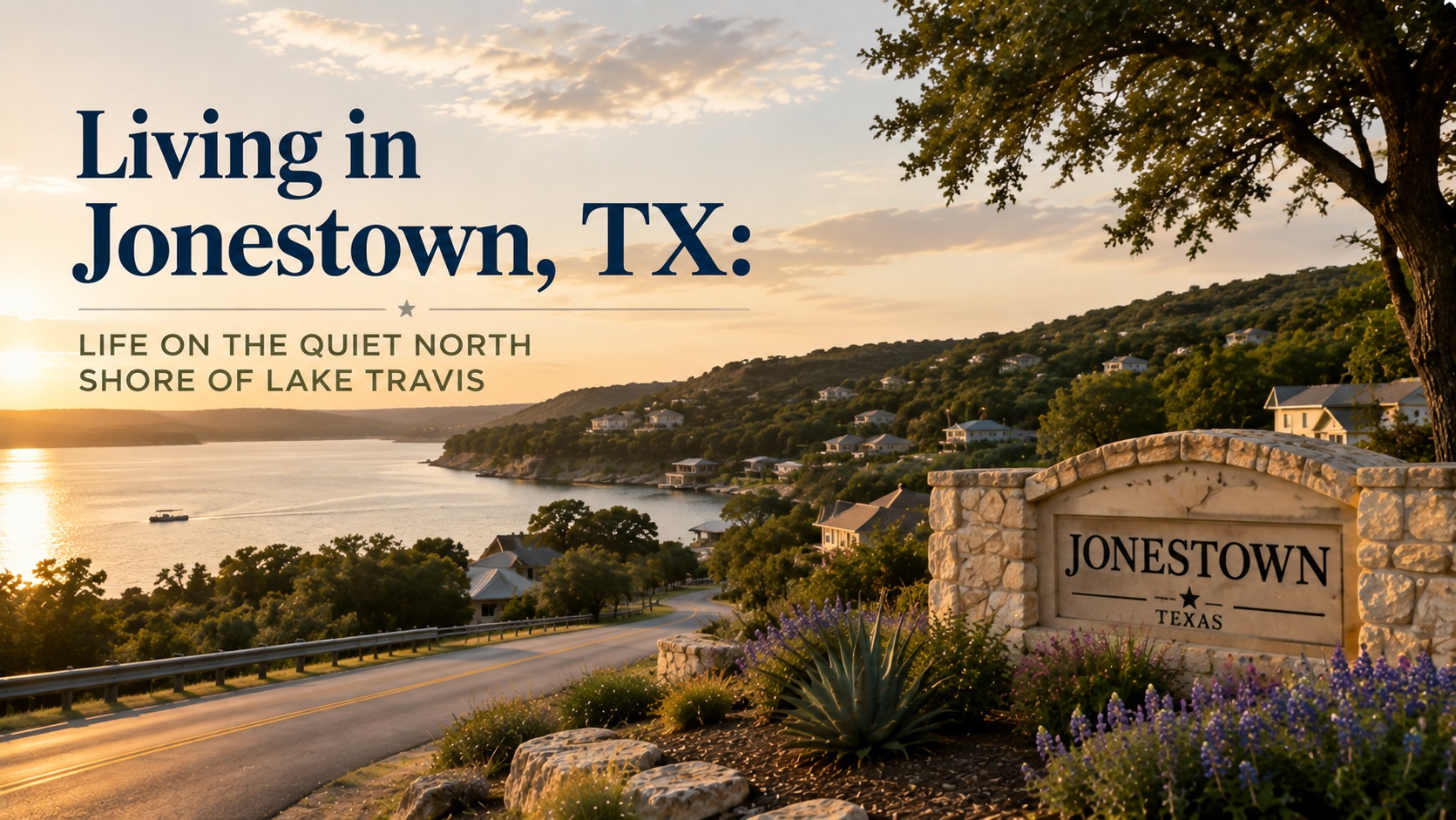
Where Jonestown Sits
Jonestown sits on the north shore of Lake Travis in Travis County, roughly 25 to 28 miles northwest of downtown Austin. The drive in follows RM 1431 down to US-183, and depending on when you leave you’re looking at anywhere from about 35 minutes on a light traffic day to closer to 45 minutes or more during rush hour. It’s not a short hop, and I’m upfront with every buyer about that before we tour a single house. If your job has you downtown five days a week, drive this route yourself at 7:30 in the morning before you commit to living out here. Numbers on a map don’t tell you what the traffic actually feels like at that hour.
That said, Jonestown isn’t isolated. Cedar Park is a reasonable drive to the east, Lakeway and the rest of the south shore lake communities are close by if you cross over, and Leander and its growing retail corridor aren’t far either. You’re trading a straight commute for a lake-community lifestyle, and most people who end up buying out here have already made peace with that trade before they call me. I’ve had clients who tried living closer in and moved out to Jonestown later once they realized the extra drive time was worth what they got back on the weekends.
Community Character and Lakefront Lifestyle
Jonestown didn’t exist as a town before Lake Travis did. The Jones brothers platted it in the 1930s once it was clear Mansfield Dam and the resulting lake were coming, and the city wasn’t formally incorporated until 1985. That history still shows up in how the place feels. It grew up around the lake rather than the lake being an amenity bolted onto an existing town later, and there’s a real difference between those two things once you’re actually walking the streets.
It’s a small city, population a bit over 2,300 as of the last census, and it carries itself that way. Big oak trees line a lot of the older streets. You’ll find modest lake cabins that have been there for decades sitting near newer construction, and the overall pace is slower than what you’ll find closer to Austin proper. People wave at you from their yards. The city calls itself the “Gateway to the Hill Country,” and once you’re driving the back roads west of town you’ll see why: the terrain opens up into that classic limestone and cedar Hill Country look pretty quickly.
I tell clients not to expect a town center in the traditional sense. There isn’t a main street lined with shops. Jonestown is organized around the lake and its residential streets, not around commercial density, and that’s on purpose as much as it is a product of the town’s size. If you want that small-downtown feel with restaurants and boutiques, this isn’t it, and I say that as a positive for the buyers who are drawn to Jonestown precisely because it isn’t trying to be a destination town.
The Housing Market Here
I’ll say this carefully because Texas doesn’t require sale price disclosure, so I’m not going to hand you exact numbers or claim I know what a specific house sold for. What I can tell you from working this market directly is that Jonestown generally runs more affordable than Lakeway and the higher-end lake-adjacent pockets around Cedar Park. You’re not paying south-shore prices for a similar lot or a similar view, and that gap is a big part of why buyers who get priced out of Lakeway end up calling me about Jonestown instead.
What you’ll find on the ground is a genuine mix. There are older lake cottages, some of them original to the earlier decades of the town, sitting on lots that are larger than what you’d get in a newer subdivision closer to Austin. There’s also newer construction that’s gone in over the past several years as more buyers have discovered the area, and a fair amount of remodeled or expanded original homes in between. Lot sizes tend to run bigger here than in comparable subdivisions closer to the city, which is part of the draw for people who want some room between themselves and the neighbors.
If waterfront or near-waterfront access matters to you, that’s a distinct category with its own pricing logic and its own set of considerations around lake levels and deeded access. Lake Travis is a managed reservoir, and water levels move around more than a lot of out-of-town buyers expect, so waterfront value out here is its own conversation. I’d rather walk you through actual comparable listings and current lake conditions than throw a number at you in a blog post.
Schools
This is the part I tell every Jonestown buyer to slow down on. The city is split between two school districts. Part of Jonestown falls in Lago Vista ISD, which serves Lago Vista, Jonestown, and Point Venture, with all three communities feeding into the same high school. Another part of the city falls in Leander ISD, one of the larger and faster-growing districts in the region, serving Leander, Cedar Park, and pieces of northwest Austin in addition to this corner of Jonestown.
I’ve seen buyers assume a house is zoned one way because a neighboring street is, and that’s a mistake I don’t want you making with your own offer. The dividing line has shifted in places as newer subdivisions have been assigned over the years, so don’t take my word for it and don’t take a listing sheet’s word for it either. Before you write an offer, confirm the exact school assignment for that specific address directly with the district. It’s a five-minute check that can save you a real headache later, and it’s something I run for every Jonestown client before we ever get to the offer stage.
Parks, Lake Access, and Things to Do
Jones Brothers Park is the heart of the town and the reason most people end up here in the first place. It sits right on the lake with public boat ramps for launching, and it’s built for actual family use, not just a boat launch with a parking lot attached. There’s a tennis and basketball court, a sand volleyball court, ball fields, covered picnic tables with grills, a playscape, and a walking trail that connects over to Fireman’s Park nearby. Boat launch and parking are pay-to-use, which keeps the ramps from getting overrun on busy summer weekends, and there’s an annual pass option if you’re going to be out there regularly.
Beyond the park itself, this is a lake-recreation town first. Boating, fishing, swimming, and general water time are the default weekend activity for a lot of residents. The birding and hiking crowd has plenty to work with too, given how close you are to the Hill Country terrain west of town. Don’t expect a downtown strip of restaurants and shops. That’s not what Jonestown is selling. For that kind of thing you’re driving into Cedar Park, Lakeway, or further into Austin, and most residents I’ve talked to are fine with that arrangement because they moved out here for the lake, not for dining options within walking distance.
Who Jonestown Is a Good Fit For
I point buyers toward Jonestown when they want real lake access and a small-town pace, and they’re not willing to pay Lakeway or south-shore prices to get it. It works well for buyers who can be flexible on commute. That covers a lot of ground, from a hybrid work schedule to retirement to a job based closer to Cedar Park or Leander than downtown Austin. It also tends to fit buyers who want more land under their feet than a typical subdivision lot gives them, and who don’t mind driving a bit for groceries and dinner out.
Where it doesn’t fit: if you need a short, predictable commute every single weekday, or if having restaurants and retail within a five-minute drive is a dealbreaker, I’ll usually steer you somewhere else and tell you why. That’s the honest version, and it’s the same thing I’d tell you sitting across the table from you. If Jonestown sounds like your kind of place after reading this, reach out and I’ll walk you through what’s actually available right now, school zoning included, before you fall in love with the wrong house.