A major residential appraisal reporting change is already entering the mortgage market. The new UAD 3.6 standard and redesigned Uniform Residential Appraisal Report will change how appraisal information is organized, displayed, and delivered, but it does not replace the appraiser’s professional judgment or rewrite the basic meaning of market value.
That is not quite what is happening. The more accurate explanation is that Fannie Mae and Freddie Mac have redesigned the way residential appraisal information is collected and presented. The familiar collection of form-numbered reports is being replaced by a single, flexible, data-driven Uniform Residential Appraisal Report, often called the URAR. It can expand or contract according to the property and assignment instead of forcing every appraisal into the same fixed set of boxes.
For consumers, the most noticeable difference will be the appearance and depth of the report. The new report is cleaner in some places, much more detailed in others, and better organized around the actual property. Appraisers will report more information as discrete data, attach photographs closer to the related feature or problem, and document property characteristics in a way that is designed to be more consistent across assignments.

Too Long; Didn’t Read: New Home Appraisal Report Changes in 2026: What Buyers, Sellers, and Homeowners Need to Know
- Fannie Mae and Freddie Mac are moving to UAD 3.6 and a redesigned Uniform Residential Appraisal Report.
- The new format entered broad production on January 26, 2026, and becomes mandatory for new UCDP submissions on November 2, 2026.
- The old collection of numbered appraisal forms is being replaced by one dynamic report that adapts to the property type and assignment.
- The change affects reporting, data structure, photographs, and presentation more than the basic principles appraisers use to develop an opinion of value.
- Buyers and sellers should expect a different-looking report and possibly more detailed questions about the property, but not an automatic change in the home’s value.
What Is Actually Changing With Home Appraisals?
For years, residential appraisal reporting has revolved around familiar form numbers. A detached single-family property might be reported on one form, a condominium on another, a manufactured home on another, and a two-to-four-unit property on yet another. Those forms became so familiar that people in the mortgage and real estate industries often used the form number as shorthand for the entire assignment.
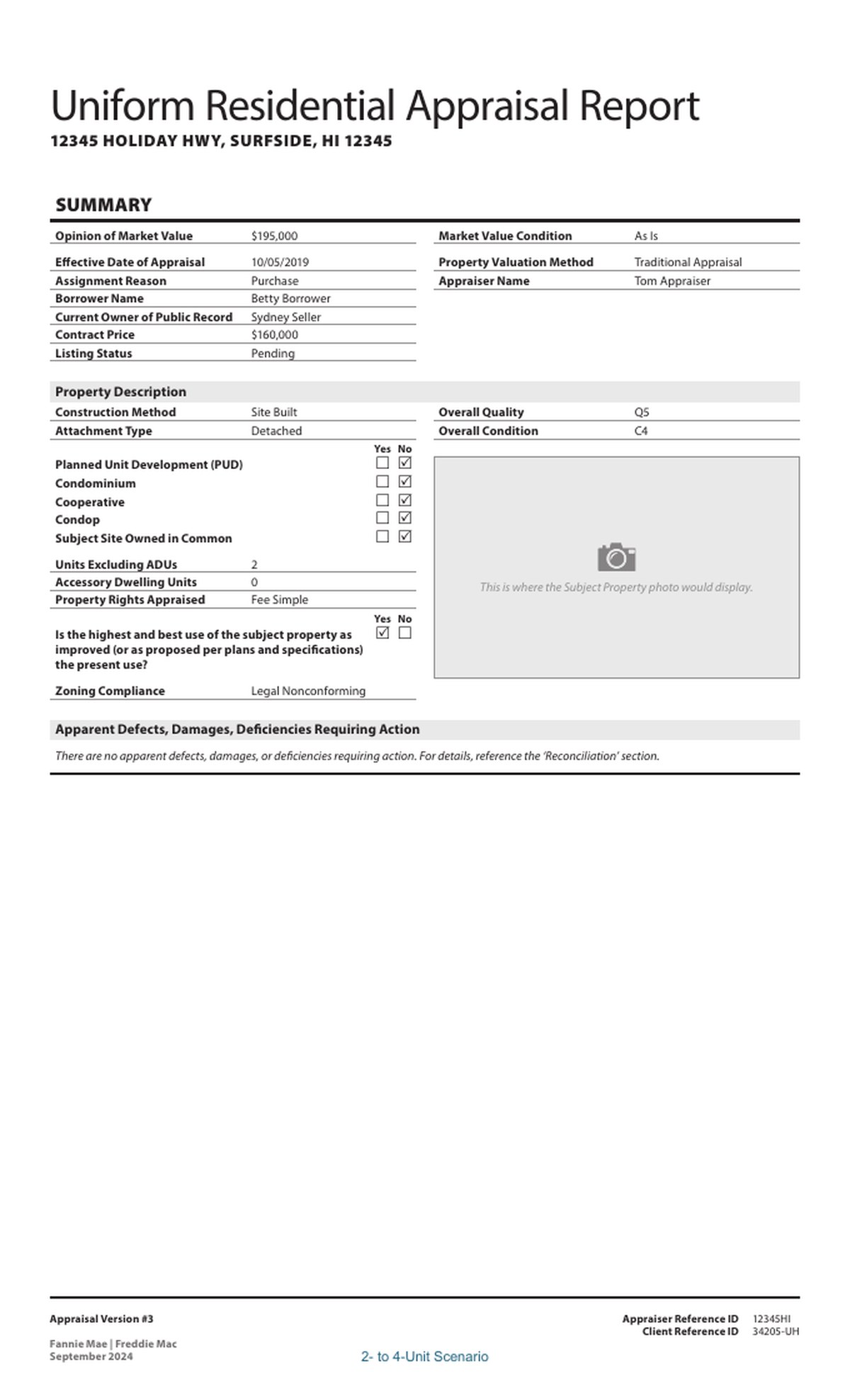
The redesigned system moves away from that form-number-first approach. Instead, the new Uniform Residential Appraisal Report builds itself around the characteristics of the subject property and the scope of the appraisal. That is why the report is described as dynamic. A straightforward one-unit property may produce a more concise report, while a property with an accessory dwelling unit, multiple structures, unusual site features, repairs, or multiple units can trigger additional sections.
The underlying data standard is UAD 3.6. UAD stands for Uniform Appraisal Dataset. The update aligns appraisal reporting with a newer mortgage industry data standard and allows information to be captured more precisely. Rather than burying important facts in abbreviations or long commentary boxes, the redesigned report collects many features as individual data points that can be understood and reviewed more consistently.
When Do the New Appraisal Requirements Take Effect?
The transition is not waiting somewhere far off in the future. Broad production began on January 26, 2026, which means lenders with compatible systems and participating appraisal providers may already use UAD 3.6 reports. As a result, two people buying homes at the same time could receive appraisal reports that look very different, depending on the lender, appraisal software, and workflow involved.
The major deadline is November 2, 2026. Beginning on that date, new appraisal reports submitted through the Uniform Collateral Data Portal for loans sold to Fannie Mae or Freddie Mac must use UAD 3.6. Reports first submitted under the older standard after the mandate are expected to receive a fatal submission message rather than being accepted as successful submissions.
That does not mean every appraisal in America will change in exactly the same way on the same morning. Cash transactions, private appraisal assignments, certain portfolio lending decisions, government lending programs, and other valuation products may operate under different requirements. Still, Fannie Mae and Freddie Mac influence a substantial portion of the residential mortgage market, so this transition will quickly become the new normal for many financed home purchases and refinances.
Will Appraisers Use a New Method to Determine Value?
This is the question most buyers and sellers are likely to ask, and it deserves a plain answer. The redesigned report does not erase the traditional appraisal approaches or instruct appraisers to abandon market evidence. Appraisers will still analyze the property, research the market, select relevant comparable sales when the sales comparison approach applies, consider appropriate adjustments, and reconcile the available evidence into an opinion of value.
The sales comparison approach is still recognizable. The appraiser will still compare the subject property with other properties, study important similarities and differences, and explain how the evidence supports the final opinion. What changes is the structure surrounding that work. The redesigned grid can adapt to the subject and the comparables, capture more detail, and present the analysis in a format intended to be easier for systems and reviewers to understand.
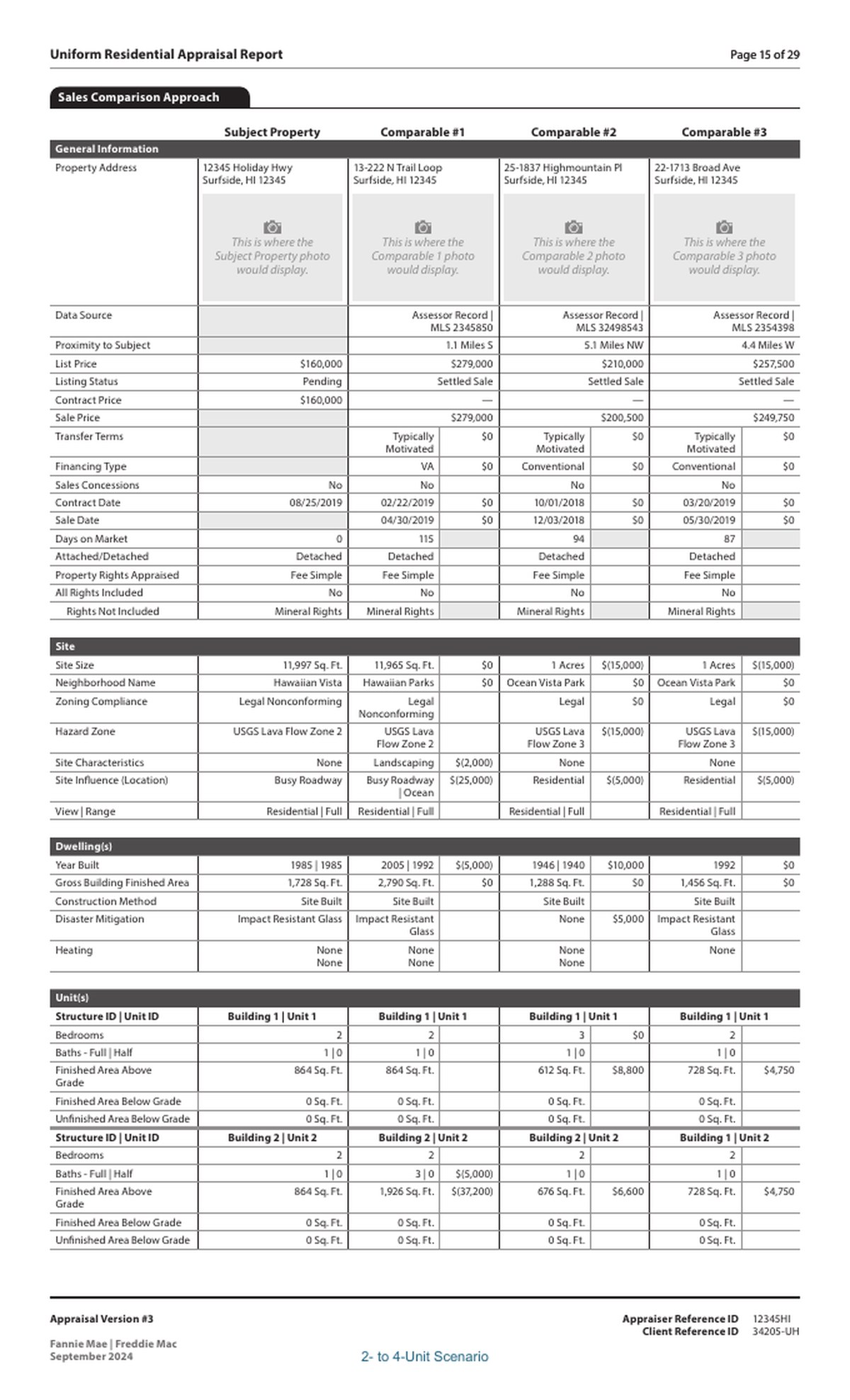
That distinction matters. A new report design does not automatically produce a higher or lower value. It may, however, make the appraiser’s reasoning more visible. A buyer may be able to see more clearly why one comparable received an adjustment, how a site influence was described, or which property characteristic required additional analysis. A seller may see property details that were previously compressed into an abbreviation or narrative comment.
What Will the New Appraisal Report Look Like?
The first thing many consumers will notice is that the report looks less like a rigid government form and more like a professionally organized property report. Section headings are clearer. Summary information is easier to locate. The report can repeat sections when a property has more than one dwelling, unit, outbuilding, or relevant feature. It can also omit sections that do not apply.
The redesigned report is expected to place photographs within the section they support. Instead of flipping to an addendum and trying to match a photograph with a brief caption, the reader may find room photographs, comparable photographs, maps, sketches, certifications, and defect images closer to the related discussion. The official guidance also distinguishes between required, conditionally required, and optional images.
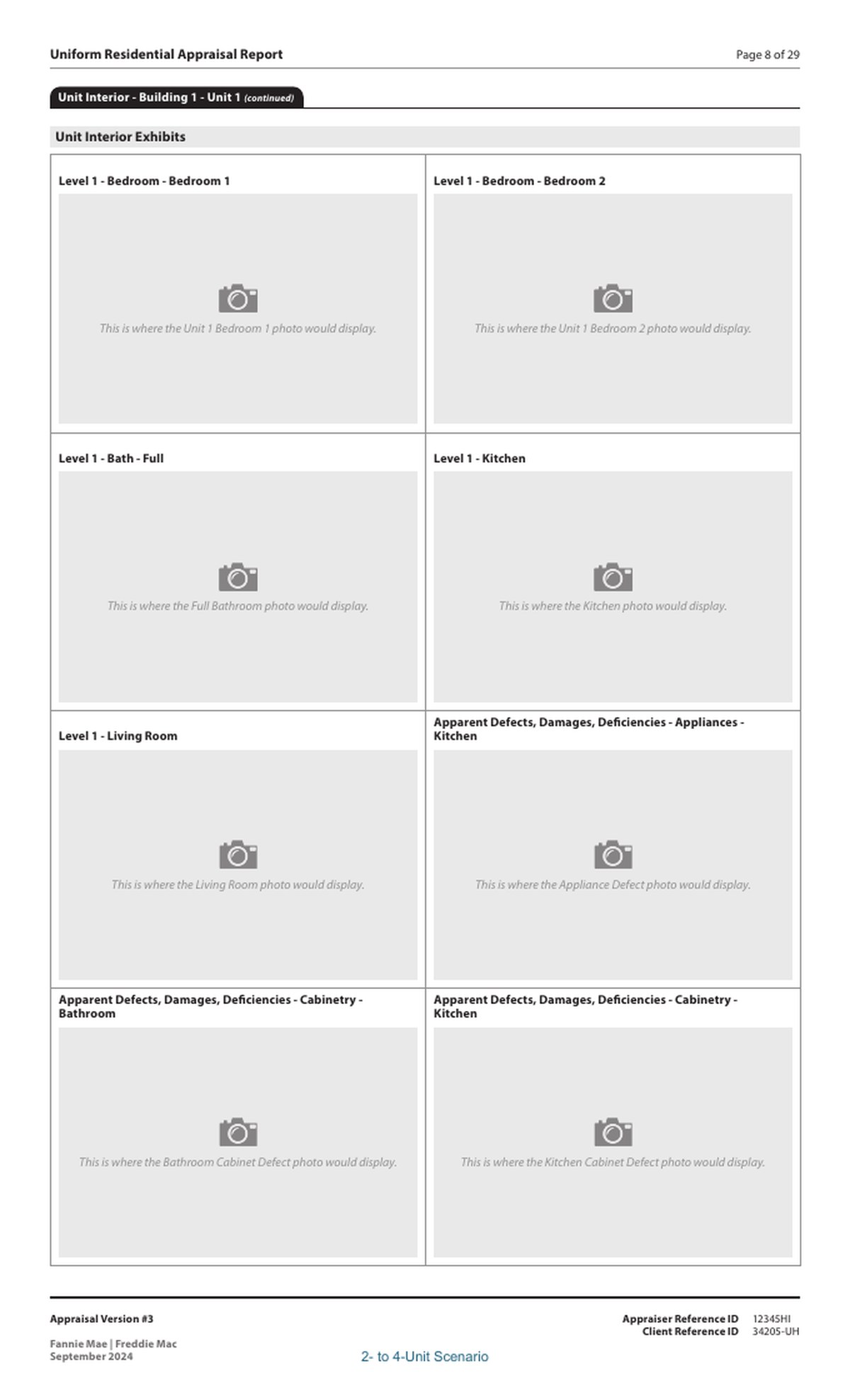
The report is also designed to capture defects, damage, and deficiencies as structured information. The appraiser may identify the feature, its location, what was observed, whether it appears to affect soundness or structural integrity, and whether the recommended action is repair, inspection, completion, or no action. That does not turn the appraisal into a home inspection. It does, however, give the report a more organized way to communicate conditions that are relevant to the appraisal assignment.
Take a Breath: An Appraisal Is Still Not a Home Inspection
An appraiser observes and reports conditions relevant to value, marketability, safety, soundness, and the requirements of the assignment. A home inspector performs a different and usually more detailed evaluation of systems and components. Buyers should not treat the appraisal as a substitute for the inspection, and sellers should not assume that a clean-looking appraisal means every component of the home has been fully evaluated.
What New Property Details May Be Reported?
The redesigned dataset allows appraisers to report a wider range of characteristics in a standardized way. Depending on the property, that may include details about water frontage, disaster-mitigation features, renewable-energy components, building certifications, green ratings, broadband availability, converted areas, roof age, ceiling heights, kitchen and bathroom updates, accessory dwelling units, outbuildings, and finished areas that are attached but not directly accessible from the main living area.
That does not mean every appraiser will need to investigate every possible characteristic for every property. The dynamic report is supposed to display what is relevant. A typical suburban home will not suddenly require pages of waterfront information. A home with solar panels, a detached guest house, flood-mitigation features, or a converted garage may require more detailed reporting because those characteristics can affect use, marketability, financing, condition, or value.
For sellers, this is a reminder that good property records matter. Documentation concerning permitted additions, roof replacement, solar ownership, accessory dwelling units, major renovations, energy certifications, and other improvements may help the appraiser understand the property accurately. Documentation does not guarantee a dollar-for-dollar increase in value, but it can reduce uncertainty and help distinguish a completed improvement from an unsupported claim.
How Could the Change Affect Home Buyers?
Most buyers will experience the same basic appraisal sequence. The lender orders the appraisal, the appraiser researches and inspects as required, the report is reviewed, and the lender determines whether the collateral supports the loan. The buyer may receive a copy of the report and, depending on the result, proceed toward closing, address lender conditions, challenge an apparent error, renegotiate, contribute additional cash, or exercise contractual rights.
The difference is that the report may contain more organized information and a clearer explanation of the property. That can be helpful when a buyer is trying to understand why the appraised value differs from the contract price. It may also make factual errors easier to spot. For example, if the report identifies the wrong ownership status for solar panels, overlooks a legal accessory unit, or misstates a material property characteristic, the buyer and the buyer’s representatives may be able to identify the discrepancy more quickly.
Buyers should still focus on material facts rather than simply disliking the value conclusion. A reconsideration of value is not a request to pressure the appraiser into “hitting the number.” It is a process for presenting credible information, such as a factual correction, a relevant comparable sale, or market evidence that may not have been considered. The redesigned report may improve transparency, but the quality of any reconsideration request will still depend on the quality of the evidence.

How Could the Change Affect Home Sellers?
Sellers may notice that the appraiser or lender requests more specific information about improvements, accessory units, energy features, or unusual property characteristics. A well-prepared seller can help by organizing permits, invoices, surveys, plans, warranties, and a concise list of improvements before the appraisal appointment. The goal is not to overwhelm the appraiser with a scrapbook. The goal is to make reliable information available so the property can be described accurately.
The new format may also place more attention on distinctions that were previously buried in commentary. A converted space is not necessarily the same as permitted living area. A detached structure may function differently from an accessory dwelling unit. Solar panels may be owned, financed, leased, or subject to another arrangement. A view may be full, partial, seasonal, or affected by another site influence. These distinctions can matter to buyers in the market, which means they can matter to the appraiser.
Sellers should not assume that more data means the appraiser is looking for reasons to reduce value. Better data can work in either direction. Accurate documentation may help the appraiser recognize a feature that would otherwise be misunderstood. At the same time, standardized reporting can make it harder for unresolved defects, functional problems, or unsupported living-area claims to disappear inside vague language.
Could the New Report Cause Appraisal Delays?
Any large technology and workflow transition carries some risk of temporary friction. Appraisers must learn new reporting requirements. Software providers must support the updated standard. Lenders must update ordering, review, quality-control, and submission systems. Staff members must become comfortable reading reports that no longer resemble the forms they have used for years.
During the transition, some assignments may take longer if the lender, appraiser, or software platform encounters a compatibility issue or needs clarification. That does not mean widespread delays are inevitable. Broad production began months before the mandatory date specifically so lenders and providers could begin using the new format gradually rather than flipping the entire industry overnight.
From a transaction-management standpoint, the practical response is simple: order the appraisal promptly, avoid unnecessary changes to access, provide requested documents quickly, and leave enough time for lender review. Buyers and sellers should also understand that an appraisal can be complete from the appraiser’s perspective while still awaiting lender review or a correction before the loan file is cleared.
What Is Not Changing?
| What is changing | What is not automatically changing |
|---|---|
| The layout, data structure, terminology, and presentation of the report | The definition of market value used for the assignment |
| One dynamic URAR replaces multiple legacy GSE appraisal forms | The appraiser’s obligation to remain independent and objective |
| More property characteristics can be captured as discrete data | The need for credible market evidence and appropriate analysis |
| Photographs and defect information can appear closer to the relevant section | The separate purpose of a professional home inspection |
| The report can expand according to the property and assignment | The fact that the contract price and appraised value can differ |
Robbie’s Perspective: Better Reporting Can Support Better Conversations
I have spent more than 40 years in real estate, and I have watched our industry make a habit of turning technical changes into consumer confusion. Appraisal language already makes many buyers nervous. Sellers often hear that the appraisal has been ordered and immediately wonder whether a stranger is about to undo the transaction. Adding new acronyms and a completely different report layout can increase that anxiety unless someone explains what is really happening.
My view is that a clearer and more property-specific report can be a good thing when it is used well. Buyers deserve to understand the collateral analysis connected to their loan. Sellers deserve a process that accurately identifies the features of their property. Lenders need reliable data. Appraisers need a report that allows them to describe a complex property without squeezing every explanation into a form designed for a simpler time.
At the same time, no reporting format can remove professional judgment from valuation. Real estate markets are local. Comparable sales are rarely identical. Adjustments require support and reasoning. A structured dataset can improve consistency, but it cannot turn an appraisal into a mechanical price calculator. Consumers should be cautious when anyone describes UAD 3.6 as though a computer will now dictate the value of every home.
How Buyers and Sellers Can Prepare
Buyers should make sure their financing timeline allows the lender to order and review the appraisal without unnecessary delay. They should read the report carefully when it becomes available, compare key property facts with what they know, and raise questions through the appropriate lender process. They should also keep their inspection, appraisal, title work, survey, and loan underwriting in their proper lanes. Each serves a different purpose.
Sellers should prepare the home for reasonable access and assemble concise, credible documentation about material improvements or unusual features. A list of improvements is more useful when it includes dates, permits where applicable, and supporting records. Sellers should not follow the appraiser through the property making a sales pitch, but they can make relevant information available in a professional way.
Real estate agents should learn to read the new report instead of relying on the location of familiar boxes. We should be able to explain the difference between an appraisal issue, an underwriting issue, a property-condition issue, and a factual reporting error. We should also resist promising that an improvement will add a particular amount to the appraised value. The market, the assignment, and the appraiser’s supported analysis determine the result.
Frequently Asked Questions About the 2026 Appraisal Changes
Is UAD 3.6 a new appraisal form?
UAD 3.6 is the updated appraisal dataset and reporting standard. It supports the redesigned Uniform Residential Appraisal Report, which replaces multiple legacy GSE forms with one dynamic report.
When will the new appraisal report be required?
Broad production began January 26, 2026. UAD 3.6 becomes mandatory for new appraisal reports submitted to the Uniform Collateral Data Portal on or after November 2, 2026, for loans intended for sale to Fannie Mae or Freddie Mac.
Will the new report make appraised values lower?
No automatic increase or decrease follows from the report redesign. The change is primarily about the structure, consistency, and presentation of appraisal information. The opinion of value must still be supported by the applicable appraisal analysis and market evidence.
Will artificial intelligence replace the appraiser?
The redesigned dataset is intended to improve data quality and consistency, but a traditional appraisal assignment still relies on a qualified appraiser’s analysis and professional judgment. Lenders may use automated tools in collateral review, but UAD 3.6 is not an announcement that appraisers are being eliminated.
Will buyers receive more photographs?
The redesigned report places photographs within relevant sections and includes more specific photo requirements. The number and type of images will depend on the property, assignment, observed conditions, and applicable requirements.
Does the new appraisal replace the home inspection?
No. The appraisal and home inspection serve different purposes. The appraisal addresses value and collateral considerations, while the inspection provides a more detailed evaluation of property systems and components.
Can a buyer challenge an error in the new report?
Buyers can raise concerns through their lender, including factual errors or credible market information that may support a reconsideration of value. The process is not a guarantee that the value will change, and the request should be based on relevant evidence.
Will FHA and VA appraisals use the same timeline?
Not necessarily. The November 2, 2026 mandate described here applies to new UAD submissions for Fannie Mae and Freddie Mac. Other agencies and programs may publish their own adoption requirements and timelines.
Final Thoughts
The appraisal report is changing in a meaningful way, but buyers and sellers do not need to panic. The new URAR is intended to create a more flexible, modern, and consistent way to report residential appraisal information. It may look unfamiliar, and it may ask appraisers to document certain characteristics more precisely, but the foundational work of studying the property, analyzing the market, and developing a supported opinion of value remains recognizable.
The smartest approach is to understand the purpose of the change, prepare good property information, respect the appraiser’s independence, and address genuine questions with reliable evidence. That is how we keep a technical reporting transition from becoming unnecessary transaction drama.
For more practical guidance on appraisals, inspections, contracts, financing, and the real estate process, visit the Real Estate Resource Center by Robbie English. When you are preparing to buy or sell in the Greater Austin area, I would be glad to help you understand the process before the surprises begin.
Official Sources and Image Attribution
The implementation dates, report descriptions, and sample report images in this article are based on official materials published jointly by Fannie Mae and Freddie Mac. The sample pages are illustrative, contain fictional scenario information, and remain the property of their respective publishers.
You Might Also Find These Helpful
I touched on a related piece of this here too: Homeowners Insurance in Austin: What Buyers Should Know.