Northwest Hills falls inside zip code 78731, bounded roughly by Spicewood Springs Road to the north, RM 2222 to the south, MoPac (Loop 1) to the east, and Loop 360 to the west. That puts it about 15 to 20 minutes from downtown Austin depending on traffic, and it explains why so many residents commute along the MoPac corridor or cut over to Loop 360 to reach the Hill Country side of town. If you’re weighing Northwest Hills against other Austin neighborhoods, the location is really the starting point: it’s one of the closer-in options on the west side that still has the space and topography people associate with the Hill Country further out.
TLDR (Too Long; Didn’t Read): Living in Northwest Hills, Austin TX
- Northwest Hills sits in zip code 78731, bounded by Spicewood Springs Road, RM 2222, MoPac, and Loop 360, about 15 to 20 minutes from downtown Austin
- Most homes were built between the 1960s and 1980s in ranch-style construction on larger, hillier lots than newer Austin subdivisions
- The neighborhood borders Bull Creek District Park and the Bull Creek Greenbelt, with the Arboretum and the Domain both a short drive away for shopping and dining
- Homes feed into Doss Elementary, Murchison Middle School, and Anderson High School in Austin ISD
- Recent pricing has run in the high $300s to around $400 per square foot, with wide variation based on home condition, lot slope, and how much of the original 1960s-80s construction has been updated
I’ve sold homes in Northwest Hills for years, and I still think it’s one of the more overlooked pockets of Austin when people talk about where to live west of MoPac. It doesn’t get the same attention as Westlake or Tarrytown, but the terrain, the lot sizes, and the location do a lot of the same work without the same price tag per square foot. Here’s what I’d want a buyer or a longtime resident curious about the area to actually know, from the boundaries and the housing stock to the schools and where the market stands today.
The housing stock: mostly 1960s through 1980s
Northwest Hills was developed primarily from the 1960s into the 1980s, and that shows in the architecture. Ranch-style single-story homes dominate, with some colonial-influenced designs mixed in from the same era. Lots tend to run larger than what you’ll find in newer subdivisions built north of the city in the 1990s and 2000s, and a lot of that space went to mature trees rather than additional square footage on the house itself.
Because the housing stock is older, condition varies block to block and even lot to lot. Some homes have been fully remodeled or rebuilt, others are still close to original, and you’ll find everything in between. Buyers looking here should expect to evaluate foundations, roofs, electrical, and plumbing on a case-by-case basis rather than assuming new-construction standards. There’s also a smaller supply of townhomes scattered through the neighborhood for buyers who want the location without maintaining a larger lot.
A neighborhood made up of smaller pockets
Northwest Hills isn’t one uniform subdivision. It’s a collection of smaller sections platted over a couple of decades, each with its own street pattern and lot layout. Some pockets sit closer to Loop 360 with steeper grades and larger lots, while sections nearer MoPac tend to sit on flatter ground with smaller yards. A handful of small condo and townhome developments are mixed in as well, which gives buyers a range of price points and maintenance levels within the same general area. When I walk a buyer through here, I usually spend time comparing two or three of these pockets side by side rather than treating the whole neighborhood as one product.
Hilly terrain and tree-lined streets
The name isn’t just marketing. Northwest Hills sits on rolling, hilly terrain that’s part of the same limestone topography running through much of West Austin. Streets curve with the land instead of following a grid, which means lot shapes and elevations vary a lot from one property to the next. Some homes sit up on a rise with long sightlines, others sit lower and closer to the tree canopy. If you’re shopping here, it’s worth walking the actual lot rather than relying on square footage numbers alone, since slope and lot placement affect everything from yard usability to drainage.
Bull Creek District Park and the greenbelt
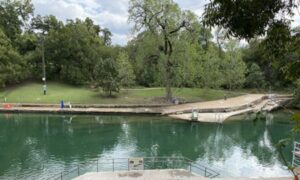
One of the bigger draws to this part of Austin is direct proximity to Bull Creek District Park and the Bull Creek Greenbelt. The park has trailheads, picnic areas, and access points down into the creek, and the greenbelt itself stretches for miles with limestone pools and swimming holes along the way, plus rougher trail sections further upstream. Bright Leaf Preserve and the Mount Bonnell area are also within a short drive, so if creek access or trail time factors into where you want to live, Northwest Hills puts you closer to it than most neighborhoods on the east side of MoPac.
Shopping and dining nearby
Northwest Hills sits within a few miles of two of the busier retail corridors in this part of Austin. The Arboretum, with its mix of national retailers, restaurants, and a movie theater, is a short drive north. The Domain, with its larger concentration of shops, restaurants, and offices, is roughly five miles away and reachable via MoPac. Between the two, most day-to-day shopping and dining needs are covered without a trip downtown, though downtown itself is still a reasonably quick drive when you want it.
Schools serving the neighborhood
Homes in Northwest Hills feed into Austin ISD, specifically Doss Elementary, Murchison Middle School, and Anderson High School. Doss has been recognized as a National Blue Ribbon School and offers a Spanish language program starting in first grade. Murchison runs an International Baccalaureate Middle Years Programme, one of the smaller number of IB-authorized middle schools in the district. Anderson High School has offered Austin ISD’s IB Diploma Programme since 1991, alongside a range of Advanced Placement and dual credit courses through Austin Community College. Attendance boundaries can shift, so if a specific school assignment matters to your decision, I’d always verify the current boundary against the actual address before writing an offer.
What the market looks like right now
Pricing in Northwest Hills varies more than you’d expect for a neighborhood this size, mostly because of the range in home condition and lot size I mentioned earlier. A fully updated home on a flat, larger lot and an original 1960s ranch on a steep lot can sit two streets apart and price very differently. Recent per-square-foot figures for the area have generally landed in the high $300s to around $400, and closed prices span a wide range depending on square footage, updates, and lot characteristics. Homes here have typically spent anywhere from two to five weeks on the market before going under contract, though that window moves with pricing strategy and condition.
Because so much of the housing stock is original or partially updated, I spend a fair amount of time with sellers here walking through what actually adds value in a remodel versus what doesn’t move the needle for this particular buyer pool. And for buyers, the older stock means there’s often room to negotiate on price relative to condition, especially on homes that need cosmetic or systems work.
Remodeling and rebuilding trends
Given how much of the housing stock dates back 40 to 60 years, remodeling and full rebuilds are common here. I regularly see original ranch homes gutted down to the studs, additions built onto smaller footprints, or a home torn down entirely and replaced with new construction on the same lot. Larger lot sizes make this more feasible in Northwest Hills than in tighter subdivisions, since setbacks and lot coverage rules leave more room to work with. If you’re buying with renovation in mind, it’s worth checking the specific lot dimensions and any deed restrictions tied to that particular section before you assume a project is straightforward.
Getting around
MoPac and Loop 360 are the two main corridors bordering the neighborhood, and most residents use one or the other depending on where they’re headed. Spicewood Springs Road and RM 2222 cut east-west through the area and connect out to both highways. It’s a drive-oriented part of Austin, similar to most of the city west of I-35, so plan around a car for daily errands even with the Arboretum and Domain both close by.
If you’re looking at Northwest Hills, whether you’re buying your first home here or you’ve lived in the area for twenty years and want a straight read on where values and the market stand, I’m happy to walk through it with you. I work as a broker with Uncommon Realty, and you can read more about my background on my about page. Northwest Hills is one of the neighborhoods I know block by block, and I’d rather give you the real picture, terrain, school boundaries, lot quirks and all, than a generic pitch.
Robbie English, REALTOR, Broker at Uncommon Realty.