I get calls fairly often from people who found one Westlake listing online, fell for the trees and the hilltop view, and now want to know what the area is actually like day to day. West Lake Hills gets lumped in with “Westlake” as a general term, but it’s worth understanding what it really is before you start touring homes here. I’ve worked this part of the market for years, and I want to lay out the real picture: the government, the schools, the terrain, the shopping, and what it actually costs to live here right now.
TLDR (Too Long; Didn’t Read): Living in West Lake Hills, TX
- West Lake Hills is its own incorporated city in the 78746 zip code, sitting on limestone hills west of downtown Austin, roughly 10 to 15 minutes from the Capitol.
- Every home in the city is zoned to Eanes ISD, which feeds into Westlake High School, a campus that consistently posts some of the strongest academic ratings in Texas.
- Lots run larger than most of Austin proper, and the terrain is genuinely hilly, with homes tucked into limestone ridges, tree canopy, and canyon views.
- The Bee Cave Road corridor carries most of the day-to-day retail, grocery, and dining, and Lake Austin and the Lost Creek area give residents nearby water access.
- Home prices in West Lake Hills run well above the Austin median, with the market favoring larger, established properties over new construction.
West Lake Hills Is Its Own City, Not Just an Austin Neighborhood
West Lake Hills is an incorporated municipality in Travis County, with its own city government, its own police department, and its own building and zoning codes. It sits within the 78746 zip code, bordered by Austin on several sides, roughly between Loop 360 and Bee Cave Road. The city was incorporated in 1953, and that local control is a big part of why the area looks and feels the way it does today. Because zoning and development decisions are made at the city level rather than by Austin, lot sizes have stayed larger and density has stayed lower than in most of the surrounding metro.
That local governance also means West Lake Hills has its own city hall, its own parks, and its own set of ordinances around things like tree preservation and impervious cover, which matters a lot given the terrain. If you’re moving from elsewhere in Austin, it’s worth knowing you’re crossing into a different city, with different permitting and different rules, the moment you cross into West Lake Hills.
The Terrain: Limestone Hills, Canyon Views, and Mature Tree Cover
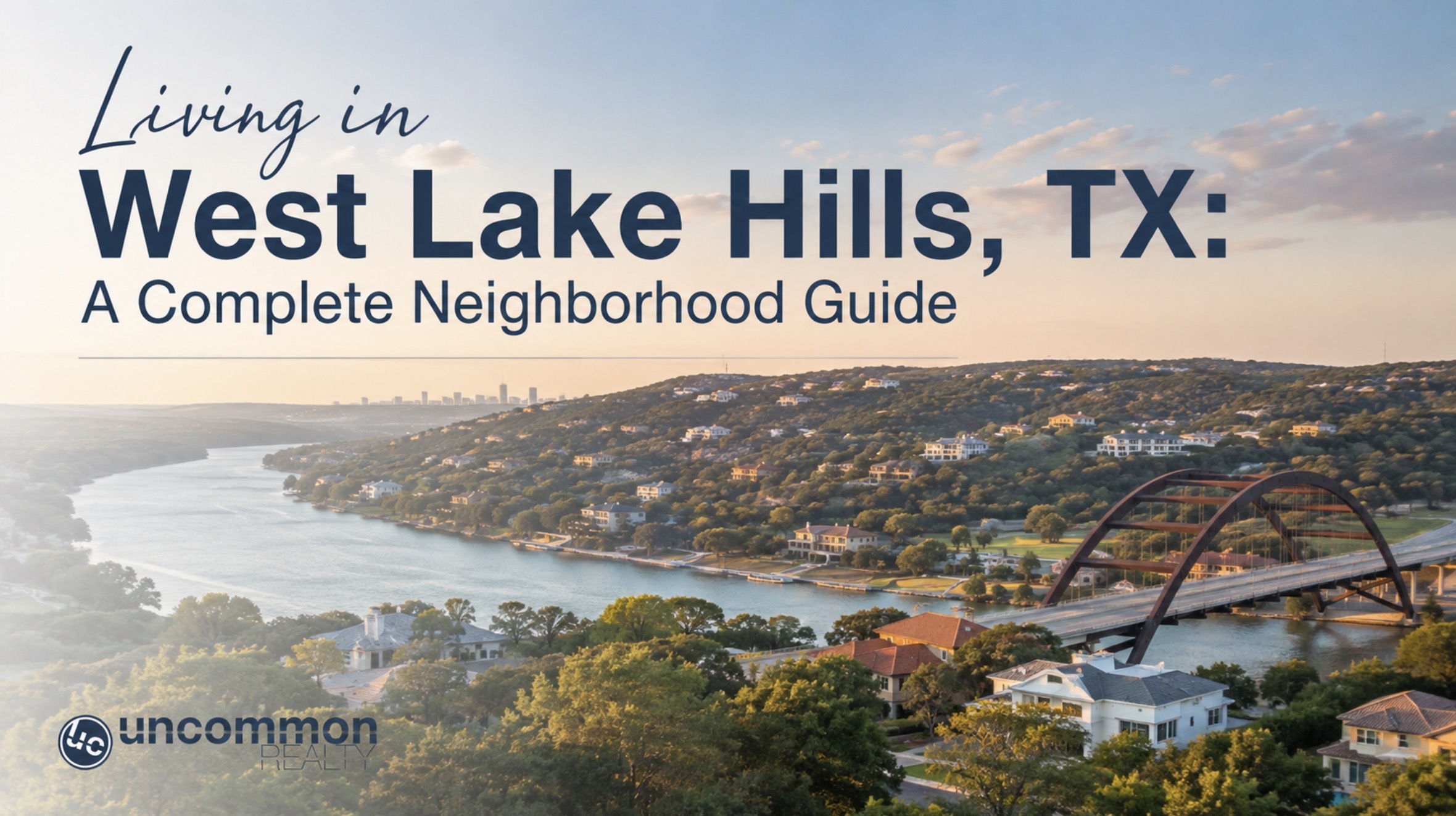
The name isn’t marketing. West Lake Hills sits on the limestone ridges of the eastern Hill Country, and the topography shapes almost everything about how homes are built and sited here. Streets climb and curve around canyons, driveways slope, and a lot of homes are positioned to capture a view across a ravine or out toward the Colorado River valley rather than sitting flat on a graded lot. Live oak and cedar cover much of the hillside, and mature tree canopy is one of the more consistent visual features across the city.
This terrain is also why lots here tend to run larger than what you’ll find in central Austin. Building on a slope requires more land to work with, and the city’s development rules have generally kept subdivision and density in check. You’ll find everything from ranch-style homes built decades ago on generous acreage to newer construction designed specifically to take advantage of the elevation changes with multiple outdoor living levels, walkout terraces, and long sightlines.
Eanes ISD and Westlake High School
West Lake Hills is the only city that sits entirely within the boundaries of Eanes Independent School District, and school assignment is one of the top reasons people target this specific area over other parts of west Austin. Eanes ISD elementary campuses in the district include Cedar Creek, Bridge Point, Eanes Elementary, and Forest Trail, all serving kindergarten through fifth grade. From there, students move into either Hill Country Middle School or West Ridge Middle School for sixth through eighth grade, and every Eanes ISD student attends Westlake High School for ninth through twelfth grade.
Westlake High School’s academic ratings are consistently among the strongest in the state. The campus posts a graduation rate near 98 percent, a high rate of Advanced Placement course participation, and a student-teacher ratio around 14 to 1. It offers a wide range of AP coursework along with STEM, robotics, and fine arts programs. Specific attendance boundaries can shift within a district, so if a particular campus assignment matters to your decision, I always recommend confirming the current zoning for any specific address directly with Eanes ISD before you write an offer.
Lake Austin and Nearby Green Space
Part of what makes West Lake Hills feel more like the Hill Country than the city is its proximity to water and undeveloped land. Lake Austin runs along the area’s northern edge, and residents use it for paddleboarding, kayaking, and boating access at nearby points along the shoreline. The Lost Creek area, accessible near the Loop 360 bridge over Lake Austin, offers a hiking trail down to a swimming hole that’s popular with people who live in the surrounding hills. Camp Craft, along Camp Craft Road, adds another pocket of trail and green space within the city.
None of this is resort-style development. It’s closer to what you’d expect from unincorporated Hill Country land that happens to sit ten minutes from downtown: creek beds, limestone outcroppings, and tree cover that hasn’t been cleared for subdivisions.
Bee Cave Road: The Retail and Dining Corridor
Bee Cave Road, also signed as RM 2244, is the main commercial spine running through West Lake Hills. It’s not a dense retail strip, it’s more a series of shopping centers and standalone buildings spaced along the road, but it covers the essentials. Westbank Market, anchored by a large Randall’s grocery store, serves as one of the primary grocery stops for the area. Further along the corridor, West Woods Shopping Center brings in a mix of national retailers like Barnes & Noble, Dillard’s, and Banana Republic alongside local restaurants.
The Village at Westlake, near the intersection of Bee Cave Road and Capital of Texas Highway (Loop 360), functions as another hub with grocery, boutique retail, fitness studios, and dining. Overall the corridor leans toward a mix of everyday grocery and service businesses with local restaurants filling in the gaps, rather than a big-box retail strip. It’s a drive-to corridor, not a walkable downtown, which fits the low-density character of the rest of the city.
How Close Is West Lake Hills to Downtown Austin?
This is one of the more underrated parts of living here. Despite the Hill Country feel, West Lake Hills sits close to downtown Austin, generally a 10 to 15 minute drive depending on where in the city you are and time of day. Loop 360 and Bee Cave Road both connect fairly directly toward MoPac and downtown, so residents get a genuinely wooded, low-density setting without a long commute into the city core. That combination, quiet hillside living with a short drive to downtown offices, restaurants, and Lady Bird Lake, is a big part of the area’s draw.
What the West Lake Hills Housing Market Looks Like Right Now
West Lake Hills is one of the higher-priced submarkets in the Austin area, and pricing reflects the combination of large lots, established construction, top-rated schools, and limited new supply. Recent data shows the median sale price in the city running well above two million dollars, with many transactions landing between roughly $1.5 million and $5 million or more depending on lot size, view, and the age and condition of the home. Inventory has stayed relatively tight compared to the broader Austin metro, and well-priced, well-maintained homes have generally moved at a healthy pace.
Because the housing stock skews toward established, larger homes built across several decades rather than new construction, condition and layout vary a lot from one listing to the next. Some homes have been extensively renovated to modern standards, others retain original finishes and would benefit from updating. I walk buyers through that distinction closely, because two homes at a similar price point in West Lake Hills can be very different properties once you’re inside them.
If low-maintenance living matters to you specifically, I’ve written a separate guide on the best lock-and-leave homes in Westlake that goes deeper into that particular property type. This article is meant to cover the area as a whole.
Who Should Look Closely at West Lake Hills
West Lake Hills makes sense for buyers prioritizing larger lot sizes, established tree cover and hillside terrain, Eanes ISD school assignment, and a short drive to downtown Austin. It’s a smaller, quieter market than much of the rest of the metro, with fewer new listings at any given time, so working with someone who tracks this specific area closely helps when the right property comes up. I cover West Lake Hills as part of my broader work across Austin, TX real estate, and I’m happy to walk through current listings, recent sales, and school zoning for any specific address you’re considering.
Final Thoughts
West Lake Hills isn’t a neighborhood inside Austin, it’s a separate city with its own government sitting right up against Austin’s western edge, built on limestone hills, wrapped in tree canopy, and zoned entirely to one of the strongest school districts in Texas. The terrain shapes the lots, the lots shape the homes, and the whole area trades density for space and quiet without giving up a short drive into downtown. If you want to talk through whether it’s the right fit for what you’re looking for, or you want a read on current pricing for a specific street or property type, reach out. You can learn more about my background on my about page, or about the brokerage I lead at Uncommon Realty. You can also start browsing live listings in West Lake Hills whenever you’re ready.
Robbie English, REALTOR, Broker at Uncommon Realty.