Robbie English, Broker and REALTOR

Helping Austin Home Buyers and Sellers Make Confident Real Estate Decisions

  • Buy
    • Search Homes For Sale
    • Featured Listings
    • Get Pre-Approved
    • Schedule a Buyer Consultation
    • Hire Me As Your Buyer’s Agent
    • Buyer Guides
      • Austin Home Buyer’s Guide
      • Austin Real Estate Guide
      • Austin Relocation Guide
      • Making an Offer
      • What Are Closing Costs?
      • Closing: Now What?
      • Financial Terms Glossary
    • Download The App
    • Neighborhood Guides
      • Neighborhood Guides
      • Highland Lakes Neighborhood Guides
    • Event Guides
      • Austin Metro Event Guides
      • Highland Lakes Event Guides
  • Sell
    • Sell With Me
    • Get Your Home’s Value
    • Schedule a Seller Consultation
    • Off-Market Representation
    • Market Snapshot
    • Seller’s Guide
      • Austin Home Sellers Guide
      • 11 Steps To Selling Your Home
      • Pricing Your Home
      • Marketing Your Home
      • Adding Value To Your Home
      • Showing Your Home
  • Rentals
    • Owner Portal
    • Featured Rentals
    • Rent
      • Resident Resources
      • Resident Portal
      • Tenant FAQ
      • Resident Benefit Package
      • Wear and Tear vs. Damage
  • Service Area
  • Blog
    • Find By Topic
    • Real Estate Resource Center
    • All Blog Posts
  • About
    • Testimonials
    • Robbie
    • Robbie’s Advanced Education
    • Uncommon Realty
    • Uncommon Diversity
    • Uncommon Path
  • Contact
Home » What Earnest Money Means for Texas Home Buyers and How Much to Put Down

What Earnest Money Means for Texas Home Buyers and How Much to Put Down

September 12, 2026 by Robbie English, REALTOR, Broker, ABR, AHWD, BBA, C2EX, CRB, E-PRO, GRI, MRP, PSA, RENE, RPR, SFR, SRS, TAHS, TBS, TLS

When you sign a Texas home‑buying contract, you’ll be asked to put down an earnest‑money deposit. It’s the cash that tells the seller you mean business. Below you’ll find everything you need to know about what earnest money is, how much to offer, when you get it back, and how it fits into your overall budget.

Table of Contents

  • What Is Earnest Money?
  • How Much Earnest Money Do You Need?
  • When Is Earnest Money Refundable, and When Can You Lose It?
  • Earnest Money in Texas: Deadlines, Contracts, and Local Practice
  • How Earnest Money Affects Your Offer and Your Budget
  • Frequently Asked Questions
  • Conclusion

What Is Earnest Money?

Earnest money is a good‑faith deposit a buyer provides after the seller accepts an offer. The money sits in a neutral escrow account, usually held by the title company, until closing or a lawful termination of the contract. Wikipedia explains that the deposit demonstrates the buyer’s commitment to complete the purchase.

In Texas the deposit isn’t required by law, but it’s customary in most residential deals. The amount is negotiated between buyer and seller and can depend on the purchase price, market heat, and how quickly you need to act.

Pro Tip: Ask your agent to spell out the escrow instructions in the contract so there’s no confusion about where the funds go.

Common pitfalls include delivering the money late or mixing it up with the option fee, which is a separate, usually non‑refundable payment for the right to walk away during the option period.

Disputes arise when the contract ends abruptly and both parties claim the funds.

My Austin Home Buyer’s Guide | Step‑by‑Step Buying Process walks you through the escrow timeline and helps you avoid costly mistakes.

Earnest money deposit concept in Texas real estate

Key Takeaway: Earnest money is a refundable deposit that shows you’re serious, but only if you follow the contract’s deadlines.

How Much Earnest Money Do You Need?

Most Texas buyers stake about 1% of the purchase price, though a flat range of $500‑$2,000 works for lower‑priced homes. My experience shows the median amount sits near $3,250, while the average varies across data points.

1.5%average earnest‑money percentage in Texas

In competitive markets like Austin, you’ll often see 1‑2% of the price. The dollar amount depends on the purchase price. Higher‑priced homes can push the norm to 2% or more, roughly $15,000 on a $750,000 property.

If you’re a cash buyer, offering a larger deposit can signal financial strength. If you’re financing, a smaller but timely deposit usually satisfies the seller while preserving cash for down‑payment and closing costs.

Remember the three‑day delivery rule in the contract: you must deliver the earnest money to the escrow agent within three business days of the contract’s effective date. If a weekend or holiday falls in that window, the deadline slides to the next business day.

When you’re unsure what amount makes sense, review the How Much House Can I Actually Afford? guide. It helps you balance the deposit with your overall buying power.

When Is Earnest Money Refundable, and When Can You Lose It?

Refundability hinges on the contract’s contingencies. If you terminate during the option period, usually five to ten days after the contract becomes effective, you get the earnest money back, but you forfeit the option fee (typically $100‑$500).

An inspection contingency lets you back out if the home inspection uncovers major issues. As long as you give proper written notice within the inspection window, the earnest money returns to you.

A financing contingency protects you if your loan falls through. If the lender denies the loan and you’ve adhered to the financing deadline, you’re entitled to a refund.

Appraisal contingencies work similarly: if the appraisal comes in low and the contract includes an appraisal clause, you can cancel and recover the deposit.

But once all contingencies expire, usually around the 20‑day mark in a 30‑day contract, walking away means you’re breaching the agreement. The seller can keep the earnest money as liquidated damages.

Both parties may need to sign a release for the escrow holder to move the funds. If they can’t agree, the money stays in escrow until mediation or a court order resolves the dispute.

In my practice, I’ve seen escrow sit for months when buyers and sellers argue over notice dates. That’s why I always set calendar reminders for every deadline.
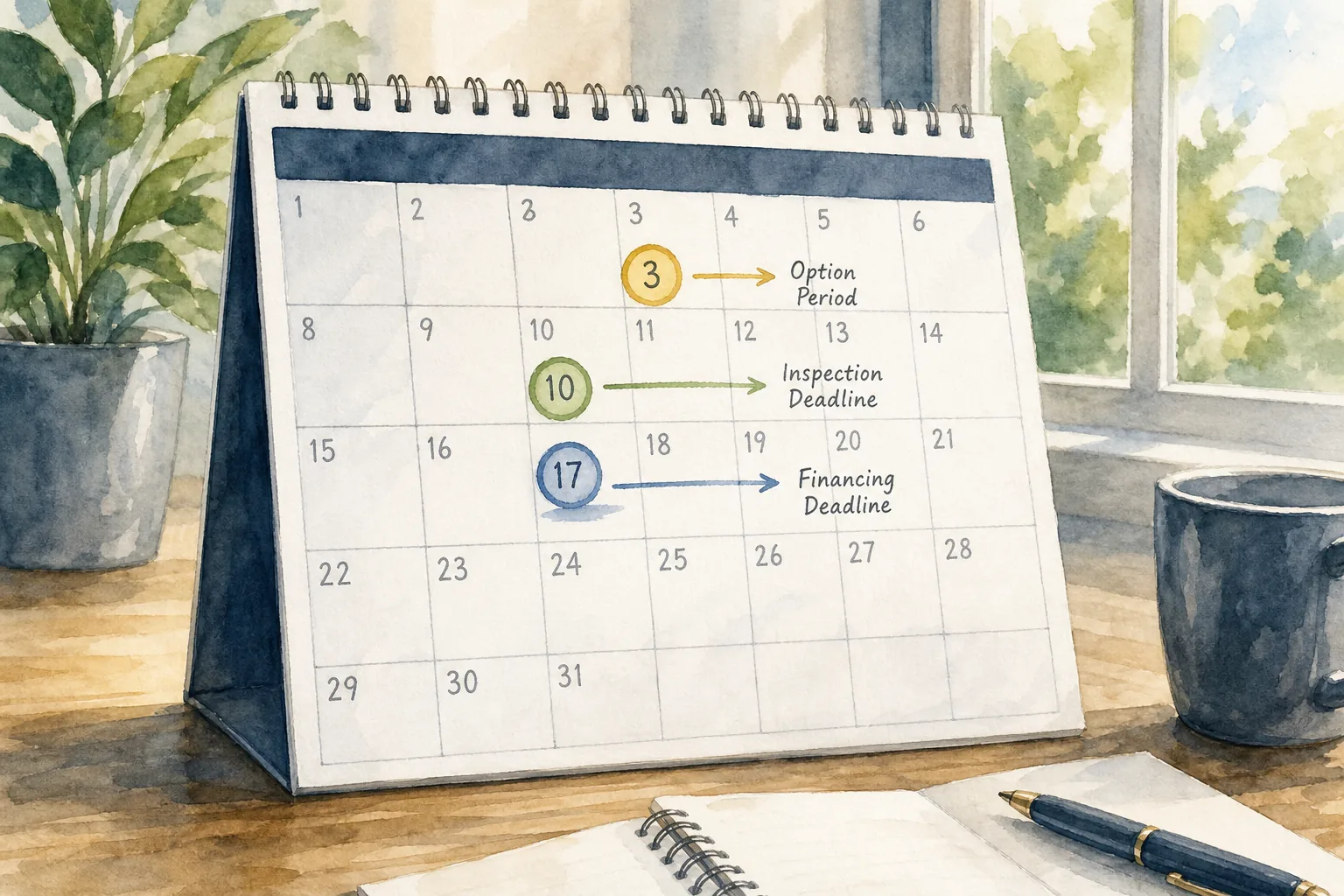
Texas earnest money deadlines visual guide

Understanding these triggers lets you protect your cash and avoid surprises at closing.

Earnest Money in Texas: Deadlines, Contracts, and Local Practice

The standard contract form spells out where to send the deposit, how to label it, and the exact timing. Most Austin and Zilker transactions use the same form, but local REALTORS may negotiate a shorter option period in hot markets.

Typical deadlines look like this:

  • Earnest‑money delivery: within three business days of the contract’s effective date.
  • Option period: 5‑10 days, depending on market pressure.
  • Inspection contingency: usually 7‑10 days after the option period ends.
  • Financing deadline: often 15‑20 days after the contract is effective.

If a deadline lands on a holiday, the contract automatically extends to the next business day. That protects you from missing a cut‑off when banks are closed.

Local practice can differ. In Zilker, sellers sometimes ask for a 2% deposit on higher-priced homes because the market moves fast. In slower suburbs, a flat $1,000 may be enough to show intent.

My Moving to Texas from New York and buying a house guide breaks down these regional quirks and helps newcomers avoid costly missteps.

Always double‑check the escrow instructions on the contract. A typo in the bank account number can delay the release of funds and even cause the seller to terminate the agreement.

How Earnest Money Affects Your Offer and Your Budget

Earnest money is the first line of credit you show a seller. A larger deposit can make your offer stand out, especially when multiple bids are on the table. But it also ties up cash that could otherwise go toward your down payment or closing costs.

For example, on a $400,000 home with a 1% deposit, you tie up cash until the transaction moves forward. If the seller rejects your offer, that deposit returns to you, assuming you haven’t breached any contingencies. If you win the deal, the deposit rolls into your down‑payment or closing costs.

Cash buyers often offer 2% or more because they can afford to keep that money liquid. Mortgage buyers may stick to the 1% benchmark to preserve funds for lender‑required reserves.

When you calculate your budget, treat the earnest money as part of your total cash‑to‑close estimate. My How to Choose a Mortgage Lender in 2026 article walks you through budgeting for deposits, reserves, and closing fees.

Keep an eye on the market. In a hot Austin summer, sellers might ask for 2% to weed out weaker offers. In a slower market, a $500‑$1,000 flat amount can be enough to get the contract signed.

Bottom line: balance the signal you send with the cash you can afford to lose if something falls through.

Frequently Asked Questions

What happens to my earnest money if I back out before the option period ends?

You get a full refund of the earnest money, but you lose the option fee you paid to the seller.

Can I use a personal check for earnest money?

Yes, a personal check works, but many sellers prefer a wire transfer for speed and security.

Is earnest money required for a new‑construction home?

Builders often ask for a deposit, but the terms can differ from resale contracts. Review the builder’s agreement carefully.

What if the seller backs out after I’ve paid earnest money?

The seller must return your earnest money, and you may be entitled to additional damages under the contract.

Do I need to pay earnest money if I’m buying with cash?

Cash buyers still provide earnest money to show seriousness; the amount can be higher to strengthen the offer.

Conclusion

If you’re ready to make an offer, start by deciding on a deposit that matches the market pressure and your cash‑flow plan. Then work with a trusted Texas agent, like me, Robbie English, REALTOR, Broker, to get the paperwork right and keep your money safe.

Reach out via my website to schedule a consultation and lock in a strategy that protects your earnest money while keeping your offer competitive.

Y'all Might Want To Check These Out Too...

What to Look for During Open Houses: A Buyer’s ChecklistWhat to Look for During Open Houses: A Buyer’s Checklist Why Robbie English is the Realtor You Can Trust in AustinWhy Robbie English is the Realtor You Can Trust in Austin What is pmi on a mortgage what pmi means and how it works on a mortgageWhat Is PMI on a Mortgage? Costs, Removal & How It Works Default ThumbnailHow a Quarter-Point Rate Change Affects Your Mortgage Payment

Filed Under: blog, Home Buying

your dream home starts here
download closely
sell your home

Disclaimer: The content on this website is provided for general informational and educational purposes only. It is not legal, tax, accounting, financial, appraisal, or other professional advice. Reading these articles or contacting me through this website does not create a broker-client relationship. I am not an attorney, tax advisor, accountant, financial advisor, or licensed real estate appraiser. Only a licensed or certified real estate appraiser can provide a real estate appraisal. Only a licensed and certified appraiser can set a property’s value. Real estate laws, contracts, market conditions, and individual circumstances vary, so you should seek advice from the appropriate licensed professionals before making decisions.

start your home search

download closely

sell your home

Real Estate Resource Center by Robbie English

Pick a Topic:

Find Answers To Real Estate Questions Asked on Reddit

You may also like

What to Look for During Open Houses: A Buyer’s ChecklistWhat to Look for During Open Houses: A Buyer’s Checklist Why Robbie English is the Realtor You Can Trust in AustinWhy Robbie English is the Realtor You Can Trust in Austin What is pmi on a mortgage what pmi means and how it works on a mortgageWhat Is PMI on a Mortgage? Costs, Removal & How It Works Default ThumbnailHow a Quarter-Point Rate Change Affects Your Mortgage Payment

Blog Article Topics

Absentee Owners • Austin Area Housing Market • Austin Real Estate • Austin Landlord Service • Build to Rent • Building A Home •  Cedar Park • Compensation • Distressed Homeowners • Downsizing • Financially Motivated • Find Your Place • First Time Home Buyers • For Sale By Owner • Greater Austin Housing Market • Green-Energy Efficiency • Homeowners Associations • Home Buying • Home Improvements • Home Pricing • Home Staging and Depersonalization • Home Values • Homeownership • Interest Rates • Investment and Vacation Rentals • Leander • Lifestyle • Living in Austin • Living in Cedar Park • Living in Central Texas • Living in San Antonio • Luxury Real Estate • Market Updates • Mortgage Financing • Moving to Austin • Moving to San Antonio • Moving to Texas • Multi-Generational Housing • My Advanced Education •  Negotiations • Off-Market Representation • Preparing for Closing • Probate and Estate Sales • Property Taxes • Real Estate • Refinancing Your Mortgage • Renting and Leasing •  Representation •  San Antonio Housing Market • San Antonio Real Estate • Selling Your Home • Selling Your Luxury Home • Short Term Rentals • Supply and Demand • Texas Property Management •  Trends

Search By Category

Blog Posts

When Is the Perfect Time To Move?

When Is the Perfect Time To Move?

To Buy or Rent: Making the Right Real Estate Decision for You

To Buy or Rent: Making the Right Real Estate Decision for You

Your Guide to Fort Croghan Day

Your Guide to Fort Croghan Day

Thinking About Renting Your House Instead of Selling?

Thinking About Renting Your House Instead of Selling?

Your Listing Looks Great, But How Does It Smell?

Your Listing Looks Great, But How Does It Smell?

What You Need to Know About Intermediary in Texas Real Estate

What You Need to Know About Intermediary in Texas Real Estate

What Is a Title Commitment and Why Do You Need to See One?

What Is a Title Commitment and Why Do You Need to See One?

Robbie English, REALTOR, Broker

512-910-HOME (4663)

512-400-3082

830-953-5571

Uncommon Realty

Main Office:
5114 Balcones Woods Dr. Ste 307, Austin, TX 78759

Download My App
download my app

Common sense is a flower that doesn’t grow in everyone’s garden. That’s why we’re Uncommon!

I look forward to representing you! -Robbie

Robbie English Texas Real Estate Education Expert     Unlock MLS  Austin Board of REALTORS  Texas REALTORS  National Association of REALTORS  Highland Lakes Association of REALTORS

Find Homes For Sale in: Austin TX • Bee Cave TX • Burnet TX • Cedar Park TX • Cottonwood Shores, TX • Georgetown TX • Granite Shoals TX •  Highland Haven • Highland Lakes • Horseshoe Bay, TX • Hutto TX • Jonestown TX • Lago Vista TX • Lakeway TX • Leander TX • Marble Falls, TX • Manor TX • Pflugerville TX • Round Rock TX

My website uses state-of-the-art property search, including an interactive map search, to find homes for sale in the Central Texas Hill Country.

  • Buy
  • Sell
  • What’s My Home’s Value?
  • Search Properties
  • Service Area
  • Download App
  • Infographics
  • Real Estate Resource Center

© Copyright 2026 · All Rights Reserved · Robbie English, Broker, Property Manager, and REALTOR, National Instructor, Speaker

Privacy Policy • DCMA • Texas Real Estate Commission Information About Brokerage Services • Texas Real Estate Commission Consumer Protection Notice • Web Accessibility Help
All information deemed correct but not guaranteed.

Accessibility Adjustments

Powered by OneTap

How long do you want to hide the toolbar?
Hide Toolbar Duration
Select your accessibility profile
Vision Impaired Mode
Enhances website's visuals
Seizure Safe Profile
Clear flashes & reduces color
ADHD Friendly Mode
Focused browsing, distraction-free
Blindness Mode
Reduces distractions, improves focus
Epilepsy Safe Mode
Dims colors and stops blinking
Content Modules
Font Size

Default

Line Height

Default

Color Modules
Orientation Modules