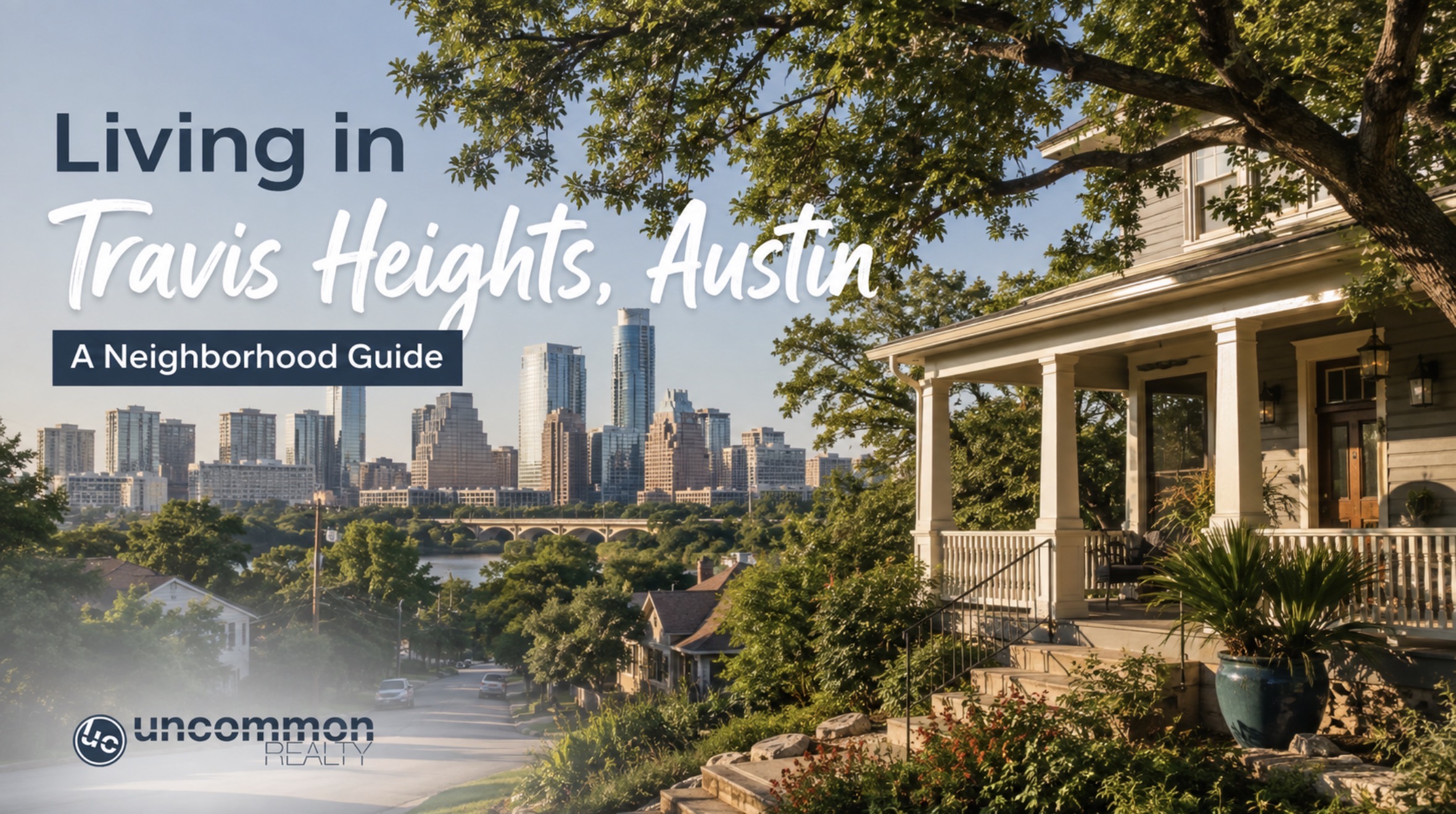
I’ve sold real estate in Austin long enough to watch a lot of neighborhoods change names, boundaries, and reputations. Travis Heights is one of the few that has held onto its identity the whole time. It’s one of the older residential neighborhoods in the city, and it still looks the part: mature oak trees arching over the streets, front porches close to the sidewalk, and a housing stock that tells you exactly when Austin first started building outward from the river.
If you’re weighing whether Travis Heights fits what you’re looking for, I want to give you the real picture, not a marketing version. Here’s what I know about the neighborhood after years of working in Austin real estate, along with the history and details worth knowing before you go look at a house.
TLDR (Too Long; Didn’t Read): Living in Travis Heights, Austin: A Neighborhood Guide
- Travis Heights sits just south of Lady Bird Lake, a short walk or bike ride from downtown Austin across the South First or South Congress bridges.
- The neighborhood is built around Craftsman bungalows and 1920s cottages on tree-lined, curving streets platted by developer General Stacy, and much of it now sits within the Travis Heights-Fairview Park Historic District on the National Register of Historic Places.
- Stacy Park and Big Stacy Pool, a spring-fed pool open nearly year-round, anchor the neighborhood’s green space along Blunn Creek.
- South Congress Avenue runs along the western edge, putting shops, restaurants, and live music venues within easy walking distance of most homes.
- Homes here range from small original bungalows to fully renovated and new construction, and I can walk you through what’s currently listed and what recent sales look like.
Where Travis Heights Is and How It’s Bordered
Travis Heights sits directly south of Lady Bird Lake and downtown Austin. Its general boundaries run from the lake on the north, to Interstate 35 on the east, to South Congress Avenue on the west, down to Oltorf Street on the south. That puts almost the entire neighborhood within a mile or two of downtown, and closer sections are walkable to the lake trail in minutes.
Because of that location, getting downtown doesn’t require a car. Residents cross the river on the South First Street bridge or the South Congress Avenue bridge, both of which connect directly into downtown Austin’s street grid. I’ve had clients choose Travis Heights specifically because they wanted a short commute to downtown offices without giving up a quiet residential street to come home to.
The History Behind the Streets
Travis Heights has an unusually well-documented history for an Austin neighborhood. The area’s development started with the Fairview Park subdivision in the 1880s, platted by real estate developers from New York not long after the 1876 Congress Avenue bridge connected South Austin to downtown for the first time.
The Travis Heights subdivision itself came later, in the 1910s, after the city extended its streetcar line south of the river. A developer named General Stacy laid out the subdivision with a mix of curving and grid streets, offering lot sizes and prices that ranged from modest bungalow lots to larger home sites with views. The neighborhood took off immediately. By the time General Stacy died in 1928, roughly 600 lots had sold and more than 160 homes had been built.
That building boom is why Travis Heights today is full of Craftsman bungalows with deep porches, low gables, exposed rafter tails, and wood or shingle siding. It’s the dominant architectural style in the neighborhood, though you’ll also find a range of homes built through the following decades and, more recently, contemporary infill construction on some lots.
In July 2021, the Travis Heights-Fairview Park Historic District was listed on the National Register of Historic Places, recognizing it as the first neighborhood south of the river in Austin to receive that designation. That listing documents the district’s architecture and development history and can affect what exterior changes are allowed on contributing structures, so if a historic designation matters to your plans for a property, it’s worth reviewing with your agent and the city before you buy.
Stacy Park, Big Stacy Pool, and the Neighborhood’s Green Space
Blunn Creek runs through the middle of Travis Heights, and Stacy Park follows it for several blocks, split into Big Stacy Park and Little Stacy Park. The park is shaded, informal green space with walking paths along the creek, and it functions as the neighborhood’s connective tissue between its residential streets.
Big Stacy Pool sits inside Big Stacy Park at 700 East Live Oak Street. Built by the WPA in 1936 and opened in 1937, it’s one of the older public pools in Austin and one of the only ones that stays open through the winter. The pool is spring-fed and geothermally warmed, holding a temperature in the 90 to 100 degree range even in cold weather, and it closes only when air temperature drops below freezing or on Mondays for maintenance. Admission is free, and the pool measures 33 yards with six lanes.
From Stacy Park, it’s a short walk north to the Ann and Roy Butler Hike-and-Bike Trail along Lady Bird Lake, which gives Travis Heights residents direct trail access without leaving the neighborhood on foot.
South Congress Avenue and Getting Around Without a Car
South Congress Avenue, known locally as SoCo, forms the western edge of Travis Heights and is one of Austin’s better-known commercial corridors. It’s lined with independent shops, restaurants, food trucks, galleries, and live music venues, and its northern stretch runs directly toward the Congress Avenue bridge into downtown.
Because South Congress borders the neighborhood rather than cutting through it, most Travis Heights streets stay quiet and residential while still putting daily errands and dining within walking distance. That combination, a walkable commercial street on the edge and calm interior streets, is one of the more consistent things I hear from people who already live here.
Downtown access works the same way. Both the South First and South Congress bridges cross Lady Bird Lake into downtown, and each is a short ride by bike or a manageable walk from most parts of the neighborhood, depending on which block you’re on.
Schools Serving Travis Heights
Travis Heights falls within Austin Independent School District, and the neighborhood is built around its own elementary campus. Travis Heights Elementary School, established in 1939, sits inside the neighborhood adjacent to Stacy Park at 2010 Alameda Drive. It operates as an official AISD Two Way Dual-Language campus, offering instruction in both Spanish and English, along with a Pre-K program.
Travis Heights Elementary feeds into Lively Middle School, located on South Congress Avenue, which in turn feeds into Travis Early College High School. The Early College designation reflects a specific academic program structure that allows students to earn college credit while completing high school coursework. As with any AISD campus, I’d encourage you to review current ratings, program offerings, and enrollment details directly through the district or GreatSchools before making a decision based on school assignment, since boundaries and program availability can change.
What the Real Estate Market Looks Like
Travis Heights real estate is defined by its housing stock: original Craftsman bungalows, a range of homes built across the decades since, and a growing number of renovated or newly built properties on original lots. Lot sizes and configurations vary block to block, a holdover from General Stacy’s original mix of small bungalow lots and larger home sites.
Prices in the neighborhood reflect its location and its limited, largely built-out inventory. Homes here have generally traded well above the citywide median in recent years, and well-maintained or updated bungalows close to South Congress or Stacy Park tend to draw the most interest. Because so much of the neighborhood sits within the historic district, buyers planning significant exterior renovations should factor in a review process before assuming a project will be approved as designed.
I don’t think it helps anyone for me to tell you what the market is doing in general terms. If you’re considering a purchase or sale in Travis Heights, I’ll pull the actual comparable sales and current listings for the specific streets you’re looking at, and we can go through what that data means for your situation.
Is Travis Heights the Right Fit for You?
Travis Heights works best for people who want to be close to downtown Austin without living downtown, and who want a neighborhood with an established architectural character rather than a newer subdivision. The trade-offs are the ones you’d expect with an older, centrally located neighborhood: smaller original lots in some sections, an active historic review process for exterior changes on contributing properties, and pricing that reflects high demand for a limited supply of homes.
I’ve represented buyers and sellers across a lot of different Austin neighborhoods, and I think the most useful thing I can do is give you a straight read on how a specific property or block compares, rather than a generic pitch. You can read more about how I work on my about page, and about the brokerage I lead at Uncommon Realty. If you want to see how Travis Heights fits into the broader Austin market, my Austin, TX real estate page is a good place to start.
If you’re weighing a move to Travis Heights, or trying to figure out what your current home there is worth, reach out and I’ll walk you through what I’m seeing on the ground, block by block.
Robbie English, REALTOR, Broker at Uncommon Realty.
You Might Also Find These Helpful
- explore homes for sale in Austin
- search current listings
- Travisso in Leander, TX
- Living in East Austin, TX