A flag lot is a piece of land where the main buildable area sits behind another property, connected to the street by a narrow strip — picture the shape of a flag on a pole. I’ve walked buyers through a handful of these over the years, and reactions split pretty evenly: some love the privacy right away, others get nervous about the driveway situation before they’ve asked the right questions.
Quick take: a flag lot can be a smart purchase when the access strip is wide enough, drainage has been handled correctly, and the home is positioned well — privacy is what draws most people to them, and what it resells for later comes down to how well it was built, presented, and priced for the right buyer. I’m Robbie English, REALTOR, Broker at Uncommon Realty, and this is exactly the kind of property where walking it with someone who’s evaluated a few before saves you from a regret later. If you end up renting the place out down the road, we handle that too through Uncommon Rentals by Uncommon Realty.
TLDR (Too Long; Didn’t Read): Are Flag Lots A Good Financial Decision?
- Flag lots offer privacy but require careful evaluation
- Buyers need to understand access, driveway, and layout
- Resale can go up or down depending on the location and design
- Access strip width, drainage, and shared-driveway agreements are the details that matter most
Understanding What Makes A Flag Lot Special
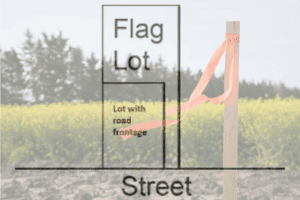 Before you look at the benefits or potential drawbacks, it helps to know exactly what a flag lot is. A flag lot earns its name from its shape, which resembles a small flag on a pole. The main portion of the land sits behind another lot, while a narrow access strip connects it to the public road. That slim driveway-like section is the only entrance. On paper it looks simple. On site it gets more complex, because every flag lot has its own personality — some stretch deep into wooded land and feel tucked away, others sit behind newly built homes and feel wide open or compact. The one constant is a buildable area tucked behind a front lot, reached by a slim pathway.
People sometimes assume the access strip always feels tight or limiting, but that’s not necessarily true. Width, paving material, fencing, vegetation, and distance from the road all vary from one flag lot to the next, and each of those variables affects value. When I walk one of these with a buyer, I’m looking at how an appraiser is likely to view the lot, how future buyers might react to the layout, and how utility placement, drainage, and local regulations affect long term feasibility — that’s the kind of thing that’s easy to miss if you haven’t evaluated a few of these before.
The Unique Appeal And Benefits Of Flag Lots
Flag lots offer benefits many traditional parcels don’t. The most obvious one is privacy. When your primary living space sits behind another home, you gain a buffer — the front home absorbs road noise, blocks headlights at night, and creates natural separation from the neighborhood’s flow of activity. In Central Texas, buyers who want a quiet retreat often gravitate toward this feature; the seclusion can feel almost like countryside living even inside a developed area. Some owners appreciate the distance from drive-by traffic. Others like that they can lay out patios, gardens, or play areas without feeling exposed to the street.
Affordability can occasionally be an advantage too. Developers sometimes price flag lots more competitively because the layout appeals to a smaller pool of buyers. That doesn’t automatically mean the value is discounted, but it can create opportunity for a buyer who values privacy or land shape more than street frontage — and if the home is well designed and well maintained, that advantage can carry through to resale.
There’s also something to be said for how a flag lot creates a sense of personal entrance. When the driveway leads only to your home, you control the approach and the flow of arrival becomes deliberate. Landscaped and lit well, that access strip becomes a feature rather than a compromise instead of a liability.
Issues To Consider Before Committing To A Flag Lot
Every property type carries its own considerations, and flag lots are no exception. Access can cause friction if it isn’t designed appropriately — the driveway-like section needs to allow for comfortable entry and exit, and that includes width, slope, stability, visibility, and usable maneuvering room. Fire safety standards sometimes require specific widths for emergency vehicles, and utility providers may need a clear pathway. Drainage matters too: if the access strip sits lower than the adjacent land, water can pool during storms, and the buildable area in back should be checked for grading and runoff since some flag lots slope sharply and others sit level.
Privacy, while a benefit, can backfire if the front home sits too close or feels visually controlling. A well positioned home behind another can feel serene and comfortable; a poorly positioned one can feel boxed in. Orientation, window placement, fencing, and tree coverage all matter here, and they’re worth evaluating with a trained eye.
Shared driveways show up in some flag lot configurations, and that arrangement needs clear terms. Agreements should address maintenance, cost sharing, repair responsibility, and access rights — without that in writing, disputes tend to follow. Lighting matters too: a narrow driveway can feel dark at night without it, which affects safety, curb appeal, and everyday usability.
How To Identify A Flag Lot When Viewing Homes
Some buyers notice something feels different the moment they walk onto a property — the driveway extends farther than usual, or the home sits behind another and the entry feels tucked away. The visual cue is the narrow access strip: if the lot touches the public road only with a slender portion of land, you’ve likely found a flag lot. That long, thin section leads to the larger buildable space, and the rear portion sitting behind another property is the main living area.
Parcel maps help confirm it. Scanned from above, a flag lot is shaped exactly like a flag attached to a pole — the pole is the access strip, the flag is the spacious back area. Online parcel maps show this clearly even when a drive-by view hides the layout. Fencing along the entry can sometimes make the access strip look like a private lane while it’s still legally part of the lot.
Another tell is mailbox placement. Homes on flag lots often have their mailbox near the street entrance rather than near the home itself, and trash pickup tends to follow the same pattern, meaning you may be hauling your bins a fair distance.
Evaluating Whether A Flag Lot Supports Your Lifestyle
Buying a home means buying a lifestyle, and a flag lot supports certain lifestyles well. If you want a sense of retreat while staying close to town, or you value privacy more than street frontage, the layout is a natural fit. Homeowners who enjoy quiet evenings on a patio or porch tend to appreciate the separation from street activity, and the longer driveway section acts as a transition zone that feels peaceful. Pet owners sometimes like being able to create enclosed, secure outdoor space, and gardeners may appreciate the rear placement shielding a yard from wind or dust off the road.
Contractors and home service providers need clear access, though. If you plan to remodel, add on, or bring in large equipment, make sure vehicles can actually handle the access strip before you commit to the project — I check this for clients as a matter of course, since it’s the kind of thing that causes real headaches after closing if it’s missed. Lighting is another practical factor: a long access driveway often needs additional fixtures to stay safe and visible, which matters more in the rural and semi-rural pockets of Central Texas where street lighting is limited.
The Financial Realities Of Buying A Flag Lot
Financial decisions around flag lots depend on several variables. Buyers sometimes find flag lots priced slightly below front-facing parcels, since demand dips a bit when some buyers prefer a traditional layout. A lower purchase price doesn’t automatically limit future value, though — if the home is well placed, well maintained, and appealing, the lot shape doesn’t cap your ability to build equity.
Appraisals vary based on comparable sales, lot usability, and overall appeal — appraisers weigh access, slope, width, utility placement, improvements, drainage, and buyer perception. Understanding how an appraiser is likely to read the property up front leads to better financial decisions down the line. Insurance costs usually stay in line with traditional lots, but access strip maintenance can affect long term expenses, and some buyers choose to upgrade the driveway to concrete or improve the entry landscaping.
Financing rarely becomes a problem, but lenders may ask for clarity on the access strip — they want assurance that legal access exists and that utilities run cleanly and conform to local guidelines, so having that documentation ready before you’re under contract saves time. In some cases a flag lot can appreciate faster than average if privacy becomes a higher-demand feature in the neighborhood, since Central Texas continues to draw buyers who want seclusion within suburban developments. That’s not guaranteed, but with the right property it’s a real possibility.
Resale Concerns And Opportunities With Flag Lots
The resale conversation matters because every purchase should consider future value, even if you plan to stay for years. Flag lots create both opportunities and challenges in resale. Some buyers actively pursue them for the privacy and the tucked-away setting, and that emotional appeal can drive strong offers on a property that feels unique and inviting. Other buyers hesitate over driveway length, layout, or how the home is oriented on the lot. Those concerns don’t have to hurt your resale potential, but they do change how you should market the property.
Presentation carries a lot of the resale outcome here. Landscaping along the access strip can turn the approach into an asset, proper lighting adds appeal and comfort, clean maintenance records reassure buyers, and open, well-designed outdoor space in the back portion of the lot improves desirability. If a flag lot feels too enclosed, targeted improvements, more light, better sightlines, opened-up landscaping, can reshape how a buyer perceives it.
Why Expert Guidance Matters With Unusual Lot Shapes
Straightforward lot shapes have fewer variables to weigh. Flag lots introduce layers, access, drainage, orientation, financing documentation, resale positioning, that are worth walking through with someone who’s evaluated a few. I’m Robbie English, and at Uncommon Realty that’s the kind of evaluation I do for clients considering one of these properties. And if your flag lot purchase ever turns into a rental property, Uncommon Rentals by Uncommon Realty can handle the management.
So, Are Flag Lots A Smart Choice
After weighing layout, lifestyle, access, value, and resale potential, you can make a thoughtful decision. Flag lots offer privacy, seclusion, and unique appeal, and they require careful evaluation of access, drainage, orientation, and maintenance. If you’re weighing whether a flag lot makes financial sense for you, I’m Robbie English, REALTOR, Broker at Uncommon Realty, and I’d be glad to walk the specific property with you before you decide. Reach out and let’s talk it through.
















Thank you, Robbie, for such a thoughtful and straight-shooting perspective on flag lots. Most articles barely scratch the surface, but you went deep into the financial side and the real-world consequences buyers should expect down the road. I especially liked how you tied everyday livability back to long-term value, because that is what people forget when they only look at the price tag. Your post made it much easier to understand who a flag lot makes sense for and who should probably keep shopping. Great insight as always.
Robbie, I really appreciate you breaking this down the way you did. Flag lots get talked about like they are either a genius move or a terrible mistake, and you laid out the reality in between better than I have seen anywhere else. The way you explained access issues, resale considerations, and how lenders and buyers may view these properties gave me a much clearer picture of what actually matters. This was helpful, practical, and refreshingly honest, so thank you for taking the time to walk folks through the real pros and cons instead of just selling a dream.
Great post, Robbie. I really appreciate how you broke down the pros and the pitfalls of flag lots instead of just painting them as a bargain or a bad idea. Your perspective on access issues, resale considerations, and how financing can be affected gave this topic a lot more depth than most articles out there. It helped me see that these properties are not a one size fits all deal and that the right decision really comes down to goals, location, and long term plans. Thanks for taking the time to lay it out so clearly and honestly.
Great read, Robbie! I really appreciate the way you broke down the realities of flag lots without trying to sugarcoat the pros and cons. Your perspective made it much easier to understand how access issues, resale challenges, and pricing dynamics actually play out in the real world, not just in theory. It is refreshing to see someone address both the financial side and the lifestyle side instead of treating it like a simple math problem. Thanks for sharing such a thoughtful, honest point of view on a topic most people never fully consider until it is too late.
Robbie, thank you for laying this out so clearly and honestly. The way you walked through the real pros and cons of flag lots, not just the price tag but the daily living side of things, made this post incredibly helpful. I really appreciated how you balanced the financial discussion with real-world livability and resale considerations, because that is the part most articles skip. Your perspective feels grounded in experience, not theory, and it gave me a much better framework for deciding whether a flag lot actually makes sense long-term instead of just looking like a deal on paper.
You are very welcome. Thank you for the comment.