Got a rental or commercial building and want to pull more cash flow out of it early? A cost segregation study can lift your first‑year tax deduction dramatically. Below you’ll find what it is, how it reshapes depreciation, who should bother, and the paperwork you’ll need, especially in Texas.
Table of Contents
- What Is a Cost Segregation Study?
- How the Analysis Changes Depreciation Timing
- Who May Benefit, and When a Study May Not Fit
- Benefits, Tradeoffs, and Common Misconceptions
- Records, Review Questions, and the Texas Real Estate Context
- FAQ
- Conclusion
What Is a Cost Segregation Study?
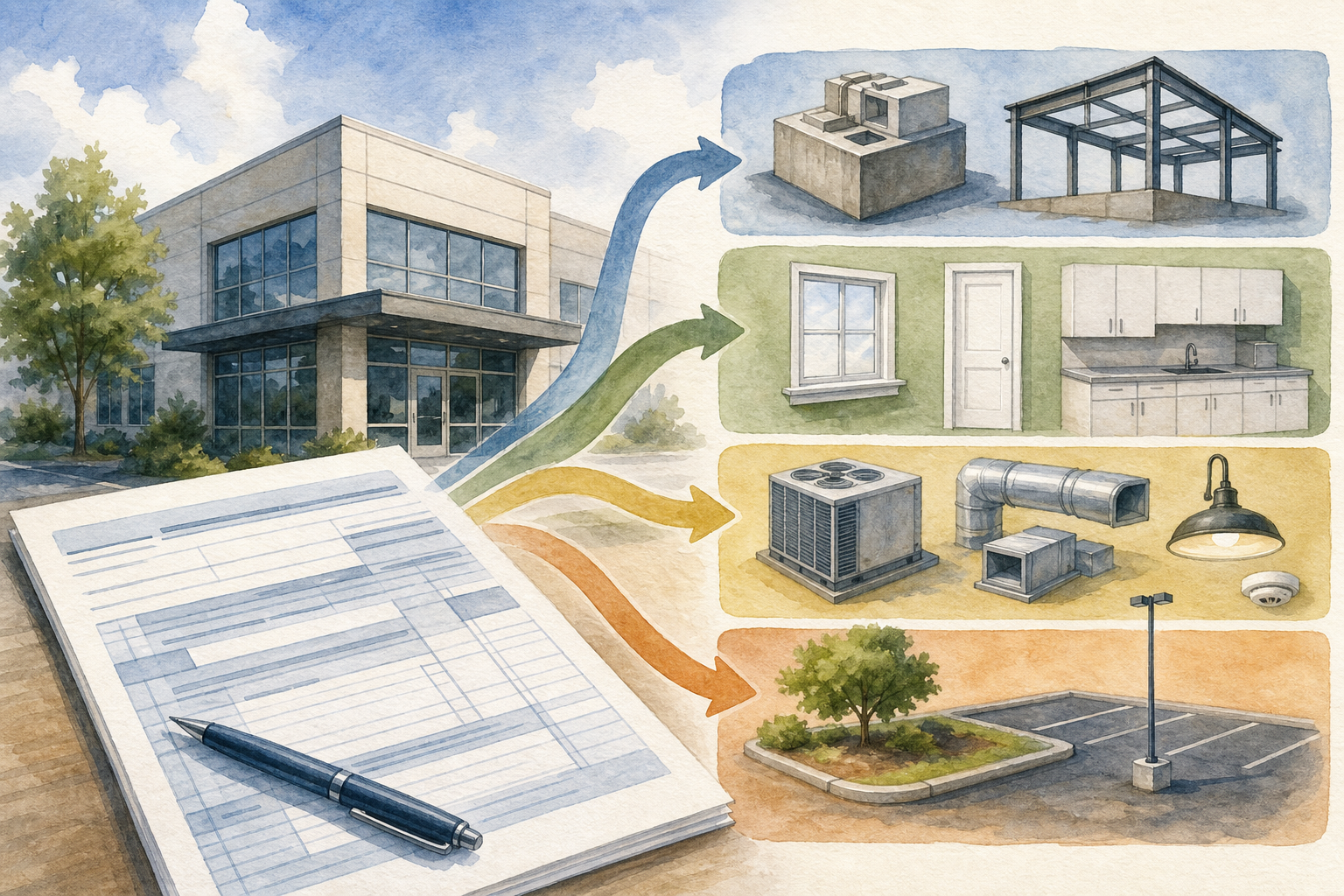
A cost segregation study is an engineering‑based tax analysis that pulls apart a building’s cost basis into shorter‑life components like carpeting, lighting, and land improvements. The IRS treats those pieces as personal property or land improvements, which qualify for 5‑, 7‑, or 15‑year depreciation instead of the 27.5‑ or 39‑year schedule for the structure itself.
Engineers and tax pros do the heavy lifting. They review construction invoices, blueprints, and site photos, then assign each line item to the correct recovery period. The final report lists every component, the cost assigned, and the depreciation schedule you’ll use on your tax return.
Because the IRS can audit the classification, a good study includes detailed support, asset lists, rationale, and source documents. Closing‑cost guides often stress the importance of keeping purchase agreements and construction contracts, which are the same records a cost segregation provider will ask for.
In short, the study re‑labels parts of your property so the tax code lets you write them off faster.
How the Analysis Changes Depreciation Timing
Under the applicable depreciation rules, residential real estate spreads depreciation over 27.5 years and commercial over 39 years. When a study reclassifies, say, 30 % of a $500 k rental into 5‑year property, you pull those deductions into the first few years instead of the tail end.
Take a modest $500,000 rental. Straight‑line depreciation gives about $5,500 in the first year. After a study that re‑classifies $150,000 of components, the first‑year deduction jumps to roughly $30,000, a six‑fold increase. That boost can shave thousands off your tax bill when you’re in a high bracket.
The math works because the accelerated portion also qualifies for bonus depreciation. For assets placed in service after Jan 19 2025, the bonus is 100 % (phasing down after that). So the re‑classified $150,000 can be fully expensed in year one, then the remaining balance follows the 5‑year schedule.
A cost segregation study should use an engineering approach that ties each component to actual cost records. The documented approach and supporting audit-defense documentation can help support the analysis.
Studies typically finish in two to six weeks, depending on how organized your paperwork is. Faster turn‑around means you can file the revised depreciation on your next return and start saving sooner.
 Who May Benefit, and When a Study May Not Fit
Any income‑producing property qualifies, but the payoff depends on size, holding period, and tax situation. A quick screen helps you decide:
- Is the depreciable basis over $500,000? Below that, the study fee can outweigh the tax benefit.
- Do you plan to hold the asset for at least five years? Short‑term owners may face depreciation recapture that erodes the early advantage.
- Can you use the extra deduction? If you’re in a low marginal tax bracket, the cash‑flow boost is smaller.
Investors with large portfolios, high tax brackets, or who need cash flow for other projects tend to see the biggest net gain. Conversely, someone buying a modest single‑family rental to hold for a few years might skip the study.
In Austin’s market, duplexes are a common entry point for investors. If you’re eyeing a duplex, the Duplexes for Sale Austin TX guide explains the price ranges and cash‑flow expectations that pair well with a cost segregation analysis.
Remember, the study is a tax‑engineering tool, not a magic money‑maker. It reshapes timing, not total depreciation over the asset’s life.
Benefits, Tradeoffs, and Common Misconceptions
The headline benefit is front‑loaded tax savings. By pulling deductions into the early years, you improve after‑tax cash flow, which can help pay down debt or fund other acquisitions.
But there are tradeoffs. The study costs a few thousand dollars for a typical residential building and can rise to tens of thousands for large commercial complexes. Those fees are sunk; if you sell the property soon after, the accelerated deductions may be recaptured at ordinary rates, cutting into your profit.
Many owners think a study creates new deductions out of thin air. It doesn’t, it merely changes the schedule. The total amount depreciated over 27.5 or 39 years stays the same; you just get a bigger chunk up front.
Another myth is that bonus depreciation will always apply. The rate is sliding, 100 % for assets placed in service after Jan 19 2025, then 40 % in 2025, with the rate falling further afterward. If your property’s acquisition date falls after the cliff, you can claim the full bonus; otherwise you’ll need to calculate the reduced rate.
Key Takeaway: A cost segregation study is powerful when the early tax cash flow outweighs the study fee and any future recapture risk.
For luxury investors, the upside can be dramatic. A $1.2 M residential rental in Texas, after re‑classifying into 5‑year property, can generate about $94 K of federal tax savings in year one at a 32 % marginal rate. That example shows why high‑value assets often merit a study.
Luxury home owners in Austin might also consider the strategy. The Luxury Homes for Sale in Austin, TX guide discusses price points that line up with the study’s cost‑benefit sweet spot.
Records, Review Questions, and the Texas Real Estate Context
Successful studies start with solid documentation. Here’s a quick checklist of the most important records:
- Purchase agreement, allocation schedules, and closing statement.
- Construction contracts, invoices, and change orders.
- Engineering plans, specifications, and as‑built drawings.
- Asset inventory showing dates placed in service.
- Prior depreciation schedules and tax returns.
Each item should be marked Ready, Requested, Missing, or Not Applicable so you and your CPA can track completeness. The pre‑study checklist from a established provider walks you through that process step by step.
When the property sits in Texas, there’s an extra layer: the state does not have an individual income tax, but the franchise tax and any decoupling rules affect the overall benefit. Texas follows the federal bonus depreciation rules but requires an add‑back on the state return. In practice, you’ll run two parallel depreciation schedules, one federal (with the full bonus) and one Texas‑adjusted.
For Texas, verify whether the owning entity has franchise‑tax or multistate considerations.
Pro Tip: Ask your CPA to set up a separate worksheet that mirrors the federal schedule but subtracts the bonus depreciation add‑back. That way you can see the exact cash‑flow impact on both returns.
 FAQ
FAQ
What types of property can a cost segregation study be applied to?
Any income‑producing real estate, rentals, office buildings, warehouses, and even certain improvements on land, qualifies as long as the component has a recovery period of 20 years or less under applicable depreciation rules.
How long does a study usually take?
Most providers finish in two to six weeks, depending on the complexity of the asset and how quickly you can deliver the required documents.
Can I do a study on a property I bought years ago?
Yes. A look‑back study lets you reclassify assets placed in service in prior years, adjusting the depreciation without amending past returns.
Will a tax authority audit my cost segregation study?
Audits are possible, but studies that follow an engineering approach and include full documentation stand up well to examination.
Do I need a CPA to use the study’s results?
While you can file the numbers yourself, a CPA helps ensure the re‑classified depreciation integrates correctly with your overall tax return and handles any state‑level adjustments.
Conclusion
If your property’s basis exceeds $500 K, you’re likely to see a worthwhile tax boost from a cost segregation study. I recommend pulling together the key documents, getting a quick engineering quote, and letting your CPA run the numbers before you commit.
Ready to see the numbers for your own building? Use the free preliminary analysis on our site, then schedule a chat with a trusted provider to map out the cash‑flow impact.
Ready to put this into practice? Robbie English, REALTOR, Broker was built for exactly this.