I’ve sold homes in Bee Cave for years now, and the question I get most from buyers isn’t about the schools or the commute. It’s “wait, is this actually a separate town, or is it just part of Austin?” Fair question. Bee Cave is its own incorporated city in Travis County, with its own city council, its own police department, and a downtown of sorts built around one of the biggest shopping centers in the Hill Country. It just happens to sit close enough to Austin that a lot of people who work downtown live here without thinking twice about the drive.
What I tell people looking at homes for sale in Bee Cave is that this is the city for buyers who want Hill Country scenery and a slower pace on their own street, but don’t want to give up good grocery stores, a bookstore, a movie theater, and a decent restaurant within ten minutes. That combination is rarer than people think out here.
TLDR (Too Long; Didn’t Read): Living in Bee Cave, TX
- Bee Cave sits about 14 to 17 miles west of downtown Austin off Highway 71, with a drive time of roughly 25 to 30 minutes outside of rush hour
- The Hill Country Galleria functions as the city’s de facto downtown, with major retail, dining, a movie theater, and regular community events
- Kids in Bee Cave attend Lake Travis ISD, one of the higher-performing districts in the Austin area, starting at Bee Cave Elementary
- Housing runs more upscale than most Austin suburbs, with newer construction, larger lots, and Hill Country terrain in most neighborhoods
- Outdoor life leans toward parks, trails, and golf rather than lake access itself, though Lake Travis is a short drive away
- It’s a strong fit for families and professionals who want space and quiet but aren’t willing to drive 45 minutes for a decent dinner out
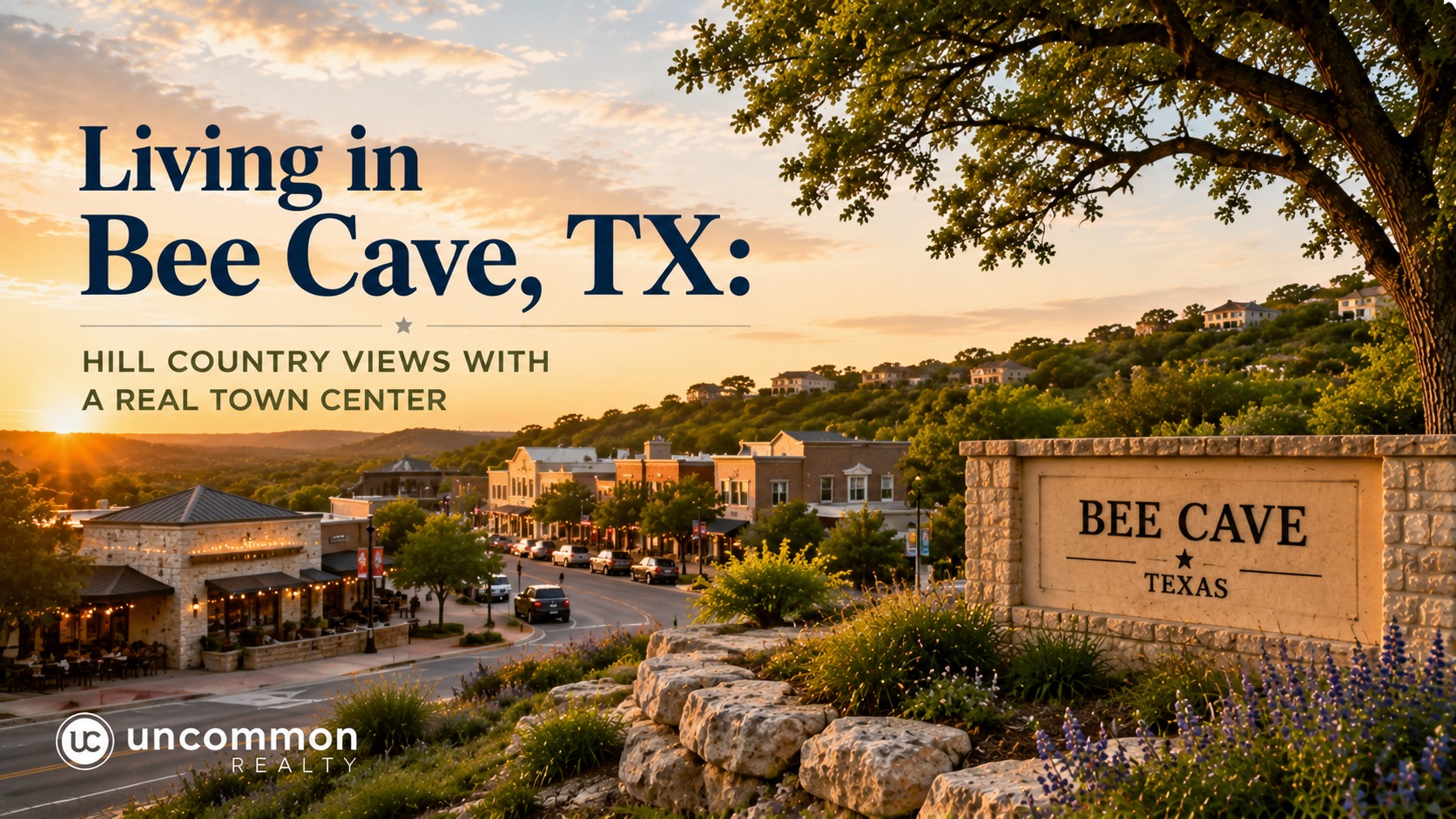
Where Bee Cave sits and what the commute actually looks like
Bee Cave is west of Austin along Highway 71, right where 71 meets RM 620. That intersection is the heart of the city and also the location of the Hill Country Galleria. If you’re coming from downtown Austin, you take 71 west, and depending on which route you use, you’re looking at somewhere between 14 and 17 miles. In light traffic that’s about 25 to 30 minutes. During peak commute hours, especially the afternoon push west on 71, it can stretch out closer to 45 minutes to an hour, and I won’t pretend otherwise. Buyers moving from other parts of the country sometimes underestimate how much Austin’s growth has changed this corridor over the last decade. It’s not the sleepy two-lane drive it used to be.
That said, a lot of my clients in Bee Cave aren’t commuting downtown every day. Plenty work from home, work locally, or commute to job centers along 620 or in Lakeway and Westlake, which cuts the drive down considerably. If your job is fully downtown five days a week, I’ll be honest with you about what rush hour looks like before you buy, because that’s the kind of thing you want to know before signing, not after.
Community character and everyday life
Bee Cave reads as a planned, deliberate kind of Hill Country suburb. The terrain does a lot of the work here, rolling hills, live oaks, limestone outcroppings, and that means most neighborhoods have real topography instead of flat subdivided grids. Streets curve with the land instead of cutting through it.
What sets Bee Cave apart from a lot of the other western suburbs is that it has an actual commercial center instead of relying entirely on Austin for daily errands. Because of the Galleria and the businesses that have grown up around it, you can do a full week of living, groceries, a doctor’s appointment, dinner out, picking up a book, without leaving city limits. That’s not true everywhere out here, and it changes the day-to-day feel of the place. It doesn’t feel like a bedroom community that shuts down after 6pm.
Housing in Bee Cave
I’ll say this plainly since Texas doesn’t require sellers to disclose sale prices and I’m not going to make numbers up: Bee Cave generally sits on the more upscale end of the Austin suburb spectrum. You’ll see more custom and semi-custom builds, larger lots, and more recent construction than you would in older, closer-in Austin neighborhoods. Compared to Lakeway or Westlake, it can run a bit more accessible depending on the neighborhood and lot size, though it’s still not a budget market by any stretch.
Most of what I show buyers in Bee Cave falls into a handful of categories: gated communities with larger acreage lots, newer master-planned neighborhoods closer to the Galleria with a more walkable feel, and a smaller number of older properties on bigger, unrestricted tracts for buyers who want more room to build or add on. If you’re cross-shopping Bee Cave against Lakeway, Dripping Springs, or West Austin, I’d rather walk you through actual comparable listings than throw dollar figures at you here. Every one of these markets moves differently street to street.
Schools
Bee Cave falls entirely within Lake Travis ISD, which is one of the district names I hear buyers specifically request by name, not just as a nice-to-have. Kids in most Bee Cave neighborhoods start at Bee Cave Elementary, then move on to Bee Cave Middle School and finish at Lake Travis High School. Lake Travis ISD has a strong academic and athletic reputation in the Austin metro, and it’s one of the bigger draws for families relocating here from out of state.
One thing I always tell buyers: attendance zones shift as neighborhoods grow, so if a specific campus matters to you, I’ll confirm the current zoning for that exact address before you write an offer rather than relying on a general assumption about “Bee Cave schools.”
Shopping, parks, and things to do
The Hill Country Galleria is the obvious anchor. It’s a large mixed-use center with retail, restaurants, office space, and residential units built in, anchored by stores like Dillard’s, Barnes & Noble, Dick’s Sporting Goods, a Cinemark theater, and Whole Foods. The Galleria also hosts a steady calendar of community events throughout the year, including a spring and fall outdoor concert series at its amphitheater and the twice-yearly Pecan Street Festival, a juried arts and crafts show that draws people in from across the metro.
For outdoor time, Bee Cave Central Park is the neighborhood standby, 50 acres with a mile of trail, a playscape, a basketball court, and a dog park with separate areas for small and large dogs. The Bee Cave Sculpture Park sits near the police department and rotates in outdoor art pieces, which is a nice surprise for a city this size. If you want something less manicured, Falconhead West Primitive Park has hiking and biking trails through native brush and is popular with people who want a quieter walk than the Galleria crowds. Golfers know Falconhead Golf Club, a public course that regularly shows up on best-of lists for the Austin area.
Lake Travis itself isn’t inside city limits, but it’s close enough that boat ramps and lake access points are a short drive for anyone who wants water on the weekends without living directly on the shoreline.
Who Bee Cave is a good fit for
I steer buyers toward Bee Cave when they want Hill Country scenery and a strong school district but still want a real commercial center nearby instead of a 20-minute drive for groceries. It tends to fit families who value Lake Travis ISD specifically, professionals who don’t need a downtown Austin commute every single day, and anyone moving from a bigger metro who wants space without feeling cut off from restaurants, shopping, or things to do on a Saturday.
It’s probably not the right fit if a short downtown commute is non-negotiable for your daily schedule, or if you’re looking for the most affordable entry point into the Austin suburbs. There are other cities in this market better suited to that. But if you want a place that feels like the Hill Country while still having somewhere to grab dinner without getting in the car for twenty minutes, Bee Cave is worth a serious look, and I’m happy to walk you through what’s currently available.
Y'all Might Want To Check These Out Too...
 Living in Buda, TX: Small-Town Main Street With an Easy Run Up I-35
 Living in Jonestown, TX: Life on the Quiet North Shore of Lake Travis
 Living in Driftwood, TX: Ranch Land, Wineries, and Hill Country Space Southwest of Austin
 Living in Kingsland, TX: Life at the Confluence of Two Rivers on Lake LBJ