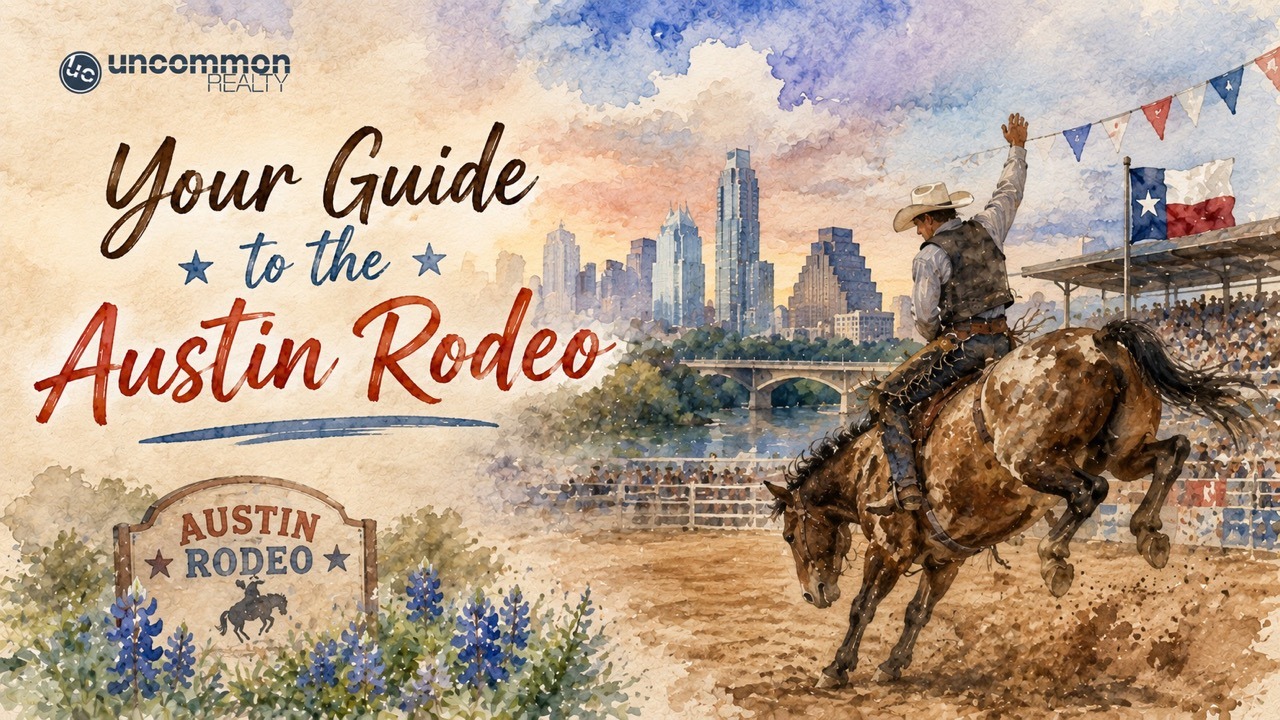
Every March, a stretch of northeast Austin turns into one of the busiest gathering spots in the region. I’m talking about the Austin Rodeo, and if you haven’t been, or if you moved here recently and keep seeing the name pop up without knowing what it actually is, I wanted to put together a real guide. Not a ticket pitch. Just the facts on what this event is, where it happens, and what it says about that part of town.
TLDR (Too Long; Didn’t Read): Your Guide to the Austin Rodeo
- The Austin Rodeo is officially the Star of Texas Fair & Rodeo, a nonprofit event held every March at the Travis County Expo Center in northeast Austin
- It combines a ProRodeo competition, a full carnival, a livestock show, and nightly concerts across roughly two weeks
- The event traces back to 1938 and now funds a scholarship program that has awarded millions of dollars to Texas students
- The Expo Center sits on more than 100 acres off Decker Lane, a short drive from downtown Austin
- I like pointing out local events like this because they say a lot about what everyday life feels like in a given part of Austin
What the Austin Rodeo Actually Is
The event most people call “the Austin Rodeo” has an official name: the Star of Texas Fair & Rodeo. It runs every March at the Travis County Expo Center, and Rodeo Austin, a 501(c)(3) nonprofit organization, produces it. That nonprofit structure matters, because it shapes what the event is built around. This isn’t a private for-profit carnival that rolls through town. It’s a community organization that happens to run a fair.
The fair itself stretches across roughly two weeks and includes a few distinct pieces that run at the same time:
- A sanctioned ProRodeo competition featuring events like bull riding, barrel racing, and steer wrestling
- A full midway carnival with rides, games, and fair food vendors
- A livestock show where young people from across Texas exhibit animals they’ve raised
- Live concerts held most nights as part of the ticket
I mention all four because a lot of people only know one piece of it, usually the concerts or the carnival, and don’t realize the rodeo and livestock show are the actual backbone of the event.
A Look at Rodeo Austin’s History and Mission
The roots of this event go back to 1938, when a small livestock exhibition called the Baby Beef Show took place on the old Capitol grounds downtown. At the time, Travis County had thousands of working farms, and the show existed to support that part of the local economy. Over the following decades it grew into the fair and rodeo it is today, and it eventually moved out to its permanent home at the Expo Center.
What stands out to me most, and what I think gets overlooked, is the scholarship program. Since 1981, Rodeo Austin has awarded millions of dollars in scholarships to Texas students through this program, funded by the fair’s proceeds. Thousands of students have received support over the years. The organization also brings in thousands of schoolchildren annually for educational tours of the fairgrounds, where they learn about agriculture and ranching directly from the exhibitors. More than a thousand volunteers, donors, and sponsors keep the whole operation running.
So when I describe the Austin Rodeo to people, I don’t just call it a fair. It’s closer to a long-running community fundraiser that happens to include a carnival and a concert series.
What You’ll Find at the Fairgrounds
The Rodeo Competition
The rodeo itself is a ProRodeo Cowboys Association sanctioned event, which means the competitors are professionals working their way through a season that spans the country. Events typically include bull riding, saddle bronc, barrel racing, and roping. The rodeo takes place in an indoor arena, a detail that makes it notable among ProRodeo events nationally.
The Livestock Show
This is where the event’s roots really show. Young exhibitors from 4-H and FFA programs across the state bring animals they’ve raised and shown, competing in judged categories. The proceeds from livestock auctions and related fundraising feed back into the scholarship program I mentioned earlier.
The Carnival
A traditional midway runs the length of the fair, with rides, games, and the kind of fair food that only shows up once a year, funnel cakes, turkey legs, and fried everything.
Concerts
Live music happens most nights of the fair, and general admission covers it. The lineup changes from year to year, so I won’t try to describe a specific act here. The consistent part is that there’s a show most evenings.
Getting to the Travis County Expo Center
The fairgrounds sit at the Travis County Expo Center, located on Decker Lane in northeast Austin. The property spans more than 100 acres and includes multiple buildings beyond the fairgrounds themselves, including an arena, a show barn, and a banquet hall that host other events throughout the year when the fair isn’t running. The Expo Center is roughly a fifteen minute drive from downtown Austin, depending on traffic and time of day.
Because the site handles events year round, not just the annual fair, it functions as a genuine piece of infrastructure for that side of the city. Horse shows, trade shows, and community gatherings use the grounds throughout the year.
The Area Around the Expo Center
Northeast Austin, where the Expo Center sits, has its own character within the broader city. The area is defined by a mix of established residential streets, newer development, and access routes like Decker Lane and Manor Road that connect out toward Highway 290 and US 183. It’s a part of town that sits within easy reach of the airport, given its position on the east side of the city, and within a short drive of downtown.
Housing stock in this part of Austin tends to include a range of home ages and styles, from older single-family homes to newer construction as development has continued to move east. Because the Expo Center draws consistent traffic throughout the year for various events, the surrounding roads and commercial areas have built up accordingly, with restaurants and retail along the main corridors.
Beyond the Expo Center grounds themselves, the surrounding area includes local parks, schools, and everyday retail spread along the main roads, the kind of infrastructure that builds up around any established part of a growing city. Colorado River access sits within a reasonable drive to the south, and the broader eastern side of Austin has continued to add restaurants, small businesses, and services over the years as more people have settled in that direction.
If you’re exploring what different parts of Austin have to offer, the area around the Expo Center is worth understanding on its own terms, both for what happens there during the fair and for what the neighborhood looks like the rest of the year.
A Few Practical Notes for Visiting
A handful of things stay true year to year, regardless of the specific dates or lineup:
- The fair runs annually in March, so if you’re planning around it, that’s the season to watch for on Rodeo Austin’s own calendar
- Parking is available on site, though it fills up on concert nights, so I’d budget extra time if you’re heading over in the evening
- General admission typically covers the carnival, livestock show, and concert, while the rodeo itself is a separate ticketed event
- The fair draws large crowds on weekends, so weekday visits tend to be less crowded if your schedule allows it
I’d always point people to Rodeo Austin’s own website for the current year’s specific schedule and ticket details, since those change annually and I want to make sure anyone reading this gets accurate, current information rather than something that might be out of date by the time they read it.
Why I Bring This Up as a Realtor
I write about things like the Austin Rodeo because local events tell you something real about a place. When I’m working with someone trying to understand a part of Austin they’re less familiar with, an annual fair with an 85-plus year history and a genuine charitable mission is a useful data point. It reflects an area with long-standing local institutions, not just new development.
I’ve spent my career in and around Austin real estate, and I try to bring that same grounded, fact-first approach to how I talk about neighborhoods, not just to how I talk about listings. If you want to know more about my background, you can read more about me, and if you’re curious how I work day to day, you can learn more about Uncommon Realty, the brokerage I work with here in Austin.
Whether you’re new to the city or you’ve lived here for years, events like the Austin Rodeo are part of what makes this a genuinely interesting place to live. I’d rather point people toward the real history and the real facts than toward a sales pitch, and that goes for how I talk about events just as much as how I talk about homes.
Robbie English, REALTOR, Broker at Uncommon Realty.