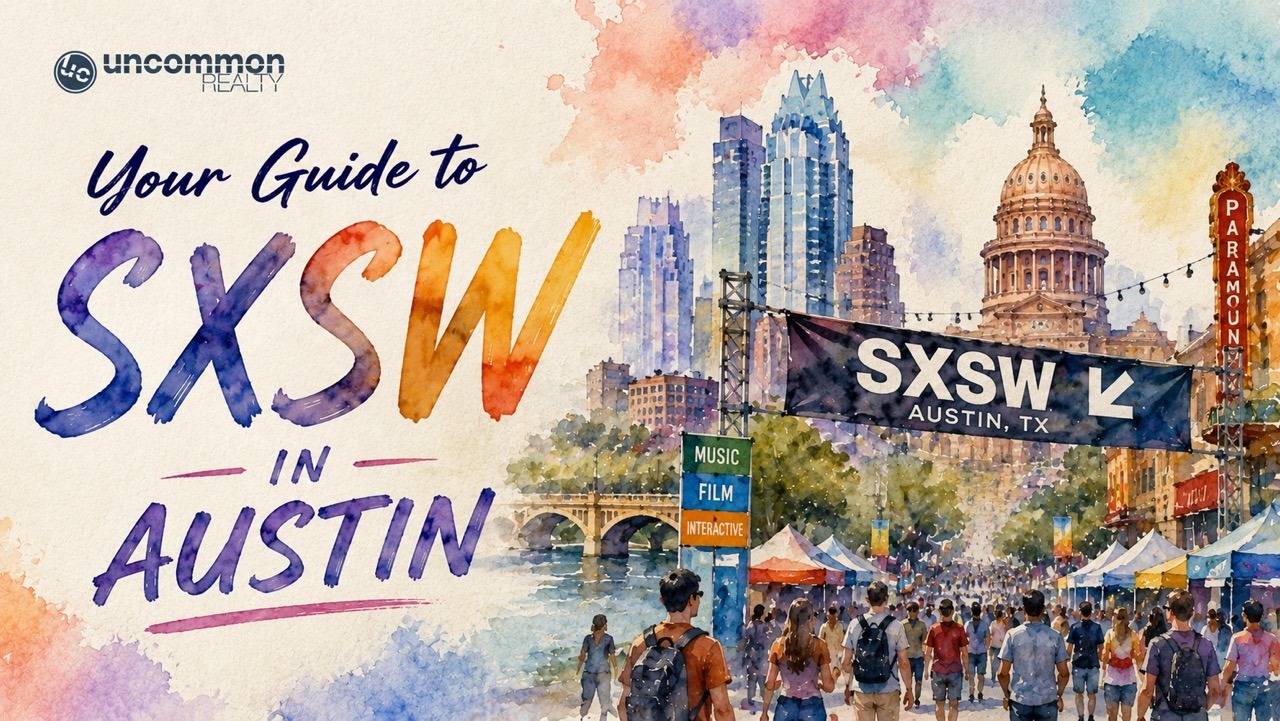
I get asked about SXSW every year, usually by someone who is either looking at a downtown condo or already lives in one and wants to know what they are in for. So I put together this guide as a straightforward look at what South by Southwest actually is, how it affects downtown Austin, and what it means if you live in or near the center of it.
TLDR (Too Long; Didn’t Read): Your Guide to SXSW in Austin
- SXSW is an annual conference and festival held every March in Austin, combining film, interactive technology, and music programming across multiple downtown venues.
- The event is concentrated around the Austin Convention Center, Red River Street, Rainey Street, and Sixth Street, with programming spilling into the Warehouse District and beyond.
- SXSW generates hundreds of millions of dollars in economic activity for Austin each year and is one of the biggest annual boosts to local hotels, restaurants, and retail.
- Living downtown or in close-in neighborhoods during SXSW means street closures, heavier foot and vehicle traffic, tighter parking, and a noticeable jump in short-term rental and hotel demand.
- Buyers and owners considering downtown or close-in Austin property should factor SXSW into their yearly calendar, since it shapes traffic patterns, noise levels, and rental potential for a stretch of March.
What SXSW Actually Is
South by Southwest, known to most people simply as SXSW, started in Austin in 1987 as a music festival. Over the following decades it grew into a much larger event that now combines three main tracks: film and television, interactive technology, and music. Each track runs its own programming, panels, screenings, showcases, and networking events, and they overlap enough that a single day can include a tech keynote, a film premiere, and a live music set within a few blocks of each other.
The event happens every March and runs for a little over a week. It is not a single show at a single venue. It is a citywide event that uses hotels, theaters, bars, parks, and conference space across downtown Austin at the same time.
Where SXSW Happens
The Austin Convention Center downtown serves as the main hub for badge holders and conference programming. From there, the festival spreads out along Red River Street, home to a cluster of live music venues that host showcases throughout the event, and Rainey Street, a corridor of converted bungalow bars that becomes one of the busiest strips in the city during the festival. Sixth Street and the Warehouse District pick up additional overflow, and film screenings and panels are scattered across theaters and hotels throughout the urban core.
If you want a sense of what downtown Austin looks like day to day, outside of festival season, I cover that in more detail on my Austin, TX area page.
The Economic and Cultural Impact on Austin
SXSW is a major driver of Austin’s hospitality and tourism economy. Independent economic impact studies commissioned around the event have repeatedly shown it contributes hundreds of millions of dollars annually to the local economy through hotel stays, restaurant spending, retail purchases, and event services. Hotels downtown routinely sell out well ahead of the festival, and restaurants across the urban core see some of their highest revenue days of the year during that stretch.
The cultural impact runs alongside the financial one. SXSW is where a lot of independent film gets its first audience, where music acts play showcases in front of industry scouts, and where tech companies have historically used the interactive track to launch products in front of a concentrated, engaged crowd. For a city that already leans into live music and creative industries, SXSW is treated as a signature annual event on the calendar, similar in scale to how other cities treat their marquee sporting or cultural events.
What SXSW Means for Downtown Traffic and Parking
If you live downtown or in a close-in neighborhood, SXSW changes your commute and your parking situation for about a week and a half. Several streets in the Red River and Sixth Street corridors close to vehicle traffic entirely to accommodate pedestrian volume and outdoor stages. Cesar Chavez Street and the I-35 frontage roads see some of the heaviest congestion of the year, often moving at a crawl during peak festival hours.
Parking gets tight fast. The garages that normally serve the Convention Center and surrounding blocks fill up early or get reserved for festival operations, which pushes everyday parking demand out into surrounding blocks and garages. Most people who live downtown during SXSW end up relying on rideshare, walking, or Austin’s transit options rather than driving their own car in and out of the core.
If you are used to a quick walk or a five-minute drive to get around downtown, plan on that taking longer during the festival. It is worth building extra time into your schedule for anything time-sensitive, whether that is a work meeting or a flight.
Noise and Foot Traffic
Outdoor stages, street performances, and a much larger volume of pedestrians are part of the deal if your building sits along or near Red River Street, Rainey Street, or Sixth Street. Noise levels increase, sidewalks get busier, and the general pace of the neighborhood picks up noticeably compared to a typical week. Buildings set back from the main corridors, or on higher floors, tend to feel the difference less than ground-floor units directly on the busiest blocks.
What It’s Like Living Downtown or Close-In During SXSW
For residents, SXSW is a mixed bag depending on what you’re looking for out of your week. Some people plan vacations around it and leave town entirely. Others love having a wristband and walking distance to more panels, films, and music than they could ever get to in a year. A lot of downtown residents fall somewhere in between: they work from home more that week, avoid driving, and dip into a show or two on a weeknight because it happens to be a block away.
The appeal of downtown living is that you get proximity to whatever is happening in the city, SXSW included, without needing to drive anywhere or find parking. That same proximity is what brings the noise and crowds right to your doorstep during the festival. It is a trade-off that comes standard with living in the center of a city that hosts a major annual event, and it is worth thinking through honestly before buying rather than being surprised by it in March.
Short-Term Rental and Hotel Demand
SXSW creates a real spike in short-term rental and hotel demand across downtown and close-in Austin. Owners of condos and homes in these areas sometimes rent their properties out for the week at a premium, since visiting attendees, media, and industry professionals are actively looking for lodging close to the action. If you own property downtown or in a walkable distance to the festival footprint, this is a period worth planning around, whether you intend to rent it out, use it yourself, or simply expect a change in the rhythm of your building or block.
What to Consider If You’re Buying Downtown or Close-In
When I work with buyers looking at property downtown, in Rainey Street area buildings, or in neighborhoods within walking distance of Red River and Sixth Street, SXSW comes up as one piece of a bigger picture. It is not the only factor, but it is a real one. Here is what I usually walk through with buyers:
- Distance from the main corridors. A building two or three blocks off Red River or Rainey will experience noticeably less noise and foot traffic than one directly on it.
- Floor level and window orientation. Higher floors and units facing away from the busiest streets tend to feel more insulated from festival activity.
- Parking arrangements. Buildings with dedicated resident parking or garage access hold up much better during festival week than units relying on street parking.
- Short-term rental potential. If income potential during high-demand periods matters to you, it is worth understanding what the building’s rules and the surrounding market look like.
- Your own routine. Some buyers want to be in the middle of everything and see SXSW as a highlight. Others prefer more distance and quiet, which points toward different neighborhoods within the same close-in radius.
None of this changes what a property is worth day to day, but it does affect how a week of the year feels for the people living there, and that is worth factoring into a decision you are going to live with for years.
How I Can Help
I have spent years working with buyers and sellers across downtown and the neighborhoods that surround it, and SXSW is one of many local factors I walk clients through when we talk about a property. If you want to talk through what a specific building or block looks like during festival season, or any other time of year, you can read more about my background on my about page or learn more about my brokerage on the Uncommon Realty page. I’m always glad to talk through what living downtown or close-in actually looks like across the full calendar year, not just the highlight reel.
Robbie English, REALTOR, Broker at Uncommon Realty.
You Might Also Find These Helpful
- explore homes for sale in Austin
- search current listings
- Exploring the Vibrant Heart of Texas
- Cedar Park’s Fastest-Growing Neighborhoods
- browse all Austin Metro event guides
I’ve got a related post that digs into this from another side: MLS Search in Austin Infographic.