A HELOC and a home equity loan both let you borrow against your home, but they work in very different ways. A HELOC gives you flexible access with a rate that can move. A home equity loan gives you one lump sum with a fixed payment. I’ll explain how each works, what it can cost, and which questions to ask before you put your Texas property up as collateral.
Table of Contents
- HELOC and Home Equity Loan: What Each One Is
- Payments, Interest Rates, Fees, and Total Cost
- Qualification, Credit Impact, and Underwriting
- When a HELOC or Home Equity Loan Makes Sense
- Risks, Market Rates, Taxes, and Questions to Ask
- HELOC vs Home Equity Loan FAQ
- Conclusion
HELOC and Home Equity Loan: What Each One Is
When I explain a HELOC vs home equity loan to a homeowner, I start with one simple distinction. A HELOC is a revolving credit line. A home equity loan is an installment loan.
Your equity is the difference between your home’s value and what you still owe on your mortgage. A lender may also review your combined loan-to-value ratio, which compares all debt secured by the home with its appraised value. Your borrowing limit depends on the lender and your finances.
A HELOC works much like a credit card secured by your home. You receive a maximum credit limit, then draw only what you need. As you repay the balance, available credit may return during the draw period. That makes it useful when costs arrive in stages.
Most HELOCs have a draw period followed by a repayment period. During the draw period, you may be allowed to make interest-only payments, though some plans require principal payments too. Once the draw period ends, you generally can’t keep borrowing in the same way. The remaining balance then moves into repayment with principal and interest.
Reported HELOC draw periods range from five to 45 years. That 45-year figure is far outside the 10-year period many guides describe, so don’t assume a familiar term applies to your offer. Read the actual disclosure.
A home equity loan gives you one approved amount at closing. You begin paying principal and interest right away. The rate is usually fixed, and the loan has a set payoff term. Once you pay down the balance, you generally can’t borrow that amount again without applying for new financing.
A lender’s HELOC explainer describes the line as secured by the home and explains how available credit can replenish after repayment. That basic structure is the key difference between the two products.
 Key Takeaway: Pick the structure first. A HELOC fits borrowing in stages. A home equity loan fits one known amount.
Payments, Interest Rates, Fees, and Total Cost
Payment behavior is where the HELOC vs home equity loan choice becomes more than a vocabulary question. The right product depends on how much you need, when you need it, and how much payment change your budget can absorb.
 HELOC rates are generally variable. The rate often follows an index, such as the prime rate, plus a margin set in the loan terms. If that index moves, your rate may move too. Your payment can rise even when you haven’t borrowed more money.
A home equity loan usually has a fixed rate. You receive the full amount at once, then repay it through a scheduled payment. That payment includes interest and principal from the start, so the balance falls with each payment if the loan stays current.
| Decision point | HELOC | Home equity loan |
|---|---|---|
| How funds arrive | Draw money as needed | One lump sum at closing |
| Rate pattern | Usually variable | Usually fixed |
| Payment during early term | May be interest-only or include principal | Principal and interest from day one |
| Can you reuse paid-down funds? | Usually during the draw period | No, not without new financing |
| Budget certainty | Lower at first, but can change | More predictable |
| Main cost concern | Rate increases and a later payment jump | Interest on the full amount from the start |
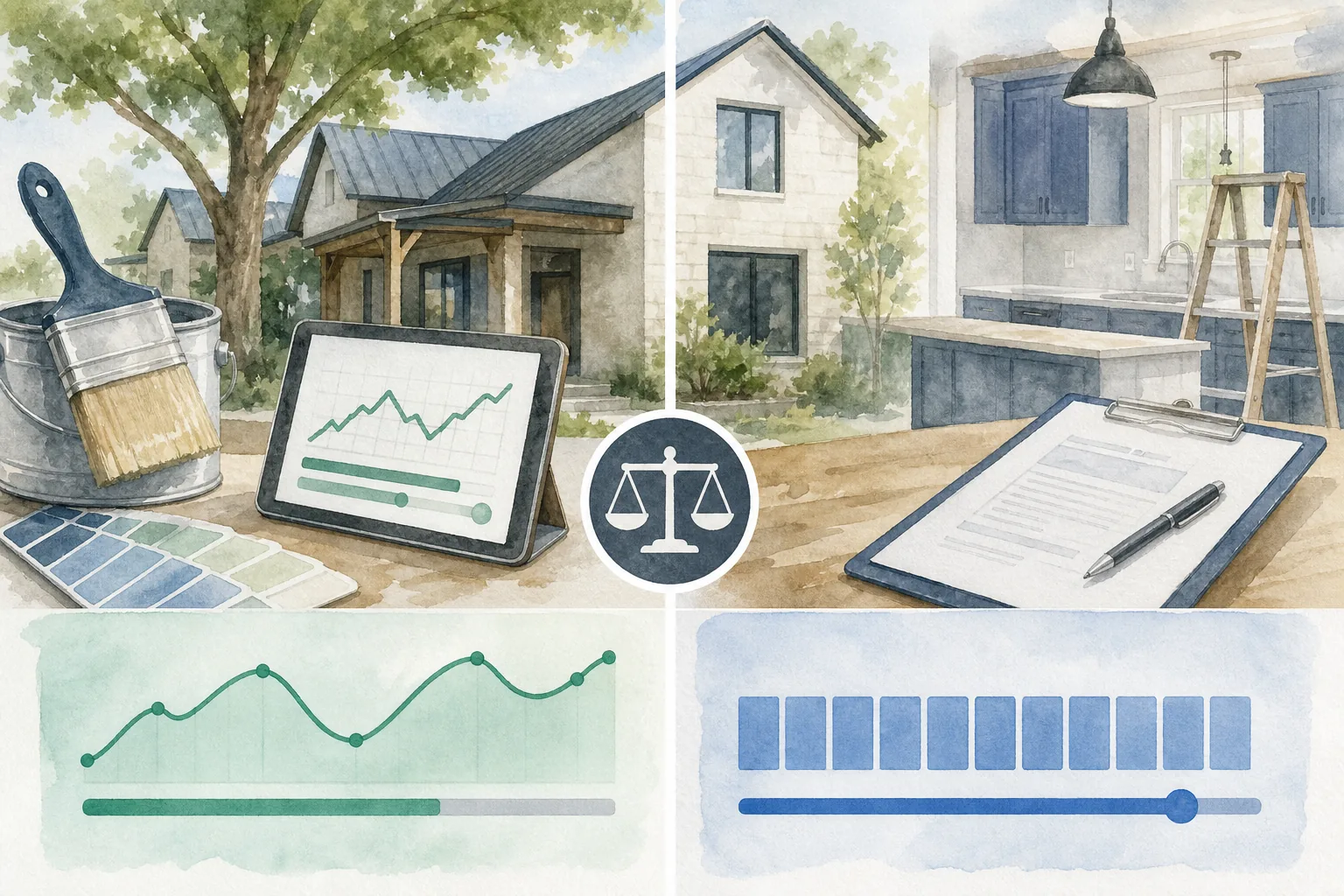
Here’s an easy example. Say a renovation begins with design work, then materials, then labor. A HELOC may let you draw each time a bill comes due. You pay interest on the amount used, rather than on the unused credit line.
Now imagine a roof replacement with a firm contract price. A home equity loan may give you the full amount and a payment schedule you can place in your monthly budget. The tradeoff is that interest starts on the entire balance, even if part of the money sits in your account for a while.
Fees need a close look. Possible charges include an application fee, appraisal fee, origination fee, closing costs, annual fee, or early-closure fee. Some offers waive certain charges but require you to keep the line open or maintain a minimum balance for a set time.
Introductory rates deserve special care. A low starting rate may last only for a stated period. Ask what rate applies after that period and how often the lender can adjust it. Then test the payment at a higher rate before you sign.
I also want you to compare total interest, not only the first payment. A low early payment can hide a slow payoff if you pay interest without reducing much principal. A fixed loan can cost more upfront while giving you a clear end date.
 Pro Tip: Ask for a payment illustration at the current rate and at a higher rate. The second number shows whether the loan still fits your budget.
Qualification, Credit Impact, and Underwriting
Qualification for a HELOC or home equity loan depends on more than the equity shown in an online home estimate. The lender will want a current value assessment and a clear view of your debts, income, credit history, and existing mortgage.
Credit score matters because it helps the lender judge repayment risk. A stronger score may improve the terms available to you, but there is no single score that guarantees approval. I explain credit review in more detail in my guide to how lenders view credit scores, though a home equity application can use different rules from a purchase mortgage.
Income also matters. The lender may verify wages, self-employment income, retirement income, or other approved sources. It then compares your monthly debt payments with your income. A large unused HELOC may still affect the lender’s risk review because the available line could become debt.
Expect the lender to review your first mortgage, property taxes, insurance, and any other liens. Texas property records can make lien review especially important when a home has had prior financing or major changes in ownership.
The appraisal can affect both approval and borrowing power. If the value comes in lower than expected, the lender may reduce the line or loan amount. I suggest keeping records of major work, permits, and invoices. My guide to preparing for a home appraisal explains how to organize that information before the appointment.
Applying can also cause a hard credit inquiry. A new account may affect your score because it changes your debt mix and total available credit. The effect varies by person, and on-time payments matter far more than trying to protect every point during a planned financing decision.
One detail gets missed often: a HELOC can be approved for a high limit, but that does not mean you should draw the full amount. Keep the amount borrowed tied to a written plan. Otherwise, the available line can make spending feel easier than repayment really is.
When a HELOC or Home Equity Loan Makes Sense
The right answer in a HELOC vs home equity loan decision follows the job the money must do. I would not choose based on the product name alone.
Situations that may fit a HELOC
A HELOC may fit a project with uncertain timing or changing costs. A kitchen remodel can begin with plans and permits, then move through several draws. You may also want a backup source for a major repair, though an approved line is not a substitute for cash reserves.
Some homeowners use a HELOC to consolidate higher-rate debt. That can reduce interest in some cases, but it also changes unsecured debt into debt secured by your home. The plan only works if you stop adding to the old balances and pay down the HELOC on schedule.
A HELOC may also appeal to someone considering an income-producing property or another large investment. That choice needs a full review of vacancy risk, repairs, taxes, insurance, and the possibility that the investment won’t produce income as planned. Borrowing against your home to invest raises the stakes.
Situations that may fit a home equity loan
A home equity loan may fit a single expense with a known price. Examples include a completed renovation contract, a large repair, or a debt payoff amount that you have already verified.
It can also suit a budget that needs a steady payment. If a variable rate would keep you awake, the fixed structure may be worth paying for. You know the payment schedule and can plan around the payoff date.
There is one tradeoff. You pay interest on the full amount from the beginning. If you borrow more than you need at first, the unused money still adds to the balance and cost.
Some borrowers ask if a HELOC can support a debt-payoff method that moves income through the line and sends extra cash toward debt. Such methods require strict cash-flow control. They don’t remove debt. They move it, and the home remains at risk if the plan breaks down.
My rule is simple: use a HELOC when flexibility has a clear purpose. Use a home equity loan when certainty has more value than access.
Risks, Market Rates, Taxes, and Questions to Ask
Both products place your home behind the debt. If you fail to make payments, the lender may have legal remedies that can put your ownership at risk. That is why I treat equity as borrowed money, not as free cash.
 Rate risk is the main HELOC concern. Changes in the prime rate can affect the cost of your balance. In 2026, current rate conditions still deserve attention, but no one can promise where rates will go next. A lender may let you convert some or all of a HELOC balance to a fixed rate, though terms vary.
A long draw period can also create a false sense of comfort. The research reviewed for this article found terms as long as 45 years in some advertised data, while many guides describe about 10 years. A longer period may extend the time you can borrow, but it can also extend your exposure to interest and delay payoff.
Home equity loans carry different risks. The fixed payment is easier to plan, but you still owe the full amount if the project costs less than expected. You may also face closing costs again if you later need more funds.
Tax treatment depends on how you use the borrowed money and on your tax situation. Interest may be deductible in some cases when funds are used for qualifying improvements, but you should ask a tax professional before relying on a deduction. Don’t make a borrowing decision based on a tax result you haven’t confirmed.
Before applying, I’d ask these questions:
- What is the index and margin for the HELOC?
- How long is the draw period?
- What happens to the payment when repayment begins?
- Is there a minimum draw or minimum balance?
- Which fees apply if I close early?
- Can I fix part of the balance later?
- What is the payment at a higher assumed rate?
- Will the lender require a full appraisal?
When I help a Texas homeowner think through a property decision, I want the financing plan to match the property plan. That may mean delaying a project, reducing the amount borrowed, or reviewing the home’s value first. If you need a broader look at lender questions, my guide to choosing a mortgage lender can help you build a comparison sheet.
And remember, you’re free to select any lender or professional you want. I can help you frame the real estate questions, but a qualified lender and tax professional must confirm loan terms and tax treatment.
HELOC vs Home Equity Loan FAQ
Is a HELOC or home equity loan cheaper?
Neither product is always cheaper because the total cost depends on the rate, fees, balance, and payoff speed. A HELOC may cost less when you draw only small amounts and repay them quickly. A home equity loan may be easier to price because its fixed payment and full amortization show the cost upfront.
Can a HELOC payment go up?
Yes, a HELOC payment can rise when its variable rate increases or when repayment begins. The payment may also change when you draw more money. Ask the lender for examples at several rates, then check whether your budget can handle the highest payment shown.
Does a home equity loan affect your mortgage?
A home equity loan usually sits behind your existing mortgage as a second lien, so your first mortgage terms may remain unchanged. You still have two debts secured by the property. The lender will review both when measuring your total obligations and available equity.
Can I use a HELOC for home improvements?
Yes, a HELOC can fit home improvements when the work happens in stages and you can control the draws. Borrow only as invoices come due, keep project records, and set a payoff plan before work starts. Confirm tax treatment with a tax professional if you expect a possible deduction.
Which option is easier to budget?
A home equity loan is usually easier to budget because the rate and payment are generally fixed. A HELOC can still work for a careful budget, but you must allow for rate changes and the shift from draw-period payments to repayment payments.
Conclusion
I’d lean toward a HELOC when you need funds in stages and can handle a changing rate. I’d lean toward a home equity loan when you know the exact amount and want a fixed payment. Before you apply, write down the project cost, test the payment at a higher rate, and ask a lender for the full fee schedule. Robbie English, REALTOR, Broker, can help you think through how the financing fits your Texas property plans, while you choose the lender and tax adviser who meet your needs.