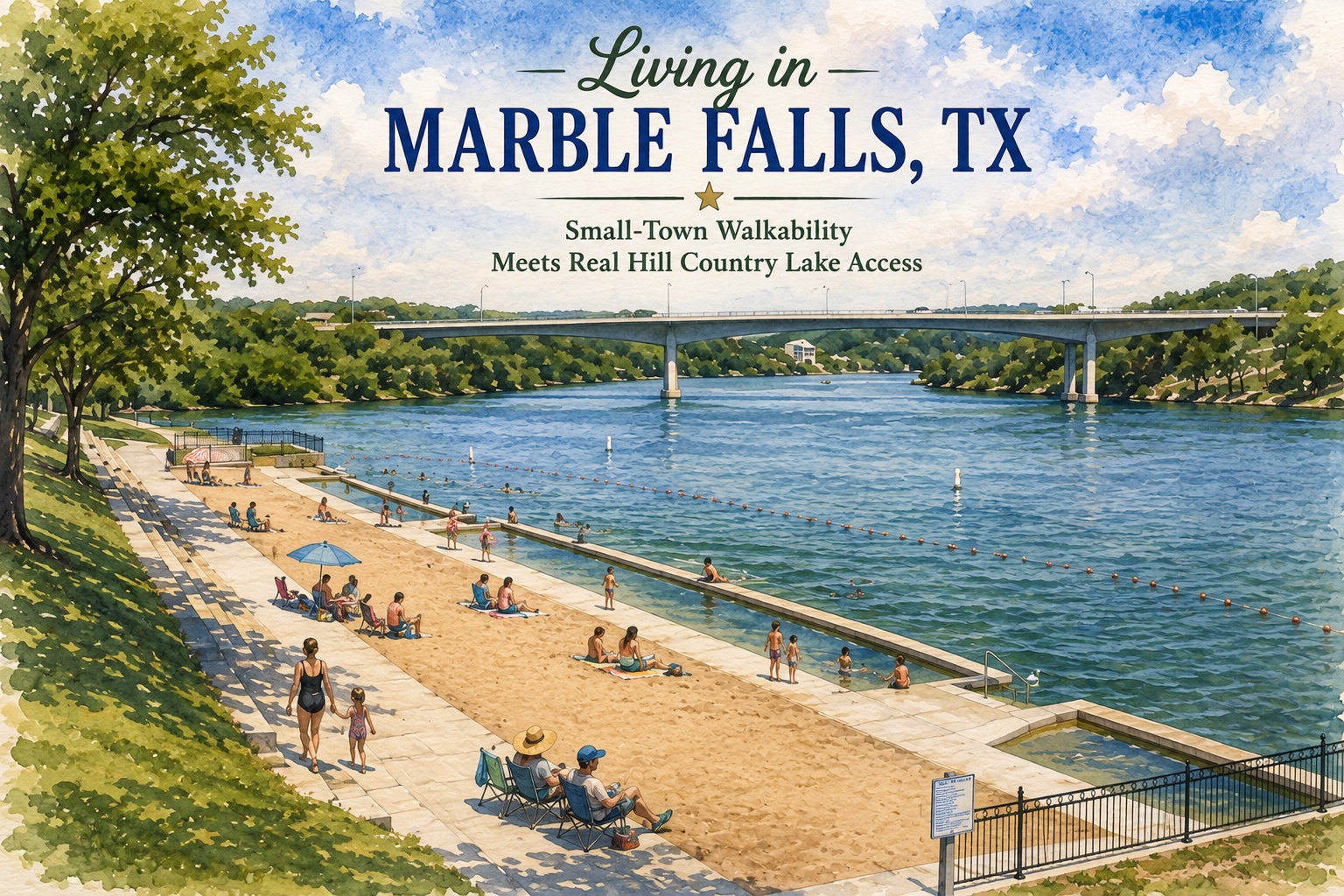
A version of this question comes up almost every time I’m working with someone new to the Highland Lakes: they’ve had lunch downtown, maybe walked out to the water at Lakeside Park, and they want to know if the town holds up once you’re not just visiting for the day. Marble Falls is the town most of my buyers end up comparing everything else to. It’s the one with the walkable Main Street, the lake right downtown, and enough grocery stores and specialists that you’re not driving to Austin for the basics. It’s also the town most people think they know from a Saturday trip, without knowing the parts that only show up once you’ve actually lived here a while.
TLDR (Too Long; Didn’t Read): Living in Marble Falls, TX
- Marble Falls sits on Lake Marble Falls in the Texas Hill Country, about 49 miles northwest of downtown Austin, and functions as the commercial and dining hub of the Highland Lakes region
- The town was founded in 1887 by Adam Rankin Johnson, and the falls it’s named for are actually underwater today, submerged when the LCRA built the Max Starcke Dam between 1949 and 1951
- Marble Falls ISD serves the town with four elementary schools, one middle school, and two high schools, including an alternative campus for students who need a different path to graduation
- The granite that built the Texas State Capitol in Austin came from Granite Mountain just outside town, part of a deal struck in 1885
- Blue Bonnet Cafe has been serving scratch-made pies on US-281 since 1929, and the annual Walkway of Lights at Lakeside Park has drawn holiday crowds every winter since 1990
- Marble Falls suits people who want small-town walkability with real lake access and don’t mind paying a premium for it; it’s a tougher sell for anyone chasing acreage privacy or the lowest price point on the chain
Where Marble Falls Sits and What the Commute Looks Like
Marble Falls sits along the Colorado River in the Texas Hill Country, roughly 49 miles northwest of downtown Austin, mostly a straight shot up US-281 or a mix of 71 and 1431 depending on where you’re starting from. Figure on close to an hour under normal traffic, which is a longer drive than Lakeway or Bee Cave but shorter than what most of my Kingsland or Horseshoe Bay clients deal with. It’s not a daily commute most people choose to make into an Austin office, though I do work with a handful of buyers who do it a couple of days a week and work from home the rest.
What sets Marble Falls apart from most of its Highland Lakes neighbors is that it doesn’t function like a bedroom community. It’s the retail, medical, and dining center for the whole region. If you live in Kingsland, Granite Shoals, or Horseshoe Bay and need a hospital, a real grocery run, or a Saturday night out, there’s a good chance you’re driving into Marble Falls to get it. That role as the hub is part of why Marble Falls real estate tends to carry a premium over some of the smaller lake towns nearby: you’re not just paying for water access, you’re paying for a walkable downtown and services that those other towns don’t have of their own.
How the Town Got Its Start
Marble Falls was founded in 1887 by Adam Rankin Johnson, a former Confederate general who’d gone blind in the Civil War and, according to local history, was led to the site by a guide who described the falls on the Colorado River to him. Those falls, and the marble and granite formations around them, are where the town’s name comes from.
The granite side of that story runs deeper than most people realize. Granite Mountain, just outside town, was the source of stone for the Texas State Capitol in Austin. A deal struck in 1885 traded the granite for a rail spur into Marble Falls, and crews quarried and hauled that stone to Austin through 1886 and 1887 while the Capitol itself was finished in 1888. That’s a separate milestone from the town’s founding the year before, not a conflicting date, and it’s the reason a lot of the old downtown buildings and curbing in Marble Falls are cut from the same pink granite that’s sitting in the Capitol dome today.
The Lake, the Dam, and the Falls You Can’t See Anymore
Here’s the detail that surprises a lot of buyers: the falls Marble Falls is named for aren’t really visible anymore. When the LCRA built the Max Starcke Dam on the Colorado River between 1949 and 1951 to add hydroelectric capacity to the Highland Lakes chain, the rising water behind it submerged the natural falls and rock shelf that gave the town its name back in the 1880s. What exists today as Lake Marble Falls is the result of that dam, not the original river feature. Every so often, when the LCRA draws the lake down for maintenance or repairs, the old falls reappear briefly before the lake fills back in.
It’s worth being clear that Lake Marble Falls is its own lake, separate from Lake LBJ upstream. Towns like Kingsland and Granite Shoals sit on Lake LBJ; Marble Falls sits on the smaller lake that carries its own name, downstream of the dam that created it. It’s a working lake more than a resort lake, used for boating, paddleboarding, and fishing close to downtown, but it’s not the same scale of water as LBJ or Travis, and that’s a distinction worth understanding before you assume every Highland Lakes town is interchangeable on the water question.
Schools: Marble Falls ISD
Kids in town attend Marble Falls ISD, which runs four elementary campuses: Colt Elementary, Marble Falls Elementary, Highland Lakes Elementary, and Spicewood Elementary. From there, students move into a single middle school, Marble Falls Middle School, before high school. The district has two high school campuses: Marble Falls High School, the traditional comprehensive high school, and Falls Career High School, an alternative campus built around a different pace and format for students who need it. Having that second high school option is something families moving from a bigger suburban district in Austin sometimes don’t expect out of a smaller Hill Country town. You can look at current ratings, boundaries, and calendars directly on the Marble Falls ISD website.
Blue Bonnet Cafe and the Walkway of Lights
If there’s one place that ties old Marble Falls to new Marble Falls, it’s Blue Bonnet Cafe. It’s been serving scratch-made pies and Southern cooking on US-281 since 1929, which means it predates the dam, the lake, and most of the town as it exists today. It’s the kind of stop that shows up on every local’s list, and it’s usually the first thing longtime residents mention when someone new asks where to eat.
The other event that comes up constantly is the Walkway of Lights, an annual holiday lights display that takes over Lakeside Park’s 6.5 acres for about six weeks every winter, from late November into the first days of January. A group of 57 residents started it in 1990, and it’s grown into one of the largest events the town puts on all year, drawing visitors from well outside the Highland Lakes for a look at the lake lit up after dark.
Both of those are worth knowing about before you buy, not just because they’re nice to have nearby, but because they’re a sign of what kind of town this actually is: one that still draws a crowd downtown, in a way that newer developments like Thunder Rock on the edge of town haven’t caught up to yet. The population has grown fast in the last few years too, from just over 7,000 at the 2020 census to somewhere north of 9,000 today, so Marble Falls isn’t a sleepy town standing still. It’s one that’s actively filling in.
Who Marble Falls Is a Good Fit For
I point buyers toward Marble Falls when they want an actual town, not just a subdivision with a lake view: walkable restaurants, a real grocery store, a hospital nearby, and a lake close enough to use regularly without it being the entire reason they moved. It works well for retirees who still want some day-to-day convenience, for families who want an established district with more than one high school option, and for anyone who’s decided a weekend trip to Marble Falls wasn’t enough and wants to actually live here.
It’s a tougher fit for people chasing the lowest possible price point on the Highland Lakes chain. Kingsland and parts of Granite Shoals typically run more affordable, especially once you’re off the immediate waterfront. It’s also not the pick for someone who wants total privacy and acreage with no crowds; downtown gets busy on weekends and stays busy through the Walkway of Lights season, and that’s simply part of what living here means. If what you want is genuine small-town walkability paired with real Hill Country lake access, and you’re fine paying for that combination, Marble Falls holds up as well as it looks from a Saturday visit.
If that’s useful, you might also want to read Living in Granite Shoals, TX — it sits just up the road and shares that same Granite Mountain history, though it’s on Lake LBJ rather than Lake Marble Falls.
For a closer look at current listings and neighborhoods around town, Marble Falls TX real estate for sale covers that in more detail.
If you want to see what’s actually available right now, you can search current listings here.