I’ve sold homes all over Austin, and Clarksville is one of the few neighborhoods where I can walk a buyer down the street and point out a piece of Texas history on nearly every block. If you’re looking into living in Clarksville, Austin TX, I want to give you the real picture: where it is, how it came to be, what the homes look like, and what day-to-day life is like there. I’m Robbie English, a REALTOR and broker with Uncommon Realty, and I’ve worked with buyers and sellers across Austin for a long time. Here’s what I know about this neighborhood.
TLDR (Too Long; Didn’t Read): Living in Clarksville, Austin TX
- Clarksville sits just west of downtown Austin, bordered roughly by West 6th Street, West 15th Street, MoPac, and Lamar Boulevard.
- Founded in 1871 by Charles Clark, a formerly enslaved man, it’s one of the oldest freedmen’s towns west of the Mississippi River and a National Register Historic District since 1976.
- Housing is a mix of small original cottages, restored Victorian and bungalow-style homes, and newer construction, with prices reflecting the neighborhood’s close-in location.
- You can walk to West 6th Street restaurants and shops, and downtown Austin is a short trip away by foot, bike, or car.
- Kids in the neighborhood are zoned to Austin ISD, including Casis Elementary, O. Henry Middle School, and Austin High School.
Where Clarksville Sits in Austin
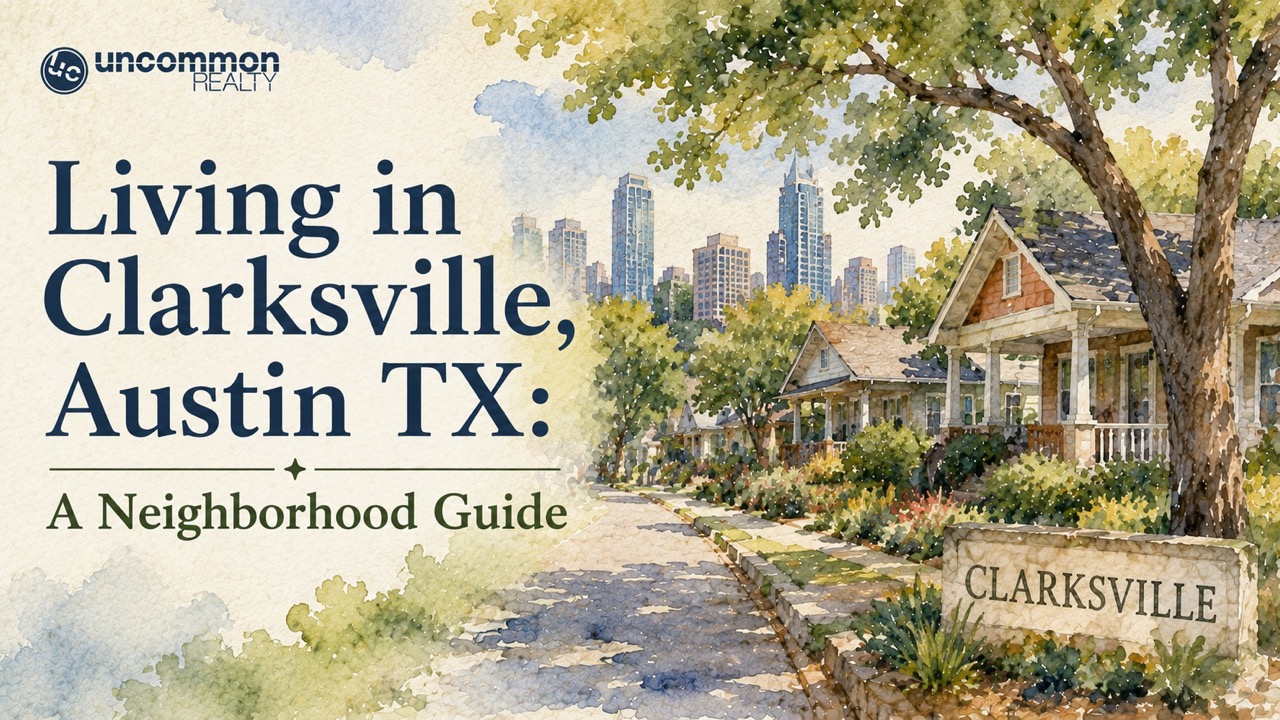
Clarksville is located just west of downtown Austin, inside the area often grouped with Old West Austin. The neighborhood is generally bounded by West 6th Street to the south, West 15th Street to the north, MoPac Expressway to the west, and Lamar Boulevard to the east, all within the 78703 zip code. That location puts residents within a few minutes of the Capitol, the Seaholm district, and the West 6th Street corridor, while still sitting on quiet, tree-lined residential streets once you turn off the main roads.
The History of Clarksville
Clarksville’s history is part of what makes it distinct, and it’s worth telling accurately. The neighborhood was founded in 1871 by Charles Clark, a man who had been enslaved before emancipation. According to the Texas State Historical Association, Clark purchased two acres of land from former Confederate general Nathan G. Shelley and built a home on what is now West 10th Street. He then subdivided and sold parcels of that land to other freedmen, forming a self-sufficient community just outside the Austin city limits at the time.
Clarksville grew into a settlement with its own churches, businesses, and schools, and it’s recognized today as one of the oldest surviving freedmen’s towns west of the Mississippi River. Sweet Home Missionary Baptist Church, founded before 1882, has been a fixture of the community since its earliest years; the congregation’s current sanctuary was built in 1935 and still stands on Ninth Street.
In 1976, the Clarksville Historic District was listed on the National Register of Historic Places in recognition of this history. The historic district covers roughly 305 acres bounded by West Lynn, Waterston, West 10th Street, and MoPac. That designation means many of the original cottages and homes built by the community’s founders and early residents are documented and, in many cases, protected from significant alteration or demolition.
The neighborhood’s boundaries shrank over the decades, most significantly when construction of MoPac Expressway in the 1970s removed a substantial portion of the original footprint. The Clarksville Community Development Corporation continues to work on preserving the neighborhood’s affordable housing stock and historic character today, and its Pauline Brown Clarksville Neighborhood Center on West 11th Street serves as a gathering space for the community.
What the Homes Look Like
If you’re picturing one style of house, drop that idea. Clarksville’s housing stock is genuinely mixed. You’ll find:
- Small original freedmen’s cottages, many dating back to the late 1800s and early 1900s, with simple gabled rooflines and front porches
- Victorian-era homes with detailed trim work, some carefully restored
- Craftsman-style bungalows from the early 20th century
- Renovated and expanded homes that keep an original facade while adding modern square footage behind or above it
- Newer custom construction built on lots where older homes were replaced
- A smaller number of townhomes and condo buildings, particularly closer to West 6th Street
Because the neighborhood sits inside a National Register historic district, some renovation and new construction projects go through additional design review compared to homes outside historic boundaries. That’s a practical detail worth understanding before you buy a fixer-upper here with big remodeling plans, since it can affect timelines and what changes are allowed on the exterior.
Lot sizes tend to be smaller than what you’d find in Austin’s suburbs, which fits the neighborhood’s original platting from the 1870s. Property values reflect the location: Clarksville is one of the closest residential neighborhoods to downtown Austin, and per-square-foot pricing runs well above the citywide median. If you want specific comparable sales for a property you’re considering, I can pull current MLS data and walk you through it.
Walkability and What’s Nearby
This is one of the most walkable neighborhoods in Austin. West 6th Street forms Clarksville’s southern edge, and it’s lined with restaurants, coffee shops, bars, and retail. Many homes in the neighborhood are a five to ten minute walk from that corridor. Clarksville Village, a small shopping center near West Lynn and West 10th, adds a grocery store and a handful of local shops within easy walking distance for residents on the north side of the neighborhood.
Downtown Austin, Seaholm, and the Lady Bird Lake hike and bike trail are all within a short walk, bike ride, or drive, and the neighborhood has direct access to MoPac for anyone commuting elsewhere in the city.
The Pauline Brown Clarksville Neighborhood Center on West 11th Street hosts community programs and events and serves as a hub for neighborhood association activity. It’s one of the places where Clarksville’s identity as a distinct community, separate from the broader Old West Austin area around it, still shows up in day-to-day life.
Schools Zoned to Clarksville
Clarksville falls within Austin Independent School District. Based on current AISD attendance boundaries, homes in the neighborhood are generally zoned to:
- Casis Elementary School, located at 2710 Exposition Blvd.
- O. Henry Middle School, located at 1715 W. Cesar Chavez St.
- Austin High School, whose attendance zone covers Clarksville along with several other central Austin neighborhoods
Attendance boundaries can shift, and AISD maintains an online boundary tool for confirming which campus applies to a specific address. If school assignment is a factor in your search, I’d always recommend verifying the zoned campus for a specific property before you write an offer, since boundary lines don’t always follow neighborhood lines exactly.
Parks and Outdoor Space
Pease Park runs along the eastern edge of the neighborhood, following Shoal Creek from West 15th Street down toward Lamar Boulevard. It’s a large, wooded green space with walking trails, picnic areas, and a section of the Shoal Creek Trail that connects north and south through this part of Austin. Reed Park, a smaller neighborhood park with a pool, is also within walking distance for residents on the western side of Clarksville. Between Pease Park, the Shoal Creek Trail, and Lady Bird Lake a bit further south, residents have quick access to outdoor space without needing to drive.
Tree cover is another feature people notice right away. Many of Clarksville’s streets are lined with mature live oaks and pecan trees that have been there for decades, which gives the neighborhood a shaded, established feel that’s different from newer parts of the city where landscaping is still growing in.
Getting Around
Clarksville’s location makes it practical to get around without relying entirely on a car. West 6th Street, West Lynn Street, and West 5th Street all provide direct routes into downtown Austin. MoPac runs along the western boundary, giving quick access north toward the Domain or Cedar Park and south toward Zilker and South Austin. Downtown, the Capitol complex, and the University of Texas campus are all within a short drive, and many residents bike or walk to destinations along West 6th Street and into downtown rather than driving.
Capital Metro bus routes run through the area, and the neighborhood’s proximity to downtown means rideshare and taxi service is generally quick as well. For anyone weighing a commute into downtown offices or a daily trip to the university, Clarksville’s location is one of its more practical advantages compared to neighborhoods further from the urban core.
Current Market Character
Clarksville’s real estate market behaves differently than much of the rest of Austin because of its size and location. The neighborhood is small, geographically fixed by its historic boundaries, and close to downtown, all of which limits how much new inventory can ever come onto the market. That scarcity shapes pricing and shows up in the pace of sales.
Homes here range widely in size and condition, from compact original cottages under a thousand square feet to fully rebuilt homes with several thousand square feet on the same size lot. That range means it’s worth looking closely at the specifics of any individual listing rather than assuming a single price point applies across the neighborhood. A renovated Victorian on a corner lot and a small unrenovated bungalow a block away can carry very different price tags even though they sit in the same historic district.
If you’re selling a home in Clarksville, positioning it correctly matters. Buyers in this market are often comparing your listing against homes with very different histories, square footage, and renovation status, so accurate pricing based on real recent comparables makes a difference. If you’re buying, I’d encourage you to move efficiently once you find a property that fits, since well-located, well-priced homes in this neighborhood don’t typically sit long.
What to Know Before You Buy or Sell in Clarksville
A few practical things I tell clients looking at this neighborhood:
- Historic district status can affect what exterior changes are allowed, so confirm any restrictions before you buy with a major renovation in mind.
- Lot sizes and setbacks vary block by block, since the neighborhood was platted well over a century ago rather than as a planned modern subdivision.
- Street parking is more common than large driveways or garages in the older sections, which is worth factoring in if that matters to your daily routine.
- Because inventory is limited and lots are small, well-priced listings in Clarksville tend to move quickly relative to other Austin neighborhoods.
I’ve represented buyers and sellers on both sides of transactions in neighborhoods like this one, and the details above are the kind of thing that only show up once you’re actually under contract on a specific address. If you want a second set of eyes on a Clarksville listing, or you’re thinking about selling a home here and want to understand what similar properties have closed for recently, I’m happy to help.
A Neighborhood Worth Understanding Fully
Clarksville isn’t just a convenient location near downtown. It’s a neighborhood with a documented, significant place in Austin’s history, built by people who created something lasting out of very little. That history is part of what earned it National Register status, and it’s part of what makes the neighborhood worth knowing before you buy, sell, or simply walk its streets.
If you want to talk through whether Clarksville fits what you’re looking for, or you’d like help finding or listing a home there, reach out. You can read more about my background on my about page, and I’m always glad to answer questions about this neighborhood or any other part of Austin.
Robbie English, REALTOR, Broker at Uncommon Realty.
You Might Also Find These Helpful
- explore homes for sale in Austin
- search current listings
- Is Austin LGBT-Friendly Enough to Buy a Home
- Horseshoe Bay TX January 2025 Market Update