Every December, Zilker Park turns into one of the more distinct stretches of Austin, and I get asked about the Trail of Lights every year by people who are new to the city or thinking about buying near the park. I want to lay out what the event actually is, where it came from, and what it means if you live nearby or you’re weighing a move to this part of town.
TLDR (Too Long; Didn’t Read): Zilker Park’s Trail of Lights: What to Know
- The Trail of Lights happens every December in Zilker Park and started as a small community gathering called Yule Fest back in 1965.
- The nonprofit Trail of Lights Foundation now produces the event in partnership with the City of Austin after reviving it in 2012.
- The Zilker Tree, a converted moonlight tower strung with thousands of lights, has stood on the park’s south lawn since 1967.
- The event includes a walking trail of lighted displays, food trucks, vendors, and entertainment stages spread across the park.
- Barton Springs Road sees nightly closures during the event, so I always plan parking and routes ahead of time if I’m heading over.
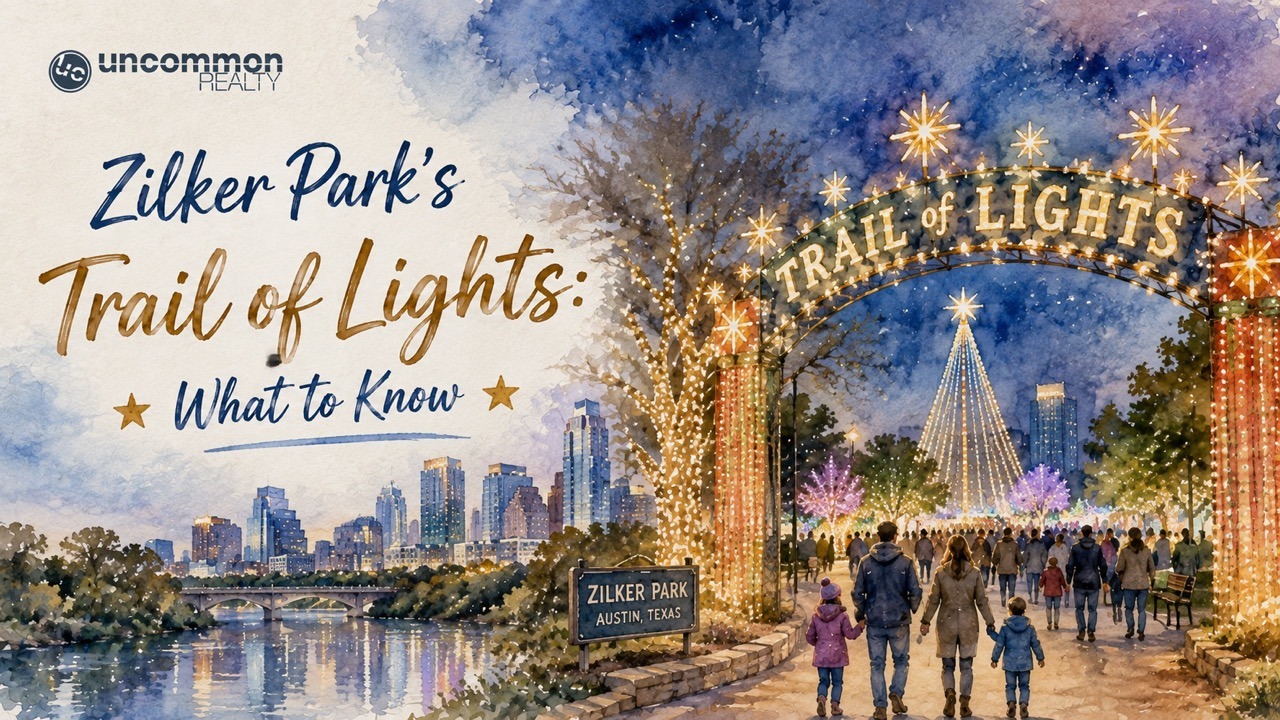
A Holiday Tradition That Started as Yule Fest
The Trail of Lights traces back to 1965, when the Austin Parks and Recreation Department hosted a small gathering in Zilker Park called Yule Fest, centered around the lighting of a Yule log. That tradition ran for decades as a city-funded program, growing a little each year as more of the park got involved. When the city cut the program from its budget in 2009, the event went through a scaled-back year and then a hiatus, and for a couple of winters Zilker Park stayed dark during what had become a regular December tradition for a lot of longtime residents.
A group of Austin residents stepped in and formed the Trail of Lights Foundation, an independent nonprofit, and brought the event back in 2012. The Foundation now produces the Trail of Lights each year in partnership with the City of Austin, raising funds through donations from individuals and local businesses to keep it running. The event officially took on the Trail of Lights name in 1992, and it’s grown into one of the largest annual gatherings in the city, with total attendance over the course of the run reaching into the hundreds of thousands. I think that history matters, because it says something about how much Austin residents wanted this event back once it was gone. It wasn’t handed down from a corporate sponsor or a tourism board; it came from a group of locals who missed it enough to rebuild it from scratch.
The Zilker Tree and Austin’s Moonlight Towers
The centerpiece of the whole display sits on the south lawn of Zilker Park: the Zilker Holiday Tree. It’s been part of the tradition since 1967, when Austinites repurposed one of the city’s old moonlight towers into a giant lighted tree. The tower itself stands about 155 feet tall and carries 39 streamers, each strung with 81 multicolored bulbs, for a total of more than 3,300 lights.
Austin installed its moonlight towers back in 1894 to light city streets before household electricity was common. Only 17 of the original 31 towers still stand today, and they’re the only working moonlight towers left in the world. They earned Texas State Landmark status in 1970 and a spot on the National Register of Historic Places in 1976. The Zilker Tree is the only one of these towers converted into a holiday display, which is part of why it’s become such a recognizable symbol of the city.
What You’ll See and Do on the Trail
The Trail of Lights transforms the outer perimeter of Zilker Park into a walking path lined with lighted displays. Current numbers put the display at more than 2 million lights, roughly 90 lighted trees, and around 70 additional lighted scenes and tunnels spread through the park. Alongside the lights, the event brings in food trucks, local vendors, and multiple entertainment stages, so there’s usually something happening beyond just walking the trail.
General admission to walk the trail is free, which is a big part of why it draws such a wide range of visitors each year, including plenty of people from outside Austin who plan trips around it. Because the park space and displays change slightly from year to year, I’d always check the current details before heading out rather than relying on what a friend told you last winter.
The trail itself takes most people somewhere between thirty minutes and an hour to walk end to end, though that depends heavily on how long you linger at the food trucks or how many photos you stop for along the way. Some sections of the display change year to year, so even people who walk it every winter tend to notice a few new scenes mixed in with the ones they remember. The vendor and food truck lineup shifts too, drawing from Austin’s broader food truck scene rather than a fixed set of vendors, so it’s worth going in without a specific plan for what you’ll eat and just seeing what’s set up that year.
- A lighted walking trail circling the outer part of Zilker Park
- The Zilker Tree on the park’s south lawn
- Food trucks and vendor booths throughout the grounds
- Multiple stages with live entertainment
- Free general admission to walk the trail
Getting to Zilker Park During the Event
If you’re planning to visit, I’d build in extra time for traffic. Barton Springs Road sees intermittent nightly closures during the run of the event, and parking is restricted in the surrounding streets, with no-parking and tow-away signs posted and enforced during event hours. GPS apps don’t always account for these closures in real time, so I wouldn’t rely on them alone to route you in.
The event runs a shuttle program from the Toney Burger Activity Center in South Austin, with free parking there for anyone riding the shuttle in and out. Walking, biking, or using rideshare are all solid alternatives if you’re coming from close by, since parking directly around the park fills up fast once the event opens for the evening.
If you live within walking distance, this is really the easiest way to experience the event. I’ve talked to plenty of people who live near the park and just walk over on a weeknight rather than deal with parking at all. That’s one of the more practical upsides of being close to Zilker Park during the holidays: you can skip the traffic question entirely and still get to see the trail.
What It’s Like Near Zilker Park in December
For anyone living in the streets around the park, the Trail of Lights changes the rhythm of the neighborhood for a few weeks each year. Barton Springs Road traffic picks up in the evenings, and the streets closest to the park see more foot traffic and parking enforcement than usual. The City has worked directly with the Barton Hills Neighborhood Association over the years to manage resident concerns like street parking and continued access to the park and Barton Springs Pool during the event.
Outside of those few weeks, proximity to Zilker Park means proximity to one of the largest green spaces in the city, with the Barton Springs Greenbelt, Barton Springs Pool, and Lady Bird Lake all within walking or biking distance depending on exactly where a property sits. Zilker, Barton Hills, and Travis Heights each border the park from a different direction, so the walk to the trail, and the daily walk to the park the rest of the year, looks a little different depending on which side you’re on.
From the Zilker side, it’s typically a short walk straight into the park from streets like Kinney Avenue or Toomey Road. Barton Hills sits across Barton Springs Road and closer to the pool and greenbelt entrances, so residents there tend to walk in from the west side of the park. Travis Heights is across the river to the east, closer to the Lady Bird Lake trail and the pedestrian bridges that connect into the park from that direction. None of these routes are difficult, but they do shape how a given property relates to the park day to day, both during the Trail of Lights and for the other eleven months of the year.
Why This Corner of Austin Draws Buyers Year-Round
I work with buyers looking at property near Zilker Park throughout the year, not just around the holidays, and the park itself is usually the draw. It’s a working green space with a pool, a greenbelt, trails, and direct lake access, and the Trail of Lights is just one example of how the park gets used for large-scale community events. If you want a closer look at what it’s like to live in the neighborhood that shares the park’s name, I’ve written a dedicated guide to living in Zilker that covers the area in more depth.
Zilker Park sits close to several of Austin’s most walkable neighborhoods, and it’s one of the reasons this part of the city holds steady buyer interest regardless of season. If you’re exploring the broader market, my guide to Austin real estate is a good starting point for comparing neighborhoods across the city.
Whether you’re weighing a first visit to the Trail of Lights or you’re further along and thinking about buying near Zilker Park, I’m happy to walk through what specific streets and properties look like on the ground. You can read more about my background on my about page, and about the brokerage I work with at Uncommon Realty.
Robbie English, REALTOR, Broker at Uncommon Realty.
You Might Also Find These Helpful
- explore homes for sale in Austin
- search current listings
- Finding Your Dream Home
- Tell Me More About Homes For Sale in Avery Ranch
I touched on a related piece of this here too: Your Guide to the Zilker Kite Festival.