I’ve written offers in Manor for buyers who got outbid three times in Mueller and finally found a house they could actually afford here. I’ve also sat across the table from sellers who bought a lot here five years ago for what felt like a gamble and watched their subdivision fill in around them. Manor is one of those Central Texas towns that changed faster than most people’s mental map of the region has caught up to, and I get asked about it more every year, so here’s what I actually tell clients.
TLDR (Too Long; Didn’t Read): Living in Manor, TX
- Manor sits about 14 miles east of downtown Austin, roughly 20 to 30 minutes via US-290 depending on traffic, with SH-130 offering a fast alternate route
- It’s a former farming town that’s now one of the fastest-growing areas in the Austin metro, with new subdivisions still filling in around a small historic downtown
- Housing here tends to run more affordable than closer-in Austin suburbs, mostly newer construction, which draws buyers who got priced out elsewhere
- Manor ISD serves the area with 16 campuses and has grown substantially alongside the city
- Location near the Tesla Gigafactory and within reach of Samsung’s Taylor plant makes it a practical choice for employees at both
- Parks like East Metropolitan Park and Jennie Lane Park give the city real green space, and the weekend Ghost Town Manor Flea Market has become a local fixture
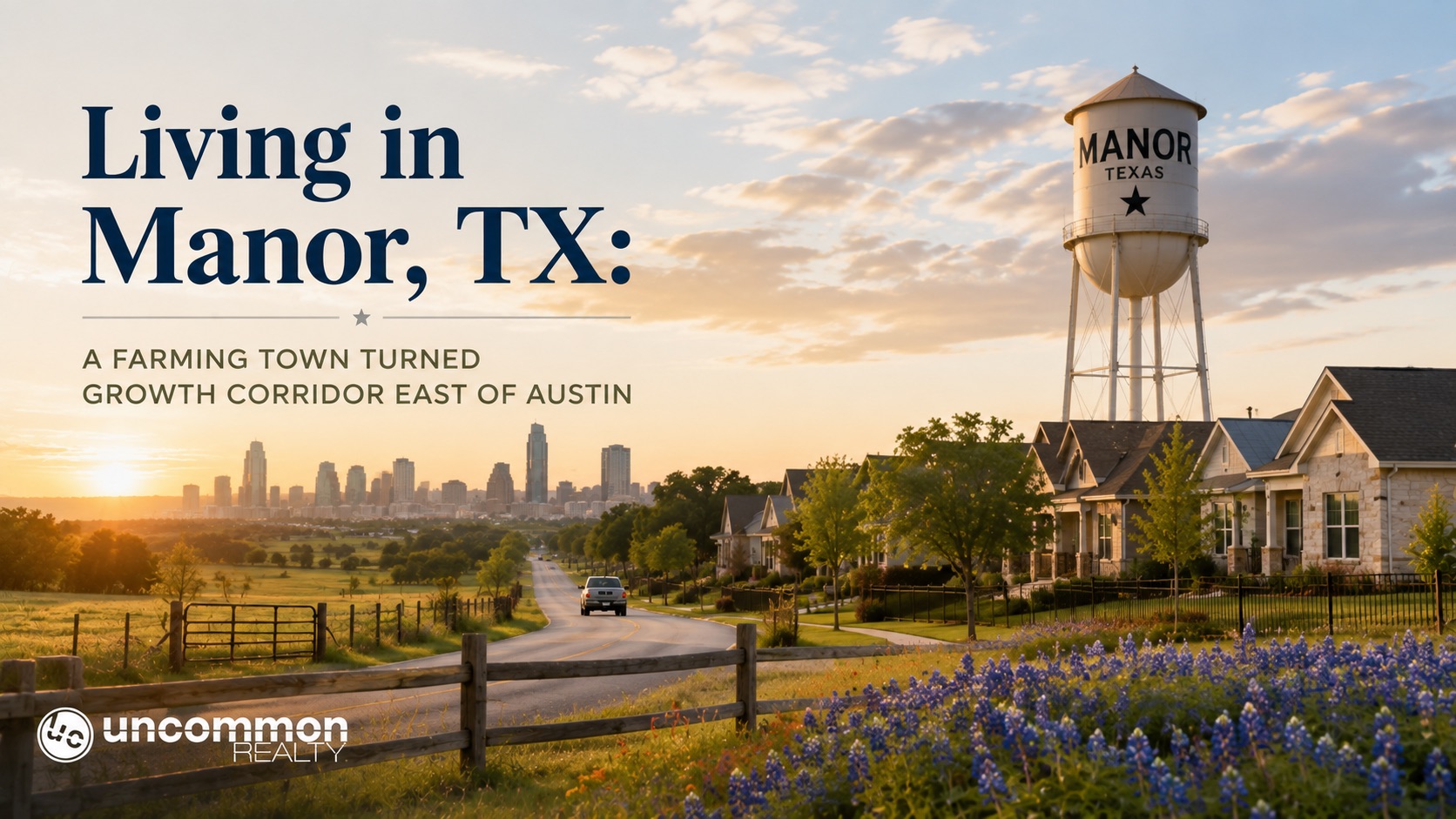
Where Manor sits and what the commute actually looks like
Manor is in Travis County, just east of Austin off US-290. The drive into downtown covers about 14 miles, and depending on when you leave, that’s anywhere from 20 minutes with light traffic to closer to 30 or more during the morning and evening rush. US-290 East is generally the smoother option during peak hours compared to fighting I-35, and SH-130, the toll road that opened in the early 2000s, gives residents another way around when 290 backs up.
That highway access matters more here than in most suburbs because Manor’s job draw isn’t just downtown Austin anymore. The Tesla Gigafactory sits close enough that plenty of Manor residents work there, and Samsung’s massive semiconductor investment in Taylor, along with its existing Pflugerville operations, put Manor within a reasonable commute of some of the biggest employers added to this region in the last decade. I’ve had buyers move here specifically to cut their drive to the Gigafactory down to fifteen or twenty minutes instead of the hour-plus some of them were doing from other parts of Austin.
I tell clients to actually drive the commute themselves before signing anything, at the time of day they’d really be doing it, because a map estimate and a 5pm Friday reality on 290 are not the same thing. If your job is downtown, budget for the slower end of that range most days. If your job is out toward the Gigafactory or Taylor, you may find Manor puts you closer to work than most of Austin proper would.
From farm town to growth corridor
Manor was a small agricultural community for most of its history, and the historic downtown still shows it, older storefronts and a slower pace that feels genuinely different from the new construction surrounding it. What’s changed is everything built around that core. Rooftops have gone up fast here over the past several years as builders chased land prices that were still reasonable while closer-in Austin suburbs ran out of room. I’ve watched subdivisions go from bare caliche lots to fully built streets in the time it took one of my listings to sell in a slower market elsewhere.
That pace of growth means Manor doesn’t feel like one town so much as several. Drive through the older sections near downtown and you’ll see the farming-town roots. Drive a mile or two out and you’re in a subdivision that didn’t exist five years ago. It’s a place still figuring out its identity in real time, and for a lot of buyers, that’s part of the appeal. You’re getting in on a city while it’s forming rather than moving into something already built out and priced accordingly.
I don’t think Manor loses its identity in the process, either. The older downtown blocks aren’t getting bulldozed for the new subdivisions, they’re just getting company. People who grew up here still run into each other at the same handful of spots, and the newer residents I’ve worked with tend to end up caring about that continuity too once they’ve lived here a year or two. It’s not a manufactured master-planned community pretending to have history. The history is real, it’s just surrounded by a lot more neighbors than it used to be.
What the housing market actually looks like
I’ll say this plainly because Texas law keeps me from citing specific sale prices anyway: Manor is consistently one of the more affordable options for buyers who want new construction within a reasonable drive of Austin. Most of what’s available is newer build, which means fewer surprises on foundations and roofs but also less character than an older Austin neighborhood. If you want a 1930s bungalow with mature oak trees, this isn’t that market. If you want a three or four bedroom house on a lot you can actually afford without commuting an hour and a half, Manor is worth a serious look.
The tradeoff buyers need to understand going in is that a lot of these subdivisions are still growing into themselves. Amenities, retail, and even some infrastructure can lag behind the rooftops for a while in a city expanding this fast. I walk every buyer through what’s actually built versus what’s planned before they write an offer, because “coming soon” on a builder’s site can mean very different timelines depending on the neighborhood.
Most of the inventory in Manor comes with an HOA, since that’s how new subdivisions tend to get built out here, so I always go over the dues, the rules, and what they actually cover before a client falls for a floor plan. It’s also worth asking about municipal utility district taxes on newer construction, since a lot of these subdivisions sit inside a MUD that adds to the tax bill beyond the county and school district rates. None of that should scare a buyer off, it’s just part of doing the math correctly on a house out here versus a comparable one closer to town.
Schools
Manor ISD covers the area, with 16 campuses serving pre-K through 12th grade. It’s a district that’s grown right alongside the city, which comes with the usual mix of new facilities and the growing pains of absorbing new students every year. Families relocating here should look at the specific campus their address feeds into rather than assuming district-wide averages apply evenly, since a fast-growing district like this one can vary quite a bit school to school. I’d rather a client call me before they fall in love with a house than after, so I can point them toward the actual attendance zone.
Parks, recreation, and things to do
Manor has more green space than people expect for a town this new. East Metropolitan Park is the big one, a 273-acre Travis County park with two stocked ponds for fishing, sports fields, trails, and a seasonal pool run through the Greater Austin YMCA. It’s the kind of park where you can spend a whole Saturday and not run out of things for kids to do.
Closer into town, Jennie Lane Park is smaller but well used, with a covered playground, a pavilion for gatherings, a Veteran’s Memorial Wall, and outdoor fitness equipment. It’s the sort of neighborhood park that ends up hosting a lot of birthday parties and evening walks.
For something with more local character, the Ghost Town Manor Flea Market runs weekends on Littig Rd with vendors, food trucks, and live music built around an Old West theme. Plenty of Austin residents drive out for it on weekends too, and it’s one of the things that gives this town a personality separate from just being a bedroom community.
None of this replaces what a full Austin neighborhood offers in terms of restaurants and nightlife within walking distance, and I won’t pretend otherwise. What Manor gives you instead is easy access to actual outdoor space without fighting a parking lot for it, plus a short enough drive back into Austin or over to Round Rock and Pflugerville when you want more options for dinner or a night out.
Who Manor is a good fit for
I point buyers toward Manor when affordability matters more than walkable urban amenities, when a Tesla or Samsung commute is part of the equation, or when they want new construction and are willing to trade an established neighborhood feel for a lower price and more house. It tends to suit young families who need the square footage and the yard, first-time buyers who got priced out of Austin proper, and anyone who’s realistic about the fact that a fast-growing town takes a few years to fill in its retail and services around all those new rooftops.
It’s less of a fit if you want mature trees, a walkable downtown with a lot of restaurants already open, or a neighborhood that’s been fully built out for a decade with no construction noise nearby. Manor is still becoming what it’s going to be, and depending on where you are in your life, that’s either exactly what you’re looking for or a reason to keep looking elsewhere. If you want to talk through whether it fits what you need, I’m happy to walk you through current listings and specific subdivisions.
For more on this, I wrote up Living in Hutto, TX: A Complete Guide as well.
If you want to see what’s actually available right now, you can search current listings here.