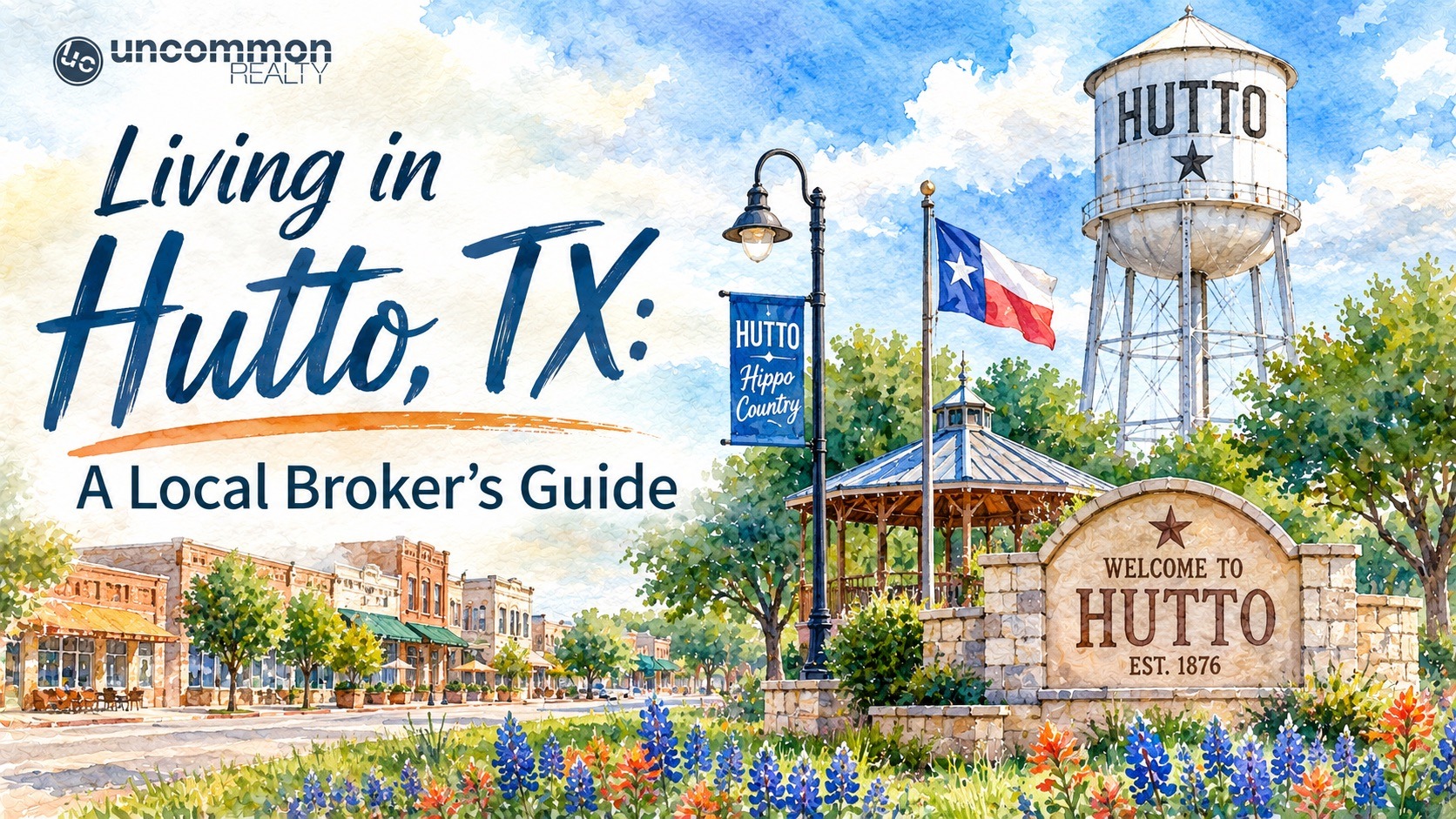
I get a lot of questions about Hutto from buyers who found it on a map, heard the name from a coworker headed to Samsung’s plant in Taylor, or noticed a hippo logo somewhere and wanted to know what that was about. Hutto doesn’t get talked about as much as Round Rock or Georgetown, but it’s grown into one of the more significant suburbs on the northeast side of the Austin area, and I think it deserves a real explanation instead of a listings page. This is that explanation.
TLDR (Too Long; Didn’t Read): Living in Hutto, TX: A Complete Guide
- Hutto sits along US-79 northeast of Round Rock, roughly a 30 to 40 minute drive from downtown Austin depending on traffic.
- The city is one of the fastest-growing in the country, with population climbing from under 30,000 in 2020 to roughly 50,000 today.
- Housing ranges from older homes near the historic core to large new-construction subdivisions built over the last two decades.
- Hutto ISD operates eight elementary schools, three middle schools, Hutto High School, and a 9th Grade Center.
- Hutto sits about 15 to 20 minutes from Samsung’s semiconductor fab in Taylor, one of the more affordable commuting options in that corridor.
The Hippo Behind the Hutto Name
If you spend any time in Hutto, you’ll notice hippo statues, hippo murals, and a hippo on the city’s official logo. The story goes back to 1915, when a circus train reportedly broke down near town and a hippo got loose, wandering down toward Cottonwood Creek before it was eventually coaxed back onto the train. The local station master is said to have wired nearby towns with the message “STOP TRAINS!! HIPPO LOOSE IN HUTTO.” Whether every detail of that story holds up to scrutiny, it stuck. Hutto schools adopted the hippo as a mascot decades ago, and it’s shown up on Hutto High School graduation materials since the 1920s. Hutto is the only town and school district in the country that uses a hippo as its mascot, and the city leans into it, calling residents “Hippo Nation.” It’s a fun piece of local identity, and it’s genuinely part of what makes Hutto feel distinct from the suburb next door.
Where Hutto Sits, and Why It’s Growing So Fast
Hutto sits in Williamson County along US-79, northeast of Round Rock and just south of Taylor. From most parts of town, downtown Austin is roughly a 30 to 40 minute drive depending on the route and time of day, and Round Rock is closer to 15 to 20 minutes. That location, combined with land that was still largely agricultural through the 1990s, set Hutto up for the kind of rapid build-out that’s defined it over the past two decades.
The growth numbers are hard to overstate. Hutto’s population sat under 30,000 as recently as the 2020 census and has climbed to somewhere around 50,000 today, a jump that’s put the city among the fastest-growing in the entire country in recent federal rankings. Williamson County as a whole has been one of the fastest-growing counties in Texas, and Hutto has been at or near the top of that growth curve for several years running.
What the Housing Stock Actually Looks Like
Hutto’s housing splits pretty cleanly into two categories. Closer to the historic core, you’ll find older homes on larger, more established lots, many built decades before the recent growth wave. Surrounding that core, and extending out along the FM roads and US-79 corridor, are the newer subdivisions that account for most of Hutto’s housing today. Communities built over roughly the last 20 years have added thousands of new-construction homes, and builders are still active in the area, with new sections opening as older phases fill in.
That mix means buyers in Hutto have real options between a resale home with mature landscaping and an established street, or a new build with a current floor plan and builder warranty. Lot sizes and price points vary a good amount by subdivision, so it’s worth walking a few different neighborhoods before deciding which side of that split fits what you’re after.
Hutto ISD: The Schools Serving the Area
Hutto ISD is the school district covering the city, and it has grown right alongside the population. The district operates eight elementary campuses: Benjamin “Doc” Kerley Elementary, Cottonwood Creek Elementary, Hutto Elementary, Howard Norman Elementary, Lee Martinez Elementary, Nadine Johnson Elementary, Ray Elementary, and Veterans’ Hill Elementary. At the middle school level, students attend Farley Middle School, Gus Almquist Middle School, or Hutto Middle School.
Secondary students attend Hutto High School, home of the Hippos, along with a dedicated 9th Grade Center that supports the transition into high school. The district also offers a Hutto Virtual Academy for remote instruction and River Horse Academy as an alternative campus option for secondary students. Because Hutto ISD has grown quickly along with the city, attendance zones have shifted over time as new campuses opened, so it’s worth confirming which specific elementary and middle school a given address feeds into before you buy.
Parks, Trails, and Recreation
Hutto’s parks system centers on Fritz Park, which has served as the community’s main athletic and recreation hub for years, home to fields, tennis courts, and the city’s parks and recreation offices. Fritz Park has been undergoing a significant renovation that includes new playground equipment, a splash pad, walking trails, and a bicycle pump track, with the athletic fields and tennis courts remaining open during construction.
The Cottonwood Trail connects Fritz Park with other points in the city for walking, running, and cycling, and it links into the broader Brushy Creek Regional Trail system, which runs more than seven miles and ties together several parks in the area. Hutto Park at Brushy Creek covers over 60 acres along the creek itself, and Adam Orgain Park offers additional green space and creek access nearby. There’s also a dedicated off-leash dog park on County Road 197. Between the trail network and the creek corridor, Hutto has a fair amount of outdoor space built into the city’s layout, even in the newer subdivisions.
Old Town Hutto and the Downtown District
Downtown, officially known as Old Town Hutto, is a small but well-preserved commercial historic district listed on the National Register of Historic Places. The dozen or so buildings date mostly to the 1890s and early 1900s, built in Late Victorian Italianate and early Commercial styles, and the district has been restored rather than replaced. It’s a walkable stretch, with locally owned restaurants, cafes, and boutiques occupying the historic storefronts, and the hippo theme shows up here too in restaurant names and local branding.
Old Town sits apart from the newer retail development along US-79 and the highway corridor, and it functions as the historic and civic center of the city even as most of Hutto’s population growth has happened in the subdivisions surrounding it.
The Samsung Taylor Connection
A lot of the current interest in Hutto traces back to Samsung’s semiconductor fabrication plant in nearby Taylor. Hutto sits roughly 15 to 20 minutes from the Samsung site via US-79, which puts it within a reasonable commute without the more limited housing supply and higher demand found in Taylor itself. That’s made Hutto one of the towns buyers look at when they’re relocating for work tied to the fab or its supplier network. I’ve put together a separate relocation guide focused specifically on Samsung’s Taylor facility and the surrounding housing options if that’s what brought you here, since it goes into more detail on the commute corridor and the towns around it than this guide does.
How the Hutto Market Compares to Round Rock and Georgetown
Hutto tends to price below both Round Rock and Georgetown, which is part of why it’s absorbed so much of the region’s new construction. Recent data puts Hutto’s median sale price in the mid $300,000s, with new-construction listings often available at or below that figure given the amount of ongoing building in the area. Homes in Hutto have generally been sitting on the market longer than they were a couple of years ago, and price growth has cooled compared to the sharper run-up during the earlier part of the decade, which has shifted some negotiating leverage back toward buyers.
Round Rock and Georgetown both have longer track records as established suburbs, with more built-out retail, more mature landscaping citywide, and generally higher price points. Hutto is still in an earlier stage of that same trajectory. If proximity to Samsung’s Taylor site or a lower entry price matters more to you than an established downtown corridor, Hutto is worth serious consideration. If you want more retail and dining already in place, Round Rock or Georgetown might be a better starting point.
What I’d Tell a Buyer Looking at Hutto
Hutto isn’t a secret anymore. It’s been one of the fastest-growing cities in the country for several years, and the market reflects that with a steady supply of new construction alongside the older homes near downtown. What I’d focus on with a buyer is the specific subdivision and which Hutto ISD campuses it feeds into, since the district has added and redrawn boundaries as it’s grown. I’d also factor in the actual commute, whether that’s to Samsung’s Taylor plant, into Round Rock, or down to Austin, since US-79 traffic patterns vary a lot depending on the time of day.
If you want to talk through specific neighborhoods, current listings, or how Hutto stacks up against other towns in the corridor, you can read more about how I work at my About page or learn about my brokerage at Uncommon Realty. I’m happy to walk through the numbers with you directly.
Robbie English, REALTOR, Broker at Uncommon Realty.
You Might Also Find These Helpful
- explore homes for sale in Round Rock
- search current listings
- Horseshoe Bay TX January 2025 Market Update
- Best Neighborhoods In Dripping Springs TX
I touched on a related piece of this here too: Living in Manor, TX: A Farming Town Turned Growth Corridor East of Austin.