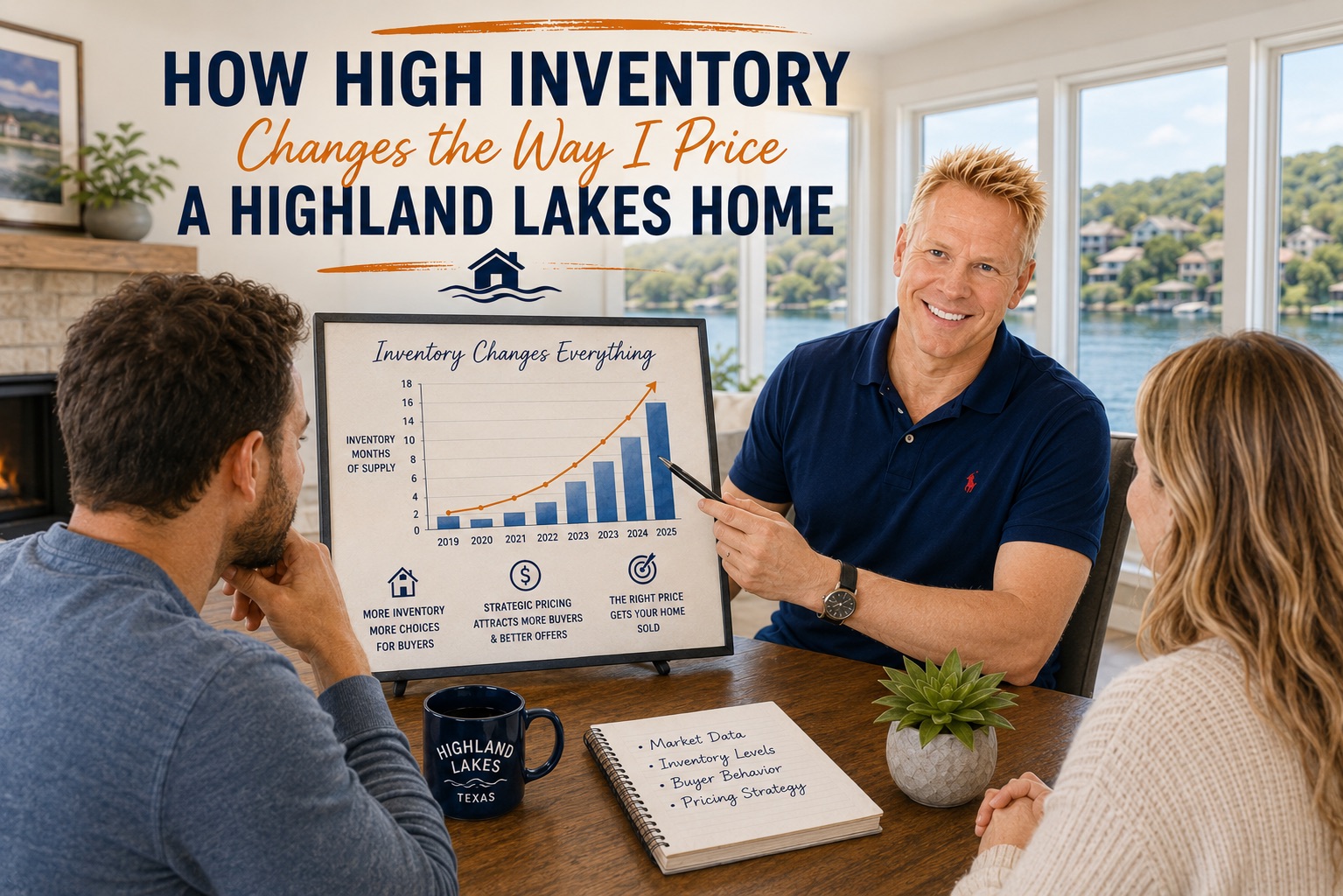
Pricing a Highland Lakes home has never been as simple as finding a few nearby sales, calculating an average price per square foot, and choosing a number that sounds appealing. In a market with high housing inventory, that kind of shortcut becomes even more dangerous. When buyers have more homes to consider, sellers are not just competing against recently sold properties. They are competing for attention against every other home a buyer could choose instead.
That changes how I approach pricing. In a low-inventory market, sellers may have more room to be liberal with their initial asking price because buyers have fewer alternatives. In a high-inventory market, pricing needs to be more conservative and considerably more strategic. A home cannot merely resemble the comparable properties and carry a similar price. It needs to offer buyers a compelling combination of price, condition, location, and features.
If you want to understand how dramatically the Highland Lakes market has changed, begin with my analysis of Highland Lakes housing inventory. That pillar article examines the inventory trends across communities such as Horseshoe Bay, Marble Falls, Kingsland, Granite Shoals, Llano, and Burnet. This article addresses the next question: How should those conditions affect the price you place on your individual home?
High Inventory Turns Pricing Into a Competition
When inventory is low, buyers may have to compromise. A home might need updating, lack certain amenities, or be priced somewhat aggressively, but limited selection can keep it under consideration. Buyers may act quickly because they are afraid another buyer will purchase one of the few suitable properties available.
High inventory changes that behavior. Buyers can move more slowly, compare more properties, ask more questions, and reject homes that do not appear to offer sufficient value. If one home seems overpriced, buyers often do not feel compelled to negotiate. They simply move on to another listing.
This is why matching the asking prices of competing homes is not necessarily a successful strategy. An active listing only tells me what another seller hopes to receive. It does not prove that a buyer will pay that amount. If another seller has chosen an unrealistic price, following that seller’s example does not make the number more defensible. It may only cause both homes to remain unsold.
I think of aggressive pricing as strategic pricing. It does not automatically mean being the cheapest home in the neighborhood or sacrificing the seller’s equity. It means knowing where the home belongs in the market, understanding the available competition, and creating a plan that gives the property a realistic path to a successful sale.
I Begin With Recently Closed Comparable Sales
When I prepare a comparative market analysis, or CMA, I prefer to use recently closed sales to develop my opinion of the property’s likely market value. Closed sales provide evidence of what buyers were actually willing to pay and what sellers were willing to accept.
I still study active and pending listings, but I use them differently. Active listings help me understand the choices currently available to buyers. Pending properties may indicate where the market is finding acceptable value, although the final terms are not yet known. Together, these listings help me determine how the subject property should be positioned when it enters the market.
I also examine the list-to-sale-price relationship of comparable transactions. It matters whether a property sold close to its original asking price or required several reductions before attracting an acceptable offer. If similar homes began at aspirational prices but ultimately sold for considerably less, that history can help us avoid repeating the same mistake.
This is one reason my pricing process is more detailed than an automated estimate or a quick CMA. I teach real estate pricing and comparative-market-analysis principles to real estate professionals nationally, and I believe the quality of the analysis depends on the quality of the comparisons. A long list of nearby sales is not useful if the properties are not genuinely comparable.
Nearby Does Not Always Mean Comparable
A house that sold two doors down is not automatically a good comparable. I need to understand the condition of that property and how it relates to the home I am pricing. I consider the interior, exterior, amenities, fixtures, improvements, and the age and condition of major systems.
Consider two homes built during the 1970s. One may have received its most recent substantial update in 1985, while the other was renovated in 2015. They may have similar square footage and sit beside each other, but their condition and buyer appeal could be very different. Treating them as equal because of their proximity would ignore information the market is likely to notice.
The same principle applies to improvements and deferred maintenance. Replacing a worn-out roof may improve salability without necessarily adding an equal amount to the property’s value. Buyers generally expect a home to have a functional roof and working heating and air-conditioning systems. Correcting a deficiency may prevent a negative adjustment, but that does not mean every dollar spent will return an additional dollar in the sales price.
If the subject property is inferior to the most relevant comparable sales, its price should reflect that difference. Whether the seller should correct the issue before listing depends on the circumstances. I consider the cost of the work, the seller’s available funds, the time required, the seller’s moving plans, and the likely effect on marketability. There is no universal list of improvements that every Highland Lakes seller should complete.

Highland Lakes Waterfront Homes Require More Than a Waterfront Label
Property differences become even more important when I am evaluating Highland Lakes waterfront real estate. Two homes can both be described as waterfront and still offer very different experiences and values.
I look at the quality and usability of the waterfront, the water depth, whether the property faces open water or a smaller inlet, the condition of the shoreline, the presence and quality of a dock, and any work that may be needed at the water’s edge. I also consider access, views, community restrictions, and what an owner can legally and practically do with the property.
Short-term-rental eligibility may matter in some locations, but it must be evaluated in context. If an entire community prohibits short-term rentals, the restriction may affect all of the most relevant comparables. If one property has a use or amenity that similar homes do not, that difference may create additional value. Every feature needs to be evaluated according to whether it makes the subject property superior, inferior, or reasonably equal to the most relevant alternatives.
This is also why a waterfront sale in one Highland Lakes community may have little bearing on a home across the lake. Horseshoe Bay and Granite Shoals can offer very different roads, subdivisions, amenities, property conditions, and buyer expectations. A regional median or a broad “waterfront price per square foot” cannot account for those differences.
Why I Do Not Let Price per Square Foot Control the Analysis
Price per square foot is easy to calculate, which is one reason people rely on it so heavily. Unfortunately, it can create a false sense of precision.
The method has a better chance of being useful when a builder is selling similar new homes in the same community. Those properties may have been constructed at approximately the same time by the same builder and may share similar materials and condition. Even then, differences in lots, floor plans, finishes, views, and upgrades can affect the price.
The Highland Lakes resale market is much less uniform. Homes vary by age, renovation history, maintenance, architecture, location, waterfront characteristics, access, amenities, and overall appeal. Price per square foot may be one data point within my analysis, but I do not allow it to substitute for a careful comparison of the properties.
The question is not simply how many square feet the buyer receives. The question is what the buyer receives within those square feet, around the home, and as part of the property’s location and lifestyle.
The Pricing Pyramid Matters More When Buyers Have Choices
The traditional real estate pricing pyramid illustrates the relationship between asking price and potential buyer exposure. According to the model, pricing at estimated market value may expose the home to approximately 60% of potential buyers. Pricing around 10% below market value may expand that exposure to approximately 75%, while pricing around 15% below may reach approximately 90%.
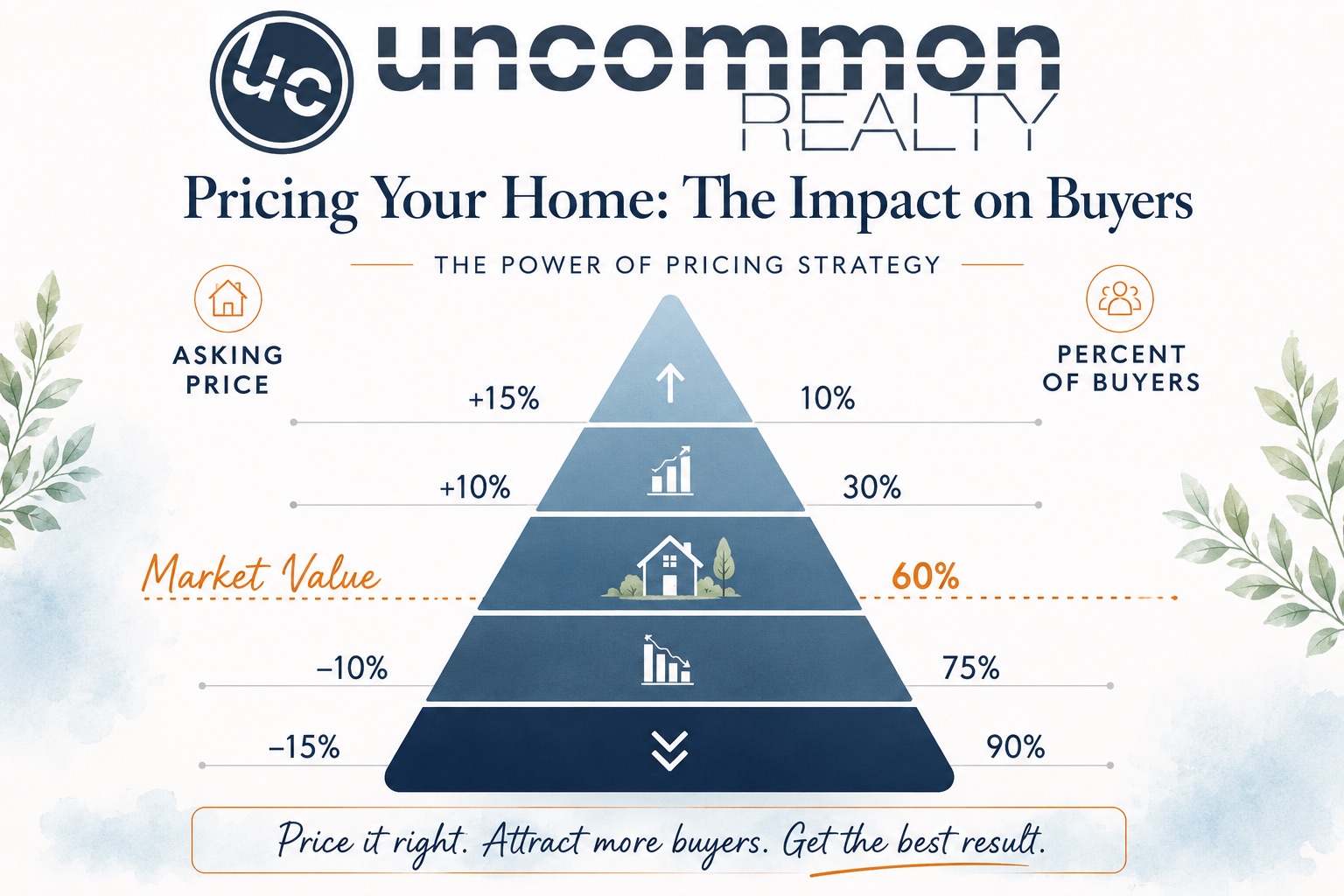
These percentages should be understood as a conceptual model, not a promise that a particular number of buyers will view or offer on a home. The broader principle is what matters: as a home becomes more competitively priced, it can appeal to a larger share of the available buyer pool.
I do not automatically recommend pricing every Highland Lakes home 10 or 15% below its indicated market value. Depending on the property and current activity, the strategic adjustment might be 5, 10, or 15%. In a high-inventory market, however, positioning a home around 10% more competitively may provide an important advantage.
The correct decision depends on the home’s condition, the history of comparable sales, days on market, recent price reductions, the immediate competition, the price range, and the seller’s goals. Luxury and waterfront homes generally have smaller buyer pools than entry-level properties. If sellers in those segments hold onto prices the market will not support while additional listings become available, inventory continues to accumulate.
Overpricing Can Cost More Than Sellers Expect
Many sellers understandably worry about leaving money on the table. They may believe that starting high protects their equity because the price can always be reduced later. In a high-inventory market, that approach can produce the opposite result.
A new listing receives its greatest opportunity to create interest and urgency when it first reaches the market. Buyers tend to favor properties that are fresh and appear likely to attract competition. When a home remains listed for a long time, the urgency begins to disappear.
Buyers move more slowly, ask more questions, and may wonder what is wrong with the property. Explanations about market conditions and high inventory do not always remove that concern. A buyer may also believe that a seller with substantial days on market has become more negotiable and submit a lower offer than the buyer might have considered when the listing was new.
An overpriced seller can eventually find themselves chasing the market. After losing the strongest period of initial exposure, the seller reduces the price, waits, and possibly reduces it again. Because property-price histories are readily available to consumers, buyers can see those changes. Five reductions of $2,500 do not hide the fact that the property has been reduced by $12,500 or more. A price adjustment should be based on how far the original price is from the market and what is happening among the home’s immediate competition. Sometimes a modest change is sufficient. In other cases, one meaningful adjustment is needed to reposition the home against a different group of listings.
The danger is waiting so long that the home ultimately sells for less than it might have received if it had been positioned correctly at the beginning.

I Watch the Market’s Response During the First Two Weeks
Modern listing syndication allows buyers and agents to discover new properties quickly. That means sellers usually do not need to wait months to receive meaningful feedback from the market. Although every property and location is different, I generally consider the first two weeks an important checkpoint. Two patterns deserve attention: no showings, or showings without offers.
No showings may indicate a problem with price, marketing, exposure, MLS selection, or how the property has been presented. Before assuming price is the only issue, I want to know whether the right buyers and agents are aware that the home is available.
Showings without offers often point more directly to price or condition. Buyers have seen the property, compared it with the alternatives, and chosen not to act. That does not mean a seller should panic after every showing, but repeated activity without an offer is information. A successful pricing plan must respond to what the market is communicating.
A CMA Is Not a Formal Appraisal
My comparative market analysis is a broker’s market-based opinion intended to help a seller choose a listing strategy. It is not a formal appraisal, and I do not represent myself as a licensed or certified appraiser. A licensed or certified appraiser is the professional qualified to produce a formal appraisal under the applicable standards. If a seller believes the value indicated by my CMA is too low and wants another professional opinion, I am happy to work with an appraiser. The seller would be responsible for the cost of that appraisal.
Even then, an asking price, CMA, or appraisal does not force a buyer to pay a particular amount. The price that ultimately matters in a sale is the amount a qualified buyer is willing to offer and a seller is willing to accept.
I Will Not Recommend an Unrealistic Public List Price
I understand that it is the seller’s home and that the seller has the final say over whether and on what terms to sell it. However, I will not take a public listing at a price I believe is materially unrealistic.
Unrealistic pricing produces unrealistic expectations and frequently unrealistic results. I know I am unlikely to make that seller happy because the strategy begins with a disagreement about how the market works. At the end of the transaction, I want my clients to feel thankful that they hired me and confident that the strategy helped them move forward successfully.
If a seller cannot trust my pricing analysis and professional advice, that seller should find a broker whose advice they do trust. My goal is not to promise the highest list price. My goal is to help the seller obtain the highest price the market will reasonably support while still accomplishing the objective of selling the property.
Sellers interested in a different approach can learn more about my off-market representation. That is a separate strategy and should not be confused with publicly listing a home at an inflated price and hoping the market eventually accepts it.
Strategic Pricing Creates a Path Forward
High inventory does not mean a Highland Lakes home cannot sell. It means the home must compete for a buyer who has more choices and less reason to overlook poor positioning.
The process begins with a careful analysis of recently closed sales. It then requires an honest evaluation of the property’s condition, amenities, location, immediate competition, and the behavior of buyers in its specific price range. Broad regional numbers, automated estimates, tax assessments, neighborhood rumors, and asking prices cannot replace that work.
My approach to pricing a home accurately is designed to establish a strategy, not merely produce a number. I want to understand where the seller needs to go, what the market is likely to support, and how we will respond if the market gives us different information.
If you are preparing to sell a home in the Highland Lakes, let’s talk and see what makes sense for you.
Frequently Asked Questions About Pricing a Highland Lakes Home
Should I price my home higher so I have room to negotiate?
Starting higher does not necessarily create negotiating room. It can prevent buyers from considering the home in the first place. When buyers have many alternatives, they may skip an overpriced property instead of making a lower offer. I prefer to establish a price that attracts attention while still supporting the seller’s financial goals.
Can I use my Zestimate or tax assessment to price my home?
Automated estimates and tax assessments may provide background information, but they do not replace a property-specific comparative market analysis. They may not adequately account for condition, updates, waterfront usability, docks, views, roads, community differences, or the current competition a buyer will see.
Is the house that sold nearby automatically a comparable?
No. Proximity is only one factor. I also compare condition, renovation history, amenities, major systems, location, waterfront characteristics, and overall buyer appeal. A home two doors away may be less relevant than a more similar property located farther away.
Does pricing below estimated market value mean I will lose money?
Not automatically. A competitive price can expose the property to more buyers and create urgency. In some situations, strong value attracts multiple buyers. The larger financial risk may be overpricing, accumulating days on market, losing buyer interest, and eventually chasing the market downward.
How quickly should I reconsider the price if the home does not receive an offer?
Every home is different, but I generally examine the first two weeks closely. No showings may indicate a pricing, marketing, exposure, or MLS issue. Showings without offers often suggest that buyers do not believe the property’s price and condition compare favorably with the available alternatives.
Do high inventory numbers affect every Highland Lakes home equally?
No. Inventory and buyer demand can vary considerably by community, price range, property type, and waterfront characteristics. Luxury and waterfront homes often have smaller buyer pools than entry-level properties. I price the individual home within its specific competitive environment rather than relying on one regional statistic.